Google Overhauls Search With 24/7 AI Agents: What It Means for Affiliate Traffic
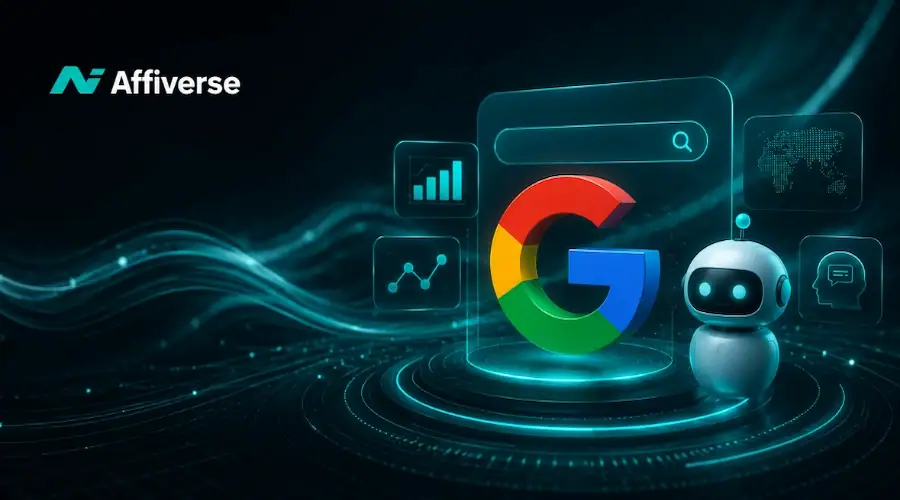
Google used I/O 2026 to introduce the biggest upgrade to its Search box in more than 25 years, alongside new AI agents, generative tools, and deeper personal context inside Search. The company said AI Mode has surpassed one billion monthly users, with queries more than doubling every quarter since launch. Search no longer behaves like a static box for short keywords. It now works more like an AI workspace, built for longer questions, mixed inputs, background monitoring, and task-based discovery.
Key Takeaways: Why Google’s AI Search Update Matters for Affiliates
- Google has upgraded the Search box so users can submit longer, more complex queries instead of short keyword searches.
- AI Mode now accepts text, images, files, videos, and Chrome tabs as inputs, giving Google more context before it shows results.
- Search agents will run in the background for AI Pro and Ultra users, monitoring information across blogs, news sites, shopping data, social feeds, finance, and sports.
- Personal Intelligence is expanding globally, allowing users to opt in and connect Gmail, Google Photos, and later Google Calendar for more tailored answers.
- Affiliate traffic may become thinner on basic informational pages, but stronger for publishers with original data, clear testing, and content AI agents can understand.
Google Turns the Search Box Into a Workspace
The new Search box expands dynamically as users type longer queries. People no longer need to compress intent into three-word searches like “best CRM software” or “cheap laptop deals.” They can paste a full problem, add context, and ask Google to work through it. The box also accepts more than text. Users can bring in images, files, videos, and Chrome tabs, then ask AI Mode to connect the dots across those inputs. Standard search results still appear alongside the AI features, but Google has clearly pushed Search deeper into AI-led interaction.During the Google I/O 2026 opening keynote, Google also introduced generative UI inside Search. The company says it’s bringing Antigravity and Gemini 3.5 Flash’s agentic coding capabilities into Search, allowing the product to create custom visual tools, simulations, dashboards, and trackers directly inside the results page. A user researching a concept might get an interactive model. Someone managing a move could get a live tracker they return to later. For publishers, that cuts close to the bone. Some pages that once earned clicks by hosting calculators, comparison tables, and simple explainers may now compete with tools generated inside Google itself.
24/7 Information Agents Change Discovery
The sharper update for affiliates comes from Google’s new Search agents. Information agents will run in the background and monitor the web for users. Google says they’ll scan blogs, news sites, social posts, shopping data, real-time finance information, and sports data, then return compiled updates when the task calls for it. The first rollout arrives this summer for Google AI Pro and Ultra subscribers.
Liz Reid, Google’s VP and Head of Search, described use cases such as apartment hunting, tracking product drops, and monitoring changing information. The user sets the criteria. The agent builds the workflow. Then it watches. No repeated searches. No tab clutter. No daily manual check.For affiliate teams, that changes the entry point. A user may no longer search “best running shoes for flat feet 2026” and browse five publisher pages. They may ask an agent to monitor price drops, reviews, stock, return policies, and creator feedback for a specific shoe profile. The agent then decides which sources deserve attention. That puts more pressure on machine-readable proof: updated specs, structured data, dated testing notes, clear pricing, author expertise, and product-level detail. We covered this same shift in our breakdown of Google’s AI search guidelines, where the focus stayed on crawlable pages, useful content, trusted signals, and clear structure.
Personal Intelligence Expands Search Context
Google also expanded Personal Intelligence in AI Mode to nearly 200 countries and territories across 98 languages. The global expansion of AI Mode no longer needs a paid subscription. Users can connect Gmail and Google Photos, with Calendar support planned later, to give Search more personal context. That means two users can ask the same broad question and receive different answers based on travel plans, receipts, photos, saved emails, or upcoming events. Search visibility starts to depend less on a generic ranking position and more on how well content matches a user’s private context.
Affiverse Take: Affiliate Traffic Gets Thinner, But Sharper
The risk sits in plain sight. Informational search keeps moving toward a zero-click environment. If Google can build an answer, a dashboard, or a tracker on the results page, fewer users need to visit the publisher that once provided that utility. Ad impressions may shrink on basic explainer pages. Comparison content may lose casual browsers. Thin listicles will struggle when an agent can scan multiple sources and synthesize the answer faster.
The opportunity looks narrower but more valuable. Traffic that leaves Google’s ecosystem could carry higher intent. A background agent won’t click randomly. It will surface publisher pages when they contain something useful enough to support a user task: original data, trusted reviews, deal accuracy, niche expertise, or proof the agent can verify.
This consumer reliance on background tasking mirrors trends happening across major platforms; just weeks ago, Spotify introduced a tool built around the idea that AI agents save generated personal audio briefings directly into user libraries, showing how digital discovery keeps moving toward automation. Spotify’s own announcement said agents can generate private daily briefings and save them directly into a user’s library.
Affiliates should treat this as a content architecture problem. Broad keyword targeting won’t disappear, but it can’t carry the same weight. Pages need cleaner entities, stronger internal linking, fresh data points, visible testing, author context, and product information that agents can parse without guessing. Google Search now works less like a directory and more like a task layer. The next click may come from an agent that has already done most of the research.
Everflow
Connect
Tradedoubler
Connect
1win Partners
Connect
PIN-UP Partners
Connect
Shopnomix, a Nomix Group Company
Connect
V.Partners
Connect
Huffson Group
Connect
Kawaii Partners
Connect
Share your expertise and expand your reach and become a content contributor with us today!
Contact Us To Find Out More