Google’s AI Search Guidelines: What Affiliates Need to Know
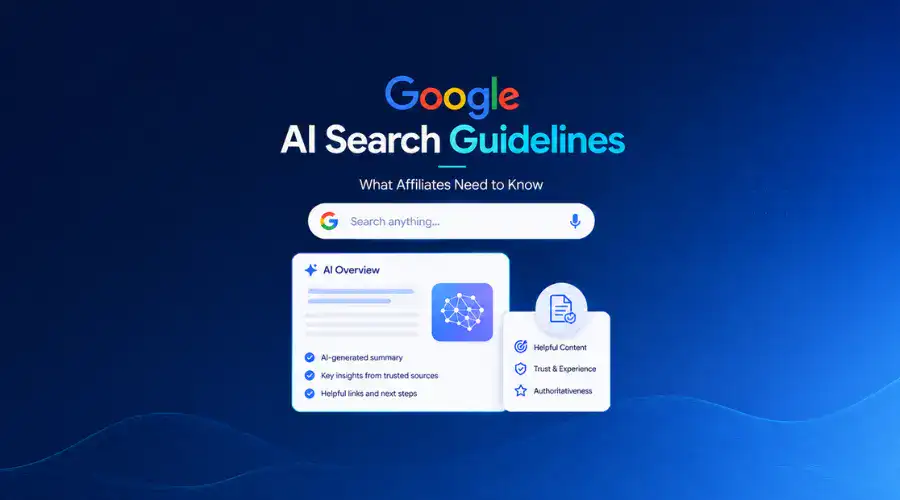
Google’s latest documentation gives marketers a blunt message: AI Search won’t reward shortcuts. The new Google AI search guidelines show that AI Overviews and AI Mode still rely on crawlable pages, useful content, trusted signals, and clear structure. This article explains which AI search tactics to ignore, how Google retrieves content, and why affiliates need stronger proof, cleaner data, and content that gives Google a reason to retrieve their pages.
Key Takeaways: What This Guide Covers
- Why Google says “AI optimization” still falls under SEO: We explain Google’s position on AEO, GEO, AI Overviews, and AI Mode.
- Which AI search tactics aren’t worth chasing for Google Search: This includes forced content chunking, llms.txt files, AI-only markup, and fake brand mention campaigns.
- How Google’s AI Search features retrieve content: We explain RAG and query fan-out in plain language and why indexed, trusted pages still matter.
- Why thin affiliate content will struggle: The article looks at how shallow reviews, copied product descriptions, and generic roundups give AI systems little value to retrieve.
- What affiliates should ask programs for: We explain why better source material, approved claims, screenshots, offer details, and market-specific context can help affiliates build stronger pages.
- Why Google’s rules don’t cover every AI platform: We separate Google’s advice from how tools like ChatGPT and Perplexity may treat content differently.
Demystifying the Buzzwords: What Are AEO and GEO?
AEO stands for Answer Engine Optimization. GEO stands for Generative Engine Optimization. Both terms describe attempts to improve how brands, websites, or pages appear inside AI-generated answers.
Google’s stance lands differently. It defines both terms, then folds them back into SEO. From Google Search’s point of view, AI visibility doesn’t require a separate channel, a secret playbook, or a new department selling “AI ranking hacks.” It requires better search visibility. For teams still building that foundation, our guide to SEO for affiliate beginners breaks down the basics before chasing newer AI search labels.
That matters because affiliates, marketers, and program teams will hear a lot of noise. Some vendors will push AI-specific files. Others will sell brand mention campaigns, AI markup, or content formatting tricks that don’t move the needle in Google Search.
Useful optimization still has a place. Content structure matters. Entity clarity matters. Product data matters. Source credibility matters. A new label doesn’t change the crawl path.
The “Stop Doing This” List: Google’s Guide to Wasted Effort
Google’s myth-busting section deserves attention because it names tactics many SEO and affiliate teams have already started testing.
- Forced content chunking: Some teams now break articles into tiny blocks because they think AI systems need bite-sized passages. Google says there’s no requirement to do that. Short sections can help readers, but artificial fragmentation won’t create authority on its own. Write the section as long as the answer needs. Then stop.
- llms.txt files: Google says websites don’t need special AI text files, machine-readable files, Markdown, or AI-only markup to appear in generative AI Search. Google can crawl many file types, but those files don’t receive special treatment.
- Inauthentic brand mentions: Dropping a brand into random forums, listicles, or guest posts just to influence AI responses may feel clever. Google warns against it. Its AI features depend on core ranking systems and spam systems, which means fake mentions don’t offer the clean path some GEO sellers imply.
For affiliates, this should kill one bad idea early: building “AI mention campaigns” with no editorial reason to exist. If the mention wouldn’t help a real buyer, don’t build a strategy around it. Useful material beats artificial signals. For a broader view of what affiliate teams should prepare for next, read our top SEO predictions for 2026.
How Google’s AI Actually Works: RAG and Query Fan-Out
Google’s documentation gives two mechanics that matter for affiliate SEO: retrieval-augmented generation and query fan-out.
RAG: Google Still Needs Pages It Can Retrieve
Retrieval-augmented generation, or RAG, means the AI response doesn’t simply guess from a closed memory bank. Google retrieves relevant, up-to-date pages from its Search index, then uses those pages to support the AI answer. That gives classic SEO work a direct role in AI visibility. Crawlability, indexability, page quality, and trust still matter because the AI needs retrievable sources.
Query Fan-Out: One Prompt Can Trigger Several Searches
Query fan-out adds another layer. Instead of running one query, Google can split a complex prompt into several related searches. A user might ask for “the best laptop for travel, video calls, and light gaming under £900.” Google can break that into subqueries around battery life, webcam quality, GPU performance, weight, reviews, pricing, and availability.
Why This Changes Content Coverage
A shallow review page may match the surface query. A stronger page answers the hidden subqueries too. It compares real features. It explains trade-offs. It shows original screenshots or product visuals. It includes current pricing, terms, limits, and use cases. This is also where brands need to rethink how AI is reshaping influence and attribution in affiliate marketing. AI search can surface, combine, and credit different content touchpoints before the user ever reaches the final conversion page. It gives Google more reasons to retrieve that page. Specific beats broad.
What This Means for Affiliates
AI Search doesn’t change the affiliate model, but it does raise the bar. Pages need clearer proof, cleaner data, and stronger reasons for Google to retrieve them.
Thin Content Gives AI Search Less to Work With
The first risk lies with thin content. Affiliate sites that publish rewrites of product pages, bonus terms, SaaS feature lists, or generic “top 10” tables won’t give AI systems enough unique material to work with. Google’s own documentation points site owners toward non-commodity content and gives first-hand reviews as an example of content with a viewpoint based on personal experience. That matters across affiliate verticals.
Travel affiliates need real route data, images, itinerary notes, and pricing context. Finance affiliates need clearer risk explanations, fee checks, and product comparisons based on user scenarios. Retail affiliates need hands-on testing, sizing notes, return-policy context, and stock accuracy. B2B affiliates need demos, screenshots, implementation notes, and buyer objections.
Commerce Data Needs to Be Cleaner
The second shift sits in commerce data. Google mentions product listings, product information, Merchant Center feeds, Google Business Profiles, Business Agent, browser agents, and the emerging Universal Commerce Protocol. AI agents can compare specs, inspect sites, read the DOM, and perform tasks for users.
Affiliates don’t control every merchant feed, but they do control how cleanly they present product data.
| Do ✅ | Don’t ❌ |
|---|---|
| Keep prices, bonuses, and product details current. | Leave outdated offers live after terms change. |
| Use clear specs, payment details, limits, and eligibility rules. | Hide key conditions behind vague promotional copy. |
| Add valid schema where it helps Google understand the page. | Treat schema as a fix for weak or thin content. |
| Build fast pages with clean layouts and readable comparison tables. | Overload pages with banners, pop-ups, and mismatched tables. |
| Make sure comparison tables match the claims in the article. | Say one thing in the copy and another in the table. |
| Include pros and cons based on real use, testing, or product knowledge. | Rewrite merchant pages and call it a review. |
| Use clear affiliate disclosures. | Bury commercial relationships where users won’t see them. |
| Be accurate about terms, pricing, availability, and restrictions. | Use bait-and-switch claims to win clicks. |
Affiliate Content Has to Move Closer to the Decision
The third shift hits monetization. AI summaries can reduce clicks for broad informational queries. That risk doesn’t disappear because Google says SEO still matters. Affiliates should expect some top-of-funnel content to lose value when users get quick answers on the results page. So the content model has to move closer to decisions.
A basic “what is travel insurance?” page may lose clicks. A page comparing travel insurance for a two-week Japan trip with skiing, camera gear, and a pre-existing condition has a better chance of earning the click because the user still needs details. The affiliate link also sits closer to the action.
Same rule across markets: build pages users can’t replace with a one-paragraph answer.
What Should Affiliates Ask Affiliate Programs For?
Affiliate Programs still matter in this shift, even if affiliates own the SEO work. If Google’s AI features reward retrievable, trusted, and detailed pages, affiliates need better source material from the brands and programs they promote. That means updated offer details, product screenshots, approved claims, payment information, market-specific USPs, landing page notes, compliance-safe wording, clear terms, fresh bonus information, and real product context.
Strong affiliates will still choose the keywords, build the pages, test the structure, and manage their own rankings. But they shouldn’t have to scrape basic details from landing pages or guess which product claims are safe to use.
Ask for better inputs. A stronger partner resource hub can help affiliates publish content that stands apart from generic roundups and copied product descriptions. It also reduces the risk of outdated claims, weak comparisons, and inaccurate offer details sitting in search results. Understanding what affiliate marketing managers should look for when creating partnership deals in 2026 helps affiliates align their requests with brand goals, ensuring that better source material leads to more sustainable, high-ranking search visibility.
The Catch: Google Isn’t the Only Player
Google’s advice applies to Google Search. That distinction matters. ChatGPT, Perplexity, Claude, and other AI answer systems may retrieve, rank, cite, and summarize sources in different ways. Research on Generative Engine Optimization found that adding citations, statistics, and relevant quotations improved source visibility by up to 40% across tested generative engine responses, with gains varying by domain. This data underscores why affiliate managers are the new architects of LLM discovery, as AI models prioritize well-structured, cited data when deciding which products to recommend to users.
A balanced AI search strategy looks more practical:
- Use clear headings because readers scan, and AI systems need a clean page structure.
- Add statistics when they prove a point, rather than forcing numbers into sections where they don’t help.
- Cite sources when claims need support, especially around pricing, regulation, performance, or market data.
- Use Q&A sections when they answer real buyer questions, not just to chase extra keywords.
- Keep the schema clean, so search engines and AI systems can understand the page properly.
- Add first-hand evidence through testing notes, screenshots, product experience, or expert input that competitors can’t copy in five minutes.
That work helps outside Google, and most of it helps inside Google too. The difference sits in the sales pitch. Google doesn’t reward AI-only hacks. Other engines may reward extractable structure, but weak content still weakens the source.
Affiverse’s Take: AI Search Rewards Proof, Not Shortcuts
Google’s AI Search documentation doesn’t kill SEO. It kills the easy pitch. Affiliates don’t need to panic-build llms.txt files, split every paragraph into fragments, or spray brand mentions across low-quality pages. They need to make pages Google can crawl, users can trust, and AI systems can retrieve without guessing.
Affiliates own the ranking work. They choose the keywords, build the pages, test the structure, and fight for the click. But they should also demand better source material from the programs they promote: cleaner product data, approved claims, market-specific proof points, and assets that answer buyer questions properly. At Affiverse, we see this as the next layer of affiliate content strategy: not replacing SEO, but making every affiliate page easier to verify, retrieve, and trust. The affiliate link still matters. The content around it now has to work harder.
Everflow
Connect
Tradedoubler
Connect
1win Partners
Connect
PIN-UP Partners
Connect
Shopnomix, a Nomix Group Company
Connect
V.Partners
Connect
Huffson Group
Connect
Kawaii Partners
Connect
Share your expertise and expand your reach and become a content contributor with us today!
Contact Us To Find Out More