Should Affiliates Focus on SEO or GEO?
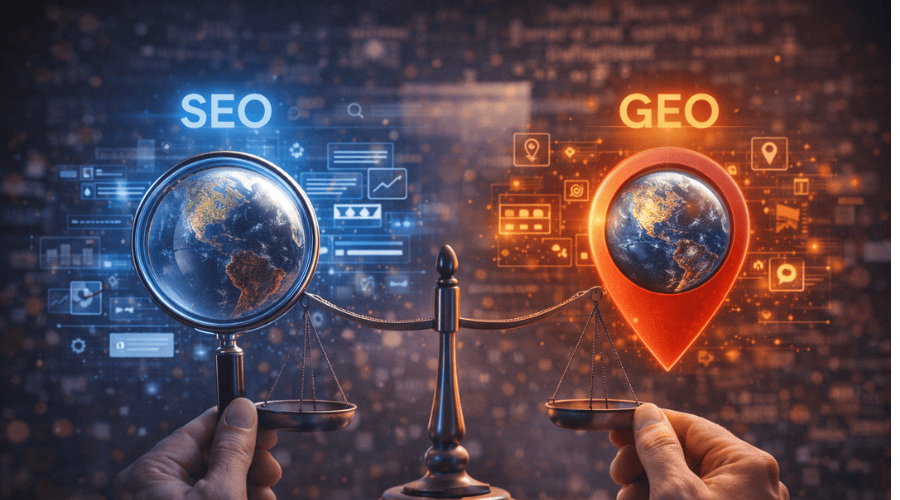
The question is all over affiliate marketing forums right now, and the framing is understandable. AI search is real, it is growing, and it is changing where consumers go to get answers. If users are increasingly asking ChatGPT or Perplexity which VPN to buy rather than Googling it, the logic goes that affiliates need to stop chasing Google rankings and start chasing AI citations instead.
That logic is wrong. Not because GEO is unimportant, but because it sets up a trade-off that does not exist.
What GEO actually is
Generative engine optimisation is the practice of structuring content so that AI platforms cite it in their responses. Where SEO asks “how do we rank higher in search results?”, GEO asks “how do we get included in the answer an AI generates?” The mechanics differ. Rankings are algorithmic and positional. Citations are selective: an AI model synthesises a response and names the sources it deems credible, accurate, and clearly structured.
The academic framework for this comes from a 2024 study by researchers at Princeton University, Georgia Tech, the Allen Institute for AI, and IIT Delhi, presented at KDD 2024. The research tested specific content optimisation techniques across 10,000 queries and found that adding statistics improved AI visibility by 41%, adding quotations from named sources improved it by 28%, and citing credible sources improved visibility for lower-ranked pages by over 100% in some query categories.
Those numbers get cited a lot. What gets cited less is the other finding from the same research: keyword stuffing performs 10% worse than the baseline in AI citation contexts. If your SEO playbook has relied heavily on keyword density, GEO will actively work against you.
The false binary
Gartner predicted in 2024 that traditional search volume would drop 25% by 2026 as AI platforms absorb queries that previously went to Google. That prediction is directionally accurate, even if the exact figure is contested. AI-referred sessions to retail sites grew 527% year-over-year in the first five months of 2025, according to Previsible’s 2025 AI Traffic Report. The shift is measurable.
What the “SEO or GEO?” framing misses is the dependency between the two. An analysis of over one million Google AI Overviews by xSeek in 2025 found that 40.58% of all AI Overview citations come from URLs in Google’s top-10 organic results. The number-one position carries a 33.07% citation likelihood. Position ten carries 13.04%. That data does not describe two separate channels. It describes one pipeline where search authority feeds AI visibility.
We made this point directly in our coverage of the value of search visibility: affiliates who have maintained strong search authority are the affiliates whose content is most likely to be cited by AI tools. Affiliates who let their content age and their authority dilute are opting out of AI visibility as a consequence, not as a separate decision.
The affiliate who abandons SEO to chase GEO is cutting the supply line to the thing they are trying to achieve.
What the data means practically
The xSeek finding has a direct implication for how affiliates should think about their content investment. You cannot optimise for AI citation on a domain with no search authority. The two signals compound. A piece of content that ranks well on Google has a structurally higher chance of being pulled into an AI Overview or Perplexity citation than the same content on a domain with no search presence.
This is the argument we explored when Google rolled out AI-only search: the affiliates best positioned for AI-mediated discovery are the ones who built genuine content authority before the transition accelerated, not the ones trying to game a new system from a standing start.
For publishers already navigating SEO volatility, the answer is not to pivot away from search investment. It is to ensure that the content being produced meets both sets of criteria at once. That is less complicated than it sounds, because the things that improve AI citation likelihood are largely the same things that Google’s quality systems reward: named sources, verifiable data, topical depth, and genuine expertise signals.
Where GEO demands something different
There are real differences, and affiliates who ignore them will underperform in AI search even with strong SEO fundamentals.
The first is structure. AI models extract and compress. A piece of content that buries its main claim in paragraph four, under a narrative introduction, is harder for a generative engine to quote accurately than a piece that leads with a direct assertion and supports it immediately with a named data point. This does not mean abandoning editorial judgment. It means thinking about how a paragraph reads when a model pulls it out of context, because that is exactly what happens when your content gets cited.
The second is entity consistency. Generative engines build internal models of sources by aggregating signals across multiple platforms. An affiliate publisher whose brand, author names, and topical focus appear consistently across their own site, third-party coverage, and industry publications becomes a recognisable entity. An affiliate site with anonymous authorship, no external mentions, and no consistent topical identity is noise. As we covered in our analysis of how AI is reshaping influence and attribution in affiliate marketing, the distinction AI systems now draw is between substantive and superficial content, not between human-written and AI-assisted.
The third is topical depth. GEO rewards concentrated expertise more than broad coverage. Ten well-sourced, data-backed articles on a specific topic will generate more citation authority on that topic than fifty surface-level pieces that mention it in passing. For affiliates who have historically produced volume content across wide niches, this is a meaningful strategic shift. Google’s query fan-out behaviour in AI Mode reinforces this: the system breaks queries into multiple sub-queries and rewards content that addresses a topic comprehensively, not content optimised for a single keyword string.
The actual answer
Affiliates should not choose between SEO and GEO. They should recognise that the content behaviours GEO requires are an extension of what quality SEO has always required: real expertise, verifiable claims, clear structure, and a reason for a reader (or a model) to treat your content as a credible source.
SEO basics still apply. Technical fundamentals, crawlability, link equity, and domain authority remain necessary conditions for AI visibility, not optional extras that a new discipline has superseded. What has changed is that content optimised purely for keyword density and click-through rate is no longer sufficient. The bar for what counts as a citable source has risen.
The affiliates who will have the hardest time with GEO are not the ones who ignored it. They are the ones who spent years producing content designed to rank rather than content designed to be right. Fixing that is the work. Whether you call it SEO or GEO is beside the point.
Everflow
Connect
Tradedoubler
Connect
1win Partners
Connect
Shopnomix, a Nomix Group Company
Connect
Huffson Group
Connect
Kawaii Partners
Connect
Trackdesk
Connect
Share your expertise and expand your reach and become a content contributor with us today!
Contact Us To Find Out More