The Value of Search Visibility

Every week brings another piece arguing that search is broken, finished, or no longer worth optimising for. The zero-click narrative has become so dominant in affiliate and performance marketing circles that some operators are quietly redirecting resource away from search entirely. That decision deserves more scrutiny than it is getting.
Search visibility still matters. The case for abandoning it is weaker than the headlines suggest, and the affiliates and program managers who treat it as a dead channel are making a strategic error that will take years to feel but will be very difficult to reverse.
The actual numbers
Start with the volume. According to independent research by SparkToro, Google grew its query volume by more than 20% in 2024. Estimates published in early 2025 placed Google’s daily search volume between 9.1 and 13.6 billion queries. ChatGPT, despite its explosive growth, processes roughly 1 billion messages per day, but only around 30% of that usage involves search-like queries, meaning Google handled approximately 373 times more search activity than ChatGPT across 2024.
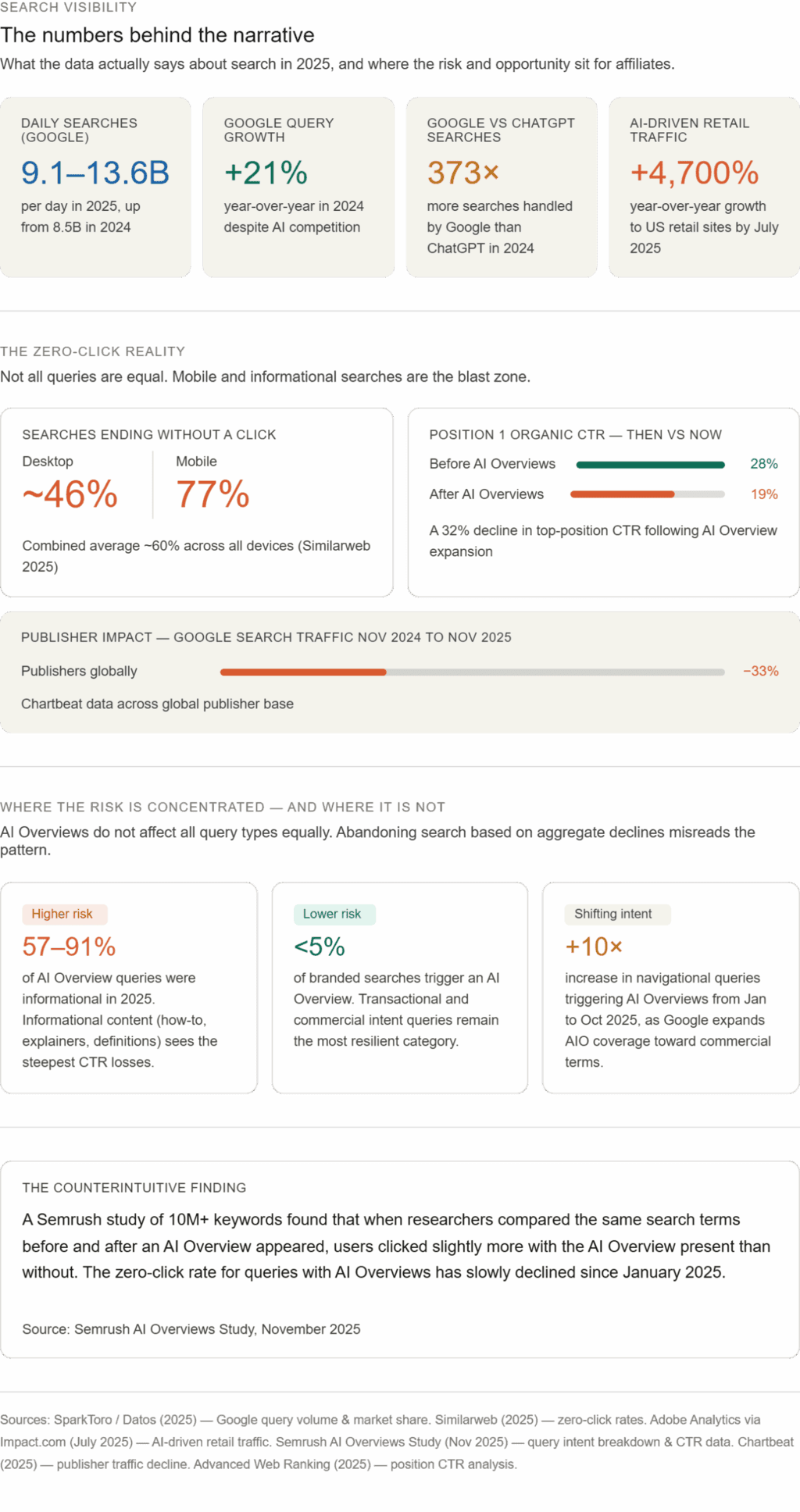
That is the context in which the zero-click discussion is happening. The percentage of searches ending without a click to an external site has risen, sitting at roughly 60% across desktop and mobile in 2025 according to Similarweb data. On mobile specifically the figure is higher, with some estimates putting it at 77% of queries. These are real numbers and the trend is real.
But what is also real is that the total number of clicks flowing from Google has not collapsed. An enormous and growing pool of search activity is being spread across a smaller percentage of clicks. The searches are there. The intent is there. The question is whether your content is positioned to capture what remains, and whether you are treating search visibility as having value beyond the direct click.
Most of the coverage on this topic does not make that distinction, and that is where the analysis breaks down.
Visibility is not the same as traffic
The shift that has occurred in search is not that search stopped mattering. It is that the relationship between search visibility and traffic has decoupled from what it once was. Those are different problems, and they require different responses.
When Google’s AI Overview surfaces a product comparison, a review, or a factual claim and attributes it to a source, that source is visible to users who may never click through. That visibility has brand value. It has influence value. And increasingly, it has a downstream commercial value that standard attribution models simply cannot see.
This is exactly the measurement problem that platforms like impact.com and Partnerize have been racing to address. As we reported when Impact.com announced its partnership with Evertune, Adobe data showed traffic to US retail sites driven by generative AI sources surged 4,700% year-over-year as of July 2025. That traffic did not appear from nowhere. It came from content that had established search visibility, built authority in AI training data, and earned citation in AI-generated answers.
The affiliates choosing to deprioritise search right now are not opting out of a traffic channel. They are opting out of the content authority pipeline that feeds AI visibility. Those two things are now the same pipeline.
What the data shows about which content survives
Not all search traffic has declined equally, and this is where the narrative about the death of search gets the most imprecise.
The zero-click attribution analysis we published last year noted a crucial distinction from former Google SEO expert Kaspar Szymanski: AI Overviews tend to surface in response to informational queries far more than transactional ones. Semrush data from a study of over 10 million keywords published in late 2025 confirms this, showing that in January 2025, 91.3% of queries triggering an AI Overview were informational. By October that share had dropped to 57.1%, with commercial and transactional query coverage expanding steadily.
That direction of travel matters. The closer a search query sits to purchase intent, the less likely it is to be answered fully inside the search result page. Branded search terms show AI Overviews in under 5% of cases. Transactional and commercial intent queries remain more resilient to zero-click behaviour than informational ones.
Separately, the same Semrush study found something counterintuitive: when researchers compared click-through rates for the same search terms before and after an AI Overview appeared, users actually clicked slightly more with the AI Overview present than without it. The zero-click rate for queries with AI Overviews has also slowly declined since January 2025.
None of this means the problem has gone away. Organic CTR from top positions has fallen significantly, with Google’s position-one click-through rate dropping from 28% to 19% following AI Overview expansion. Publishers globally saw a 33% decline in Google search traffic from November 2024 to November 2025, according to Chartbeat data. The pain is real. But the pattern of that pain is specific, and the affiliates who understand which queries are affected and which are not are in a much better position than those who treat search as uniformly broken.
The AI citation argument
Here is the case that is not being made clearly enough in the coverage of this topic: search visibility and AI citation are increasingly the same thing.
AI systems, whether Google’s own AI Overviews, ChatGPT, or Perplexity, pull heavily from the same content that has built authority through traditional search signals. Expertise signals, link equity, content depth, structured data, crawlability, and topical authority all influence whether a piece of content is selected as a source in an AI-generated answer. Affiliates who have maintained strong search visibility are the affiliates whose content is most likely to be cited, attributed, and recommended by AI tools.
The inverse is equally true. Affiliates who step back from search investment, who let their content age and their authority dilute, are opting out of AI visibility as a consequence. They are not solving the zero-click problem by diversifying to social and email. They are solving one problem while creating another.
Our coverage of the experiment with AI-generated affiliate sites made this point starkly. The sites that failed did so not because search was dead but because they had no genuine authority signals. Google indexed them, assessed them, and removed them from relevance because there was nothing behind the content. Search still works. It has just become less tolerant of content that does not deserve to rank.
As our top SEO predictions for 2026 argued, the goal is no longer simply to rank beneath AI Overviews. It is to be cited inside them. That requires more authority than traditional SEO, not less.
What search visibility protects
Beyond the AI citation argument, search visibility provides something that social traffic and paid acquisition cannot: compounding, owned discovery that does not require ongoing spend.
A piece of genuinely expert content that ranks for a transactional or commercial intent query continues to earn traffic and build authority for years. Email lists need to be maintained. Social platform reach requires content production at scale and is subject to algorithmic suppression. Paid traffic stops the moment the budget does. Search traffic, when built on genuine authority, is structurally different from all of those because it has a compounding quality over time.
The SEO volatility discussion with Luke Watkin of MVF Global on the Affiverse podcast is useful here. MVF navigated a year of significant Google algorithm disruption by maintaining investment in both paid media and long-term SEO, rather than treating them as alternatives. That balance, data intelligence plus relationship depth plus search authority, is what produced resilience when individual channels were disrupted.
The lesson is not that search survived despite the disruption. It is that businesses with genuine search authority had something to protect, and protecting it was worth the effort.
The abandonment trap
There is a specific risk in the current moment that is not being discussed enough. Many affiliates and program managers are looking at traffic declines in Google Search Console and concluding that search is no longer delivering return. They are cutting search investment. And they are correct that short-term ROI from some types of search content is compressed by AI Overviews.
But authority in search does not stay where you leave it. It decays. A publisher who stops producing expert content, stops earning links, and stops signalling topical depth will find, when the AI citation landscape stabilises and transactional search traffic remains valuable, that they have lost the position that would have made them competitive. Rebuilding authority from a degraded baseline takes far longer than maintaining it through a difficult period.
The Google crackdown on mass-produced SEO content that hit Dotdash Meredith, CNN, and others illustrates what happens when the content side of a search strategy lacks genuine depth. Those publishers lost traffic not because search stopped valuing their brands, but because the content they had been producing at scale did not meet the authority standard that the algorithm now requires. The lesson for affiliates is the same: volume without expertise loses, but expertise without abandonment wins.
What this means in practice
Search visibility in 2026 requires a different kind of investment than it did in 2022. The content that holds and builds authority is expert-written, based on genuine experience or research, and structured to be cited inside AI answers rather than simply indexed for keyword relevance. Technical hygiene matters more than it did: site speed, crawlability, structured data, and clear content architecture all influence whether AI systems can parse and use what you have published.
The metrics that matter are also shifting. Branded search growth, AI citation frequency, engagement with content that reaches users through search, and assisted conversions that begin with search visibility but convert through other channels all measure value that standard click-tracking misses. As Partnerize’s VantagePoint tool and impact.com’s Evertune integration both signal, the industry is building the infrastructure to make that influence measurable. Affiliates who have maintained search authority will be the ones with something to measure when that infrastructure arrives.
As we have covered in our analysis of why affiliates need alternative traffic channels, diversification is not optional. Email, social, community, and direct audience relationships all serve functions that search cannot. But the instinct to diversify should not become an excuse to abandon a channel that, despite its difficulties, still processes the largest volume of purchase-intent queries in the world. The affiliates who do both will outcompete the ones who chose one over the other.
Search visibility is harder to convert into revenue than it was three years ago. It is not worthless. Treating those two things as the same conclusion is the mistake.
Everflow
Connect
Tradedoubler
Connect
1win Partners
Connect
PIN-UP Partners
Connect
Shopnomix, a Nomix Group Company
Connect
V.Partners
Connect
Huffson Group
Connect
Kawaii Partners
Connect
Share your expertise and expand your reach and become a content contributor with us today!
Contact Us To Find Out More