Publishers Ask EU and UK Regulators to Halt Meta Commercial Terms
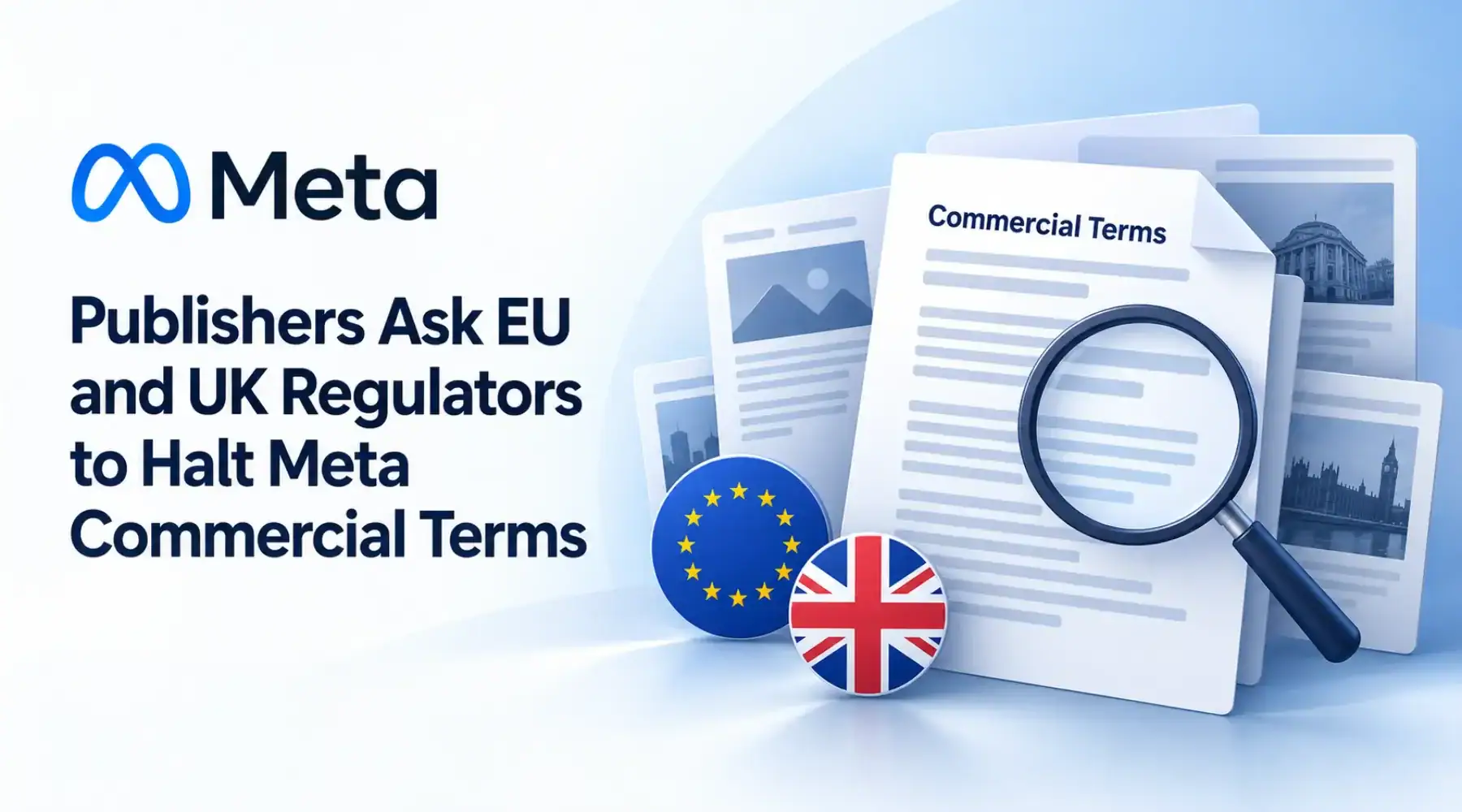
Publishers and digital advertisers are asking EU and UK regulators to stop Meta’s revised commercial terms before they take effect on October 30. Movement for an Open Web has complained about website-crawling permissions, according to Reuters. US publishers have also demanded withdrawal, while Meta says its crawling practices are unchanged. The dispute concerns control over content associated with business accounts.
Meta Commercial Terms: Publisher Opposition and October Deadlines
- Two competition authorities (the European Commission and UK CMA) have been asked to intervene before Meta’s revised terms take effect on October 30, 2026.
- News/Media Alliance represents more than 2,000 US publishers and says its members account for nearly 90% of US daily newspaper circulation. It requested withdrawal of the terms and a public response by October 26.
- Meta disputes the publishers’ interpretation, saying the update consolidates crawling provisions for advertising and business products without changing its web-crawling practices or overriding robots.txt preferences.
Publishers Seek Action Before the Terms Take Effect
Movement for an Open Web, whose members include publishers and digital advertising businesses, has sought interim measures from the European Commission and the UK Competition and Markets Authority, Reuters reported on October 22. The request seeks to prevent implementation while the concerns are assessed.
Tim Cowen, co-founder of Movement for an Open Web, quoted by Reuters, said:
Meta’s new terms are clearly anti-competitive.
Cowen argues that businesses dependent on Meta’s services have limited ability to reject the terms and face pressure to accept broad permissions over their digital content.
Those objections remain allegations. The complaint and request for interim measures do not establish that Meta has broken competition law or that the terms have been suspended.
Meta Disputes the Interpretation
Meta told Reuters that the consolidated crawling provisions apply to advertising and business products. The company says content owners can continue to signal their preferences through robots.txt and that the update does not grant rights overriding those preferences.
A Meta spokesperson, quoted by Reuters, said:
It does not change how Meta uses web crawlers.
The wording has already been revised. Search Engine Journal reported on October 19 that Meta removed the explicit reference to training from the Commercial Terms crawling clause and connected its stated purpose to advertising and business products.
The report also identified regional differences in the separate Self-Serve Ad Terms preview. Publishers’ continuing objections focus on the breadth of crawling permissions and permitted content uses, even after the Commercial Terms wording changed.
Affiverse’s explainer on checking AI bot permissions describes how publishers can inspect robots.txt and licensing rules. Those technical settings are a separate question from the contractual rights being disputed.
US Publishers Also Request Withdrawal
In an October 22 letter to Mark Zuckerberg, News/Media Alliance president and CEO Danielle Coffey demanded that Meta withdraw the revised terms and discuss future changes with publishers.
The association wants clarity about which products would use scraped material, how publishers could consent separately from accessing business services, which crawlers would be involved and how access restrictions would be respected. It requested a public response by October 26.
News/Media Alliance also argues that blocking Meta’s advertising crawler could disrupt publishers’ ability to promote their content. It wants commitments on access restrictions written into the terms.
Its argument is that publishers should be able to reach audiences on Meta’s platforms without that access becoming consent to use material across their websites. The letter also questions whether the revised language sufficiently limits future uses.
Why Meta’s Crawling Terms Matter for Affiliate Publishers
For affiliate publishers, the relevance extends to original reviews, comparisons and buying guides. Producing that material takes resources, while its commercial return may depend on readers visiting the site and following a tracked link.
The concern is how control over that work interacts with reliance on platforms for distribution. A publisher may use a social account to reach readers while wanting separate terms for automated access to its website.
Affiverse’s coverage of the SPUR AI content rights coalition examines efforts to establish clearer permissions and reporting. The separate debate over Google’s AI search opt-out for publishers also centers on how content owners can exercise choice while assessing the effect on audience access.
Our Open Attribution podcast with Alex Springer and Leanna Klyne explores the related measurement question: how publishers’ contributions to AI-assisted shopping journeys can be recognized when conventional click tracking misses their influence.
Regulatory Review Ahead of Meta’s October 30 Deadline
Reuters reported that the CMA was in urgent discussions with Meta and that the European Commission would assess the complaint. Those responses did not announce a suspension. The immediate dates to watch are the October 26 response requested by News/Media Alliance and the scheduled October 30 implementation.
Everflow
Connect
Tradedoubler
Connect
1win Partners
Connect
Shopnomix, a Nomix Group Company
Connect
Huffson Group
Connect
Kawaii Partners
Connect
Trackdesk
Connect
Share your expertise and expand your reach and become a content contributor with us today!
Contact Us To Find Out More