EU Questions Publishers About Google’s AI Search Opt-Out
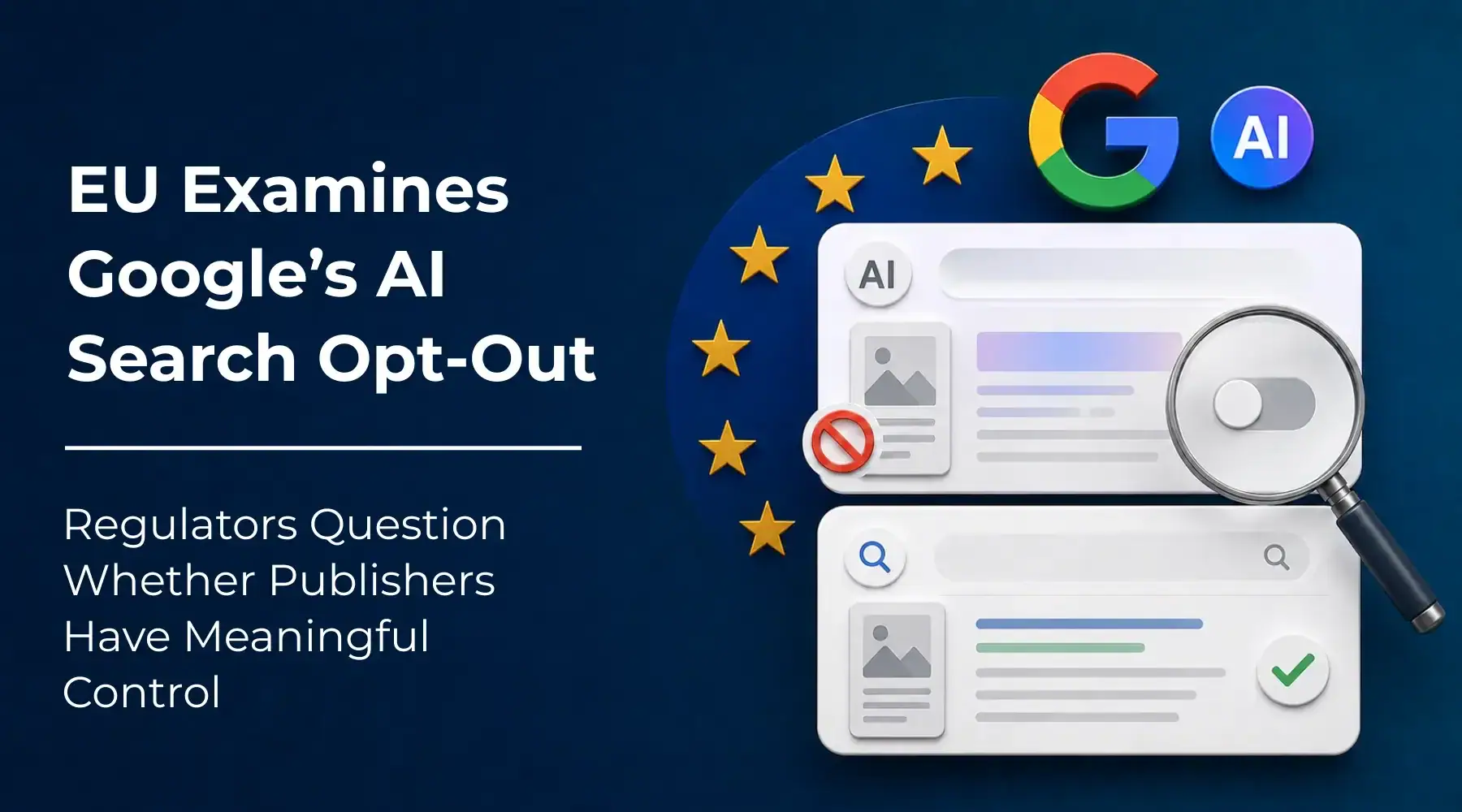
European Union antitrust regulators are asking publishers whether Google’s new AI Search opt-out gives them meaningful control over how their content appears in AI-generated results.
Google completed the global rollout of the control on August 31. It allows website owners to exclude their content from generative AI Search features without using that decision as a ranking signal outside those experiences. The European Commission is now examining whether publishers intend to use the option and what will influence their decision.
Key Takeaways: EU Examines Google’s AI Search Opt-Out
- Google’s control covers AI Overviews, AI Mode and AI Overviews in Discover.
- Sites that opt out will no longer receive impressions or traffic from those generative AI features.
- Google says the decision will not be used as a ranking signal elsewhere in Search.
- The European Commission asked publishers whether they plan to use the control and what factors will affect their choice.
- Publisher responses could influence an existing EU investigation into Google’s use of online content for AI.
- Affiliate publishers will need to measure AI visibility, referral traffic and conversions separately when assessing the option.
How Google’s AI Search Opt-Out Works
Google announced the new control on June 3 following discussions with the UK Competition and Markets Authority. Testing began with a small group of UK websites before the system was made available globally.
The Search Console control allows website owners to decide whether their sites can appear in and help support responses across AI Overviews, AI Mode and AI Overviews in Discover.
Sites that opt out will not receive impressions or referral traffic from those features. However, Google says the decision will not affect rankings in parts of Search outside its generative AI experiences.
Google has also introduced reporting intended to help publishers assess their AI visibility. This includes impression data and information showing which pages appear in AI responses and in which countries.
Publishers can compare that visibility with referral sessions using AI traffic tracking in GA4, although neither dataset alone establishes whether an AI appearance influenced a conversion.
What the European Commission Asked Publishers
The European Commission sent a questionnaire to publishers in July, with responses due by August 28, according to Reuters.
The questionnaire asked whether publishers planned to use the AI Search opt-out and which factors would influence that decision. Regulators also requested views on Google bringing AI Overviews and AI Mode together within a wider AI Search experience.
The consultation does not establish that Google’s control breaches EU competition law. It gives regulators evidence showing whether publishers consider the option usable and whether it addresses concerns about choice and content use.
Publishers may want to prevent their reporting, reviews or analysis from being summarized inside an AI-generated answer. The same publishers may be reluctant to give up visibility in a part of Google Search that is becoming more prominent.
The Questions Form Part of a Wider EU Investigation
The Commission opened a formal antitrust investigation into Google’s use of online content for AI in December 2025.
That investigation is assessing whether Google imposed unfair terms on publishers and content creators whose material is used in its AI products. It is also examining whether Google’s access to online content gives its own AI services an advantage over competing developers.
Publishers have argued that AI-generated summaries can use information from their content while reducing the need for users to visit the source. This could affect traffic, advertising revenue, subscriptions and affiliate income.
Google argues that its generative features help users ask more complex questions and discover a wider range of websites. It reported in June that AI Overviews had more than 2.5 billion monthly active users and AI Mode had passed one billion. These are company-supplied usage figures.
Publisher responses to the Commission’s questionnaire could help determine whether the opt-out addresses the investigation’s concerns or whether further action is needed.
What Remains Unclear
The Commission has not published the questionnaire responses or identified the publishers that participated. It has also not announced whether the feedback will lead to additional requirements, formal objections or changes to the existing investigation.
There is no public evidence showing how many publishers have used the global opt-out or whether adoption differs between news organizations, commercial publishers and smaller independent websites.
Publishers also lack a universal method for measuring the commercial influence of an AI citation. An appearance can increase visibility without producing a click, while a referral visit does not necessarily generate a subscription, lead or affiliate transaction. This contributes to the wider gap between AI citations and affiliate attribution.
What the Choice Means for Affiliate Publishers
For affiliate publishers, the control creates a clearer technical choice but not a simple commercial one.
Opting out may prevent reviews, comparisons and buying guides from supporting Google’s AI-generated answers. It may also remove those pages from an increasingly visible discovery environment, limiting potential citations and referral visits.
Remaining included preserves the opportunity to appear in AI Search, but it does not guarantee prominent attribution, traffic or affiliate conversions. Publishers taking this route can follow Google’s AI Search guidance for affiliates, which emphasizes crawlable, reliable and people-first content rather than AI-only files or optimization shortcuts.
Publishers should assess AI impressions, citations, referral sessions, affiliate clicks and completed transactions separately. A decision based only on rankings or total organic traffic may not show what is happening within Google’s AI features.
Google’s opt-out provides publishers with more control than they previously had. Whether that control represents a commercially realistic choice is the question EU regulators are now trying to answer.
Everflow
Connect
Tradedoubler
Connect
1win Partners
Connect
Shopnomix, a Nomix Group Company
Connect
Huffson Group
Connect
Kawaii Partners
Connect
Trackdesk
Connect
Share your expertise and expand your reach and become a content contributor with us today!
Contact Us To Find Out More