Google Sues SerpApi for Scraping—While Running the Internet’s Largest Content Extraction Operation
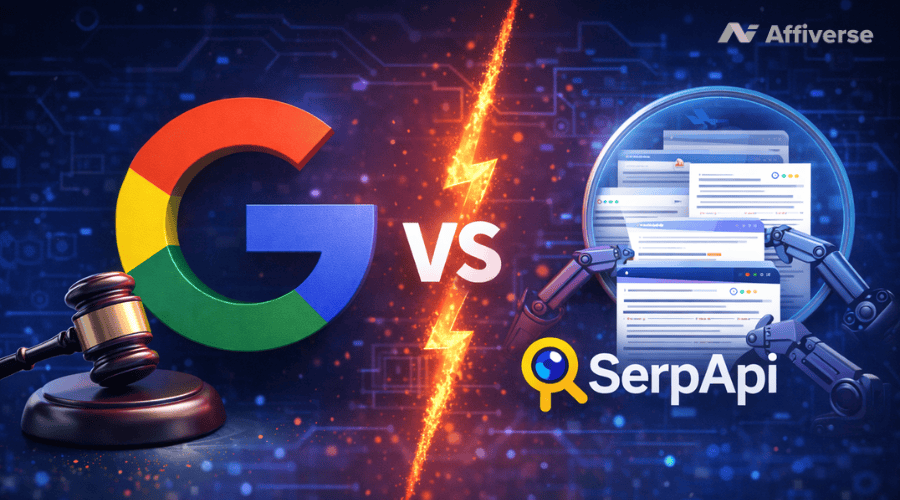
Google filed a lawsuit on December 19, 2025, against SerpApi, a Texas-based company that scrapes search results. The complaint accuses SerpApi of “circumventing security measures” and “violating the choices of websites and rightsholders.”
The irony is extraordinary.
Google—the company that has scraped billions of web pages to train AI models, that extracts content from publishers to power AI Overviews without compensation, and that has caused documented traffic collapses of 60-80% for some websites—is now positioning itself as a protector of content rights.
For affiliate marketers and publishers who have watched Google systematically hollow out their traffic over the past year, this lawsuit reads less like principled enforcement and more like a monopolist protecting its extraction apparatus from competition.
The Numbers Google Doesn’t Want You To See
While Google complains about SerpApi’s scraping, let’s examine what Google’s own AI Overviews have done to the websites whose content they claim to protect:
The data is stark. According to Seer Interactive’s September 2025 study analysing 25.1 million organic impressions, organic click-through rates have dropped 61% for queries where AI Overviews appear—from 1.76% to 0.61%. Paid CTR crashed even harder, falling 68%.
Specific businesses tell the story more viscerally:
Chegg saw non-subscriber traffic plummet 49% in January 2025 alone. The education platform, which built its business on organic search visibility, lost 90% of its market value and now trades just above $1 per share. In February 2025, they filed an antitrust lawsuit against Google, alleging that AI Overviews have “crushed” their business. Their CEO Nathan Schultz stated directly: “Traffic is being blocked from ever coming to Chegg because of Google’s AIO and their use of Chegg’s content to keep visitors on their own platform.“
HubSpot, long considered a gold standard in SEO-driven content marketing, saw traffic plunge from 13.5 million monthly visits in November 2024 to just 6 million by early 2025—a catastrophic 70-80% decline. The company now reports that only 10% of leads come from blog traffic, down from what was once the majority of their pipeline.
Wikipedia’s organic search traffic fell 26%—1.5 billion visits—since 2022 as AI systems directly provide the factual information that once sent users to the encyclopedia.
News publishers collectively lost 1.1 billion monthly visits, with organic referrals dropping from 5.8 billion in January 2022 to 4.3 billion by March 2025.
As we’ve documented in our coverage of Google AI Mode going global, these aren’t isolated incidents—they represent the systematic dismantling of the click-through economy that sustained web publishing for two decades.
“Honouring Website Directives” — Except When Google Doesn’t
Google’s blog post claims the company “follows industry-standard crawling protocols and honours websites’ directives over crawling of their content.” This statement requires examination.
Cloudflare’s CEO Matthew Prince revealed during a CNBC interview in May 2025 that the economics of Google’s crawling have fundamentally shifted. A decade ago, Google sent one visitor for every two pages it crawled from websites. By late 2024, this ratio had deteriorated to one visitor for every six pages scraped. By June 2025, the ratio had worsened further to 14 crawls per referral.
For AI companies beyond Google, the extraction-to-value ratio is even more extreme. OpenAI’s crawl-to-referral ratio is 1,700:1. Anthropic’s is 73,000:1.
But here’s where Google’s claims about honouring directives become particularly questionable:
Google’s “Google-Extended” control, introduced in September 2023, supposedly allows publishers to prevent their content from being used to train AI models. However, as revealed during federal antitrust testimony in May 2025, DeepMind VP Eli Collins admitted that while publishers can opt out of DeepMind’s training, this protection doesn’t extend to other parts of Google—including the search division that powers AI Overviews.
In other words, Google offers an opt-out that doesn’t actually opt publishers out of the AI products damaging their traffic.
The Penske Media Corporation lawsuit, filed in September 2025, characterises this as a “Hobson’s choice“—publishers must either allow Google to use their content for AI systems or lose search visibility entirely. Publishers who attempt to block AI training through robots.txt face traffic penalties that make such blocking economically untenable.
Google’s robots.txt instructions prohibit automated scraping of search results, yet Google’s own crawlers extract content from publisher websites at unprecedented scale. The hypocrisy is structural.
The Antitrust Context Google Would Rather You Forget
Google’s lawsuit against SerpApi arrives amid the most significant antitrust pressure the company has faced in its history.
In April 2025, the U.S. District Court for the Eastern District of Virginia found Google liable for monopolising digital advertising markets, ruling that the company’s conduct had “substantially harmed” publishers and “ultimately, consumers of information on the open web.”
The Department of Justice’s case documented how Google “captured publishers’ revenue for its own profits and punished publishers who sought out alternatives,” ultimately “weakening the free and open internet.“
In December 2025—the same month Google filed its SerpApi lawsuit—the European Commission launched a formal antitrust investigation into Google’s use of publisher content to train and power AI Overviews. The investigation examines whether Google scrapes content without compensation while simultaneously reducing traffic to original sources.
Penske Media Corporation, owner of Rolling Stone, Billboard, and Variety, filed an antitrust lawsuit in September 2025 alleging Google coerces publishers into providing content for AI systems without compensation while reducing website traffic.
These aren’t fringe complaints from marginal players. This is a coordinated global response to what regulators and publishers increasingly characterise as systematic content extraction disguised as search functionality.
Our analysis of zero-click search and its attribution challenges documents how this disruption is reshaping affiliate marketing strategy—with 60% of Google searches now ending without any click to external websites.
What Google Is Actually Protecting
Google’s lawsuit against SerpApi isn’t about protecting publishers. If it were, the company would offer meaningful opt-outs from AI Overviews, compensate publishers whose content powers AI features, or simply stop surfacing AI-generated answers that cannibalise the traffic those publishers need to survive.
Instead, the lawsuit protects Google’s exclusive access to its own extraction pipeline.
SerpApi charges customers to access Google’s search results programmatically. This creates competition in a market Google would prefer to monopolise—the market for programmatic access to search data. If others can scrape Google’s results, they can potentially build competing products that Google views as threatening.
The complaint is revealing in its framing. Google claims SerpApi “deceptively takes content that Google licenses from others” and “resells it for a fee.” Yet Google itself takes content it hasn’t licensed—through crawling and indexing—and monetises it through advertising without compensating the original creators.
When SerpApi extracts value from Google’s search results, it’s “unlawful activity.” When Google extracts value from publishers’ content, it’s innovation.
The Real Victims Here
The lawsuit’s stated purpose—protecting websites and rightsholders—would be more credible if Google’s own products weren’t systematically damaging those same stakeholders.
Consider what Google’s AI Overviews have done to affiliate marketers specifically:
Position 1 rankings, once the gold standard of SEO success, now deliver 34.5% fewer clicks when AI Overviews appear. The overall organic CTR for top positions has collapsed from 28% to 19% following AI Overview expansion.
Content publishers who built businesses on informational queries—product comparisons, buying guides, educational content—now watch AI platforms synthesise their research into instant answers that eliminate the need for clicks.
As we’ve explored in our coverage of why affiliates need alternative traffic channels, some sites are experiencing up to 70% traffic decreases since AI Overviews began appearing more frequently.
The affiliate marketing industry spent years building content that ranked well in Google search, driving qualified traffic to merchant partners. Google scraped that content, trained AI models on it, and now displays answers that make clicking through unnecessary—while running ads above and below those AI-generated responses.
This isn’t partnership. It’s extraction followed by disintermediation.
Where Does This Leave Publishers?
Google’s lawsuit against SerpApi will likely succeed on narrow legal grounds. SerpApi probably did violate terms of service and circumvent security measures. That’s not really the point.
The point is that Google is simultaneously playing two contradictory roles: the defender of publisher rights when convenient, and the largest extractive force those publishers have ever faced when profitable.
Publishers and affiliate marketers watching this lawsuit unfold should understand what it actually represents—not a principled stand for content rights, but a monopolist protecting its extraction franchise from smaller competitors while continuing to extract value from the very publishers it claims to defend.
The real protection publishers need isn’t from SerpApi. It’s from the zero-click experiences, AI Overviews, and answer engines that keep users within Google’s ecosystem by providing synthesised answers built from publisher content—without sending traffic or compensation to the original sources.
Until Google addresses that fundamental imbalance, its claims to be protecting publisher interests remain hollow.
What Affiliate Marketers Should Do
The strategic implications for affiliate marketers are clear:
Diversify aggressively. As we’ve covered in our analysis of alternative traffic channels, relying on Google organic traffic has become existentially risky. Email lists, social media audiences, and direct brand partnerships provide stability that algorithmic distribution cannot.
Build owned audiences. Traffic you can reach directly—through email, SMS, community platforms—isn’t subject to Google’s whims. Every click through your affiliate links should prompt list-building efforts.
Monitor AI citation, not just rankings. As zero-click search reshapes attribution, influence within AI responses may matter more than traditional position tracking.
Follow the regulatory landscape. The EU investigation, U.S. antitrust cases, and publisher lawsuits will shape how Google can operate over the coming years. Regulatory outcomes may create new opportunities or protections for publishers.
Consider advocacy. Publishers who’ve been damaged by Google’s practices may have standing to participate in regulatory proceedings or class actions. The Penske and Chegg lawsuits establish precedents that could benefit smaller publishers.
The irony of Google positioning itself as a protector of publisher rights shouldn’t obscure the practical reality: the company holds enormous power over digital publishing economics, and that power has been exercised in ways that benefit Google’s advertising business at publishers’ expense.
SerpApi may have used “shady back doors” as Google claims. But Google built the front door—and has been systematically closing it to everyone who used to walk through.
For more on navigating the shifting search landscape, explore our coverage of affiliate marketing’s transformation in the AI era and affiliate marketing mistakes to avoid in 2025.
Everflow
Connect
Tradedoubler
Connect
1win Partners
Connect
Shopnomix, a Nomix Group Company
Connect
Huffson Group
Connect
Kawaii Partners
Connect
Trackdesk
Connect
Share your expertise and expand your reach and become a content contributor with us today!
Contact Us To Find Out More