ELEVATE Education Series Finale With APMA Data That Changes Everything
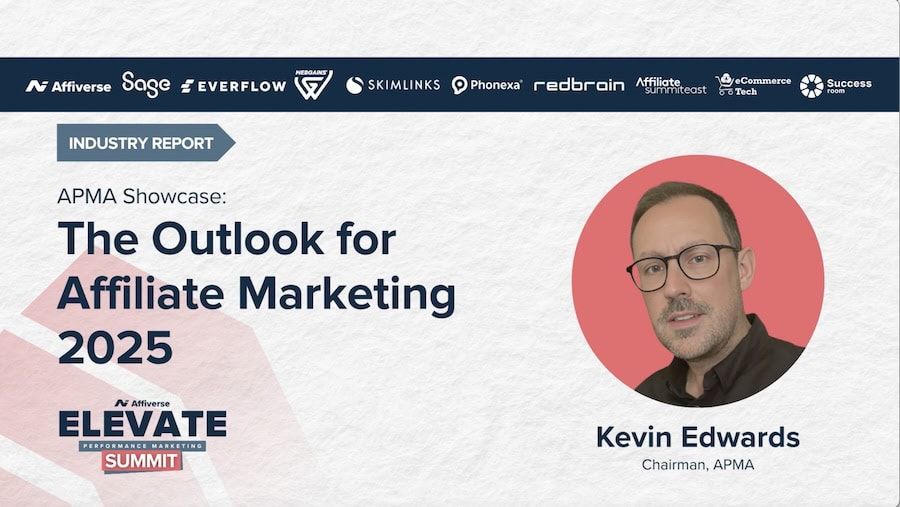
Twenty-one thousand sales. That’s roughly how many transactions flow through the UK affiliate channel every thirty minutes. Yet when Kevin Edwards, Chairman of The APMA (Affiliate and Partner Marketing Association), presented the organisation’s State of the Affiliate Nation 2025 report at ELEVATE London, he revealed something more troubling than impressive growth figures: the affiliate industry has a quarter-billion-pound blind spot in how it reports its own value.
As we close out our September ELEVATE Education series—our comprehensive “back to affiliate marketing school” examining the strategies, tactics, and insights shared at this summer’s summit—Kevin’s masterclass provides the perfect capstone. While previous sessions explored performance marketing’s reality check, B2B partnerships, media buyer essentials, Google visibility strategies, LinkedIn partnership development, and influencer collaboration, Kevin’s data-driven analysis reveals systemic issues that impact everything we’ve discussed throughout this series.
The APMA’s comprehensive industry report shows the UK affiliate channel reached £1.7 billion in 2024, representing 9% year-on-year growth despite economic headwinds. That’s nearly one million sales daily, generating £19 billion in revenue for UK brands with an impressive 16:1 ROI. One in ten pounds spent on UK e-commerce flows through an affiliate link—rising to one in seven for online travel.
Yet Kevin argues these impressive numbers mask fundamental problems that, if left unaddressed, could limit the channel’s growth potential just as economic pressures intensify. His presentation outlined four critical areas where the industry must evolve to maintain momentum through 2025’s expected turbulence.
The CPA Obsession: How Fixating on Last-Click Undermines Our Value Proposition
Kevin presented data that should make every affiliate marketer reconsider how they report program performance: 13.3% of brand spend captured by major UK networks—approximately £221 million—goes towards non-last-click CPA arrangements like tenancy deals, CPC agreements, and other brand-building activities. Yet most affiliate reporting completely ignores this investment, focusing exclusively on performance metrics.
“Imagine running your marketing budget with that kind of blind spot,” Kevin noted. The problem extends beyond missing context. The APMA research shows the affiliate channel converts roughly 5% of clicks to sales, meaning 95% of affiliate-generated clicks don’t result in immediate conversions. Traditional CPA reporting treats these as valueless when they’re actually shaping purchase decisions and informing intent.
Kevin referenced a decade-old case study that demonstrated the long-term value affiliate channels provide. A major UK retailer tracked 1,500 new customers initially referred through affiliate links across twelve months. Those customers returned an average of 3.3 times, with app users returning five times. While only £100,000 of subsequent revenue tracked through another affiliate click, approximately £670,000 came through other channels or direct visits. The initial affiliate referral generated an additional £511 per customer in lifetime value—value that vanished in traditional last-click reporting.
This reporting gap has real consequences. As Kevin emphasised, publishers increasingly run multi-channel campaigns combining email, social media, content, and paid advertising. When networks only report last-click CPA results, they undervalue these partners and potentially push them toward channels that offer better attribution visibility. The APMA data revealed that 75% of publishers received CPA payments in the past year, but substantial portions also received tenancy (40%), CPL (35%), and email sponsorship payments—indicating hybrid models are already deeply embedded in affiliate business structures.
As we’ve explored in our comprehensive guide to affiliate programme management, understanding the full value affiliates provide requires moving beyond simplistic performance metrics towards more sophisticated attribution models.
The Taxonomy Trap: Why Our Classification System Fails Modern Affiliate Partnerships
The APMA research collected data using a standard affiliate taxonomy: cashback/loyalty, content, vouchers, subnetworks, price comparison, CSS partners, social, tech partners, and “other.” This classification revealed that cashback accounts for the largest spend (30%), followed by content (25%), with vouchers at just 10%.
But Kevin revealed a massive discrepancy that exposes classification problems: while vouchers represent only 10% of reported affiliate spend, 23% of all tracked sales included voucher code redemptions. That thirteen-percentage-point gap signals fundamental misclassification—some affiliates using voucher strategies are being categorised elsewhere, making it impossible for brands to accurately understand where voucher-driven sales originate.
The classification breakdown accelerates when examining how affiliates actually operate. The APMA asked publishers to identify all routes to market they actively use. On average, publishers utilise 4.4 different channels. Email and newsletters emerged as by far the most common route to market, yet “email” doesn’t appear in the standard affiliate taxonomy at all.
This creates a three-dimensional problem being forced into two-dimensional categories. As Kevin explained, asking “what is a voucher code sale?” reveals the inadequacy of current taxonomy. Is it any affiliate that uses voucher codes, or only dedicated voucher platforms? Different networks apply different interpretations, making cross-program comparisons meaningless.
Kevin shared a provocative example of alternative classification from his time leading Awin’s data team. Rather than relying on affiliate types, his team tracked customer lifetime value by initial referring affiliate, creating performance scores based on metrics like repeat purchase rates, app downloads, and revenue retention. This approach valued affiliates based on the quality of customers they delivered rather than which arbitrary category they fit into.
The implications extend to how brands allocate budgets. If a brand believes voucher affiliates account for 10% of spend when voucher-influenced sales actually represent 23% of transactions, they’re making strategic decisions based on fundamentally flawed data. As discussed in our analysis of voucher code affiliates’ existential challenges, proper classification becomes even more critical as brands develop alternative voucher distribution strategies.
The Transparency Deficit: How Compliance Failures Threaten Channel Credibility
Kevin delivered uncomfortable truths about affiliate channel integrity. Ten years ago, industry mapping identified seven subnetworks operating in the UK market. When the APMA developed its subnetworks guide in 2024, they reached out to approximately fifty subnetworks. That seven-fold increase in subnetwork volume—much of it coming from outside Europe and particularly Asia—has brought a corresponding rise in problematic traffic, fake codes, and compliance violations.
“A lot of them are bringing incredibly damaging traffic,” Kevin stated bluntly. “This is something that has kind of happened on our watch that we haven’t really paid enough attention to.” He emphasised that while quality subnetworks exist and add genuine value, the rapid proliferation has outpaced the industry’s compliance capabilities.
The problem extends beyond subnetworks. Network compliance teams, traditionally responsible for both affiliate approvals and quality monitoring, face overwhelming volume. Application numbers have surged since COVID, leaving less time for proactive compliance work. Kevin couldn’t quantify the scale—”Is it 1%, 5%, 10%, 20%?”—but emphasised that uncertainty itself represents a management failure.
The APMA is developing responses: a shared compliance reporting tool, additional subnetwork and voucher-specific projects, and what Kevin termed a “compliance task force” to honestly assess problem scope. But he also argued for transparency about inherent challenges. “The affiliate industry is everything. It’s all digital in microcosm,” he noted. “We’re going to have to be on top of this stuff. And some of this stuff we will only find after it becomes a problem.”
This transparency imperative carries strategic importance beyond damage control. Kevin contrasted affiliate marketing favourably with programmatic advertising’s “ad tech tax,” citing Guardian research showing 70% of programmatic spend disappearing into opaque intermediary fees before reaching publishers. “We don’t suffer with this as an industry,” Kevin emphasised. “We’re all pretty much upfront and pretty honest about who gets what.”
Maintaining that transparency advantage becomes particularly valuable given new regulatory opportunities. The UK’s Data Use and Access Bill, implemented six weeks before ELEVATE, creates space for “more business-friendly” digital marketing approaches post-Brexit. The Information Commissioner’s Office has been directed towards business-friendly enforcement. Kevin argued that if the affiliate channel can demonstrate trustworthiness and deal with compliance issues proactively, it’s positioned to benefit from regulatory frameworks favouring “data-focused, privacy-first channels.”
Our recent examination of navigating affiliate tracking in a cookie-less world underscores why privacy-first positioning matters increasingly for affiliate channel credibility.
The Peak Performance Paradox: Why Black Friday Overindexing Matters More Than Ever
Kevin’s final focus addressed what should be obvious but often gets overlooked: peak trading periods represent disproportionate value for affiliate channels. The APMA data quantified this precisely—while affiliate links account for roughly 10% of UK e-commerce transactions annually, during the four-day Black Friday through Cyber Monday window, that figure rises to 13% or one in eight pounds.
This overindexing occurs even for brands that don’t actively participate in Black Friday promotions. Kevin cited Awin research showing that brands doing nothing special around Black Friday still see massive traffic and conversion increases simply because consumer behaviour shifts during that period. Affiliates capture this surge because they’ve built what Kevin called “consumer empowerment models”—trusted platforms consumers turn to when navigating promotional noise.
“Consumers go on a bit of a feeding frenzy around Black Friday,” Kevin explained. “And one of the reasons that I think affiliates are so well placed to take advantage of Black Friday is this idea of a value exchange.” He referenced former Tesco CEO Terry Leahy’s observation that “the true source of loyalty is to create benefits for people,” arguing this philosophy underpins successful affiliate models offering guides, trusted advice, and curated deals.
The timing proves particularly crucial for 2025. Kevin referenced WPP’s recent profit warning—the advertising giant blamed performance declines on brands “increasingly ignoring and shunning big media agencies because they want to work with partners direct, they want to work with performance and ROI focused advertising opportunities.” WPP’s share price dropped 15%, marking the FTSE 100’s worst single-day performance that week.
Combined with tariff-related advertising spend cuts reported by the Financial Times, Kevin warned that “2025 is going to be a crunch year.” He predicted continued growth but at lower rates than 2024’s 9%. “The stakes have never been higher,” he emphasised. “Brands will invest in those they trust and the golden quarter will be our golden opportunity.”
Our analysis of how affiliate codes provide tracking reliability demonstrates one technical advantage that positions the channel well during high-volume periods when other tracking methods face increased strain.
Three Actions for Navigating 2025’s Challenges
Kevin’s research and analysis point towards concrete actions affiliate marketers should prioritise as economic pressures intensify:
Implement Multi-Touch Attribution Reporting Immediately: Stop relying exclusively on last-click CPA metrics that ignore 13.3% of brand spend and dismiss 95% of affiliate-generated clicks as valueless. Demand that networks provide comprehensive campaign reporting showing all touchpoints and channels affiliates activate. Build internal reporting that captures the full customer journey from initial affiliate referral through lifetime value. This shift requires investment in analytics capabilities but provides the three-dimensional view necessary for defending budgets against more sophisticated competing channels.
Advocate for Taxonomy Reform Across the Industry: The current classification system wasn’t designed for multi-channel, hybrid affiliate models using an average of 4.4 routes to market. Whether through APMA membership, network advisory boards, or industry working groups, push for classification frameworks that reflect how modern affiliates actually operate rather than forcing them into outdated categories. Consider implementing internal classification systems that score affiliates based on customer quality metrics—repeat purchase rates, average order values, lifetime revenue contribution—rather than accepting network-provided categories at face value.
Prioritise Compliance Infrastructure Before Crisis Forces Action: The fifty-fold growth in subnetworks versus a decade ago signals that reactive compliance won’t suffice. Implement systematic partner vetting beyond basic network approval processes. Participate in industry initiatives like the APMA’s shared compliance tool. Budget specifically for compliance monitoring resources separate from recruitment and activation budgets. The new UK data legislation creates opportunity for privacy-first channels, but only if the industry can demonstrate proactive quality management rather than waiting for regulators to impose solutions.
Kevin closed his presentation with an invitation that reveals the APMA’s approach to industry challenges: quarterly member meetings where competitors collaborate on shared problems, open to any companies interested in participating. This philosophy—that industry growth requires collective action on foundational issues rather than individual competitive advantage—shapes everything from the annual research to the subnetworks guide.
As our ELEVATE Education series concludes, Kevin’s data-driven analysis reminds us that sustainable channel growth requires more than tactical excellence in the areas we’ve explored throughout September. It demands honest assessment of systemic weaknesses, willingness to challenge comfortable but inaccurate narratives, and coordinated action on problems no single company can solve alone.
The affiliate channel’s impressive growth trajectory—£1.7 billion in UK spend, 9% year-on-year increases, 16:1 ROI—creates both opportunity and responsibility. Opportunity to capture budgets shifting away from traditional agencies towards performance partnerships. Responsibility to fix the £221 million blind spot, reform broken classification systems, strengthen compliance infrastructure, and capitalise on peak periods that prove the channel’s unique value.
2025’s economic headwinds will separate channels that have their houses in order from those still operating on outdated assumptions and incomplete data. The choice facing affiliate marketers isn’t whether to address these four pillars—it’s whether to lead the transformation or wait until market pressures force reactive responses.
Want to continue learning from industry leaders like Kevin Edwards? Secure your tickets for ELEVATE 2026 and gain access to exclusive insights from the practitioners who are reshaping affiliate marketing. This marks the conclusion of our September ELEVATE Education series, but the conversation continues at next summer’s event. Make sure you have your seat secured.
Ready to diversify your affiliate marketing strategy? Explore our training programs and stay updated with the latest trends through our industry insights.
Everflow
Connect
Tradedoubler
Connect
1win Partners
Connect
Shopnomix, a Nomix Group Company
Connect
Huffson Group
Connect
Kawaii Partners
Connect
Trackdesk
Connect
Share your expertise and expand your reach and become a content contributor with us today!
Contact Us To Find Out More