Leveraging B2B Partnerships To Scale Your Business and Customer Reach
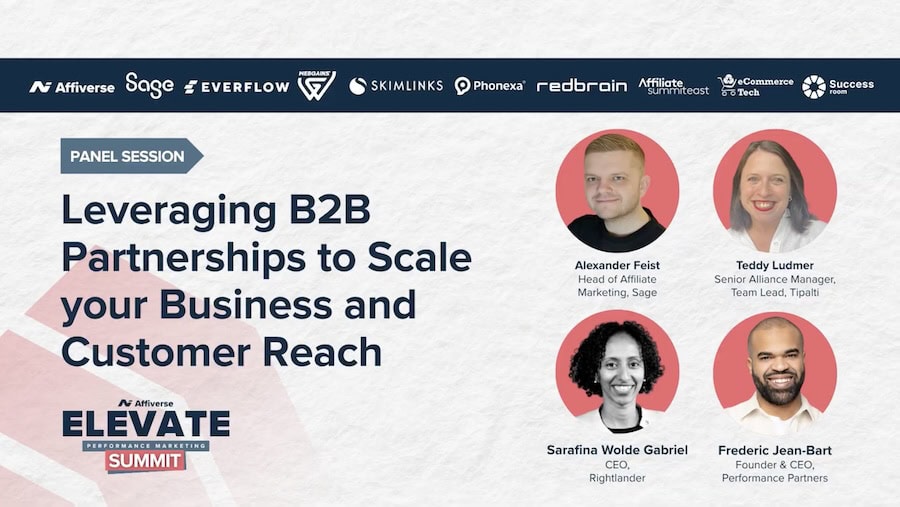
Two days of unfiltered industry intelligence unfolded when performance marketing’s brightest minds converged in London for two intensive days of industry-shaping conversations at ELEVATE 2025. We’re continuing to share some of these critical conversations through our ELEVATE Education series. Following our first panel on performance marketing’s reality check, we’re now diving into the complex world of B2B partnerships.
Moderated by the dynamic Sarafina Wolde Gabriel, CEO of Rightlander and self-proclaimed “granny of the industry” with over two decades of experience, the panel brought together a powerhouse lineup: Lee-Ann Johnstone, founder of Affiverse taking her turn in the hot seat as panelist; Teddy Ludmer, Senior Alliance Manager at Tipalti; Alexander Feist, Head of Affiliate Marketing at Sage; and Frederic Jean-Bart, Founder and CEO of Performance Partners. With Sarafina’s infectious energy keeping the conversation flowing and the expertise of these seasoned practitioners who’ve navigated the intricacies of B2B partnerships across multiple verticals, their collective insights paint a picture of a channel that demands patience, precision, and a completely different approach to partner relationships.
Watch this panel session in full now…
The Contract Myth: Redefining Partnership Success
The most persistent misconception plaguing B2B partnerships centres around the belief that success hinges on contract signatures. Lee-Ann challenged this notion directly: “My biggest misconception with building partnerships is that people think it’s always about signing the contract. It really isn’t about signing the contract. It’s actually about understanding how your two businesses can intertwine together and then really understanding how that partnership goes forward. It’s not about that first sale. It’s actually about the 25 sales that are gonna come after that.”
This perspective shift proves crucial when considering the fundamental differences between B2C and B2B partnership approaches. Alexander Feist, Head of Affiliate Marketing at Sage, emphasised the educational component: “Affiliate marketing in B2B is a long game. It’s not about chasing for volume. It’s chasing for quality, finding the right partners, bringing them on board and educating them properly on your products.”
The education element extends beyond simple product knowledge. Frederic Jean-Bart, Founder and CEO of Performance Partners, illustrated this with a practical example: “I can give you a real world example where I was looking for a new CRM for my company, and that’s not easy. It’s a big deal. I want to know all of the different features, what it’s going to integrate with. And so you need to work with partners that are going to be able to actually share that knowledge and be very intelligent about it and be able to really educate the customer on your program.”
Diversified Partnership Structures Drive Results
The panel revealed that successful B2B programs employ diverse partnership structures far beyond traditional referral models. Alexander detailed Sage’s approach: “We have a very diverse approach to partnerships. So we are not only focusing on the traditional affiliates in the B2B space, like comparison sites or cash back and coupons. We are looking for strategic partners who are kind of advocates for our product and who are talking to our potential customers in the same way as we would do as a brand.”
This diversification extends to commission structures as well. Frederic noted significant variations in client preferences: “Some of our clients, I’d say the majority of our clients, they wanna pay the partners on like a paid membership, paid subscription. But we also have a lot that want to pay on a trial… There are some B2B SaaS companies out there that are VC backed and they got a ton of money to burn and they’re willing to do cost per trial.”
The trial-based approach offers strategic advantages for both brands and partners. As Lee-Ann explained: “Working on a trial basis is actually really, really important, especially for B2B, in that sometimes the trial isn’t the part that actually brings the business in, it’s the part that builds the database, because the sale doesn’t always happen immediately when the trial starts.”
Teddy advocated for portfolio diversification: “I like to make sure that my portfolio partners are diversified. So I’ll have tech partners that might move a bit slower because they’re a bigger organisation. I might have an independent consultant who knows a ton of people who might not give me the sale, but will help promote the leads, speak to people at conferences and talk about the brand.”
Navigating Sales Cycles and Internal Politics
Perhaps the most challenging aspect of B2B partnerships involves managing extended sales cycles while maintaining alignment between partnership and sales teams. The panel identified communication as the critical success factor in overcoming these hurdles.
Teddy shared her approach to internal alignment: “I treat the sales team like a partner, right? So it’s making sure you have a strategy internally, just as much as you have a strategy externally… It’s making sure you’re tailoring your messaging to both sides, communicating, being transparent and also just making sure that updates are regular.”
The attribution challenge in B2B partnerships requires sophisticated tracking approaches. Alexander highlighted the importance of multi-touch attribution: “The biggest mistake you can make is just using last click only for evaluating your partner setup… There’s one partner that was driving zero last click conversions or actions basically. And we made the multi-touch attribution review on them and saw they’re influencing a lot of qualified and highly qualified opportunities. And we increased their payouts instead of kicking them out of the program.”
Communication transparency emerged as a key theme throughout the discussion. Frederic emphasised the importance of partner communication during long sales cycles: “If you have an affiliate and they’re trying to make money and they’re like, well, it’s been 30 days, 60 days, what’s going on? If you can just communicate with them and let them know like, hey, okay, this is where your leads are in the sales cycle. It’s looking kind of good or this is what’s happening. It eases their concerns.”
Recruitment Reality: High-Touch, Relationship-Driven Approach
The recruitment landscape for B2B partners differs dramatically from traditional affiliate recruitment methods. The panel consensus pointed toward relationship-building and industry networking as primary acquisition channels.
Frederic outlined a systematic approach to partner identification: “You start with a list of your competitors, and you just go on Google, and you say competitor plus review, and you see all the different partners that are promoting them there… The important thing with recruitment is you have to take a sales approach to affiliate recruitment.“
However, Lee-Ann revealed the investment reality: “I don’t know about anybody else in the room, but I went and created a media company to go and recruit affiliates, and you’re all here at this event. So I spend an enormous amount of money in my small business on attending events, going to events, meeting people, because B2B doesn’t work like other affiliate programs.“
The networking investment extends beyond simple attendance. Teddy shared her customer-centric recruitment strategy: “I’ll sit down with the CSM team or the support team and even try to get in front of a customer and say, who are you logging in to before and after our software? That’s one avenue. The other avenue is they’re obviously selling to our same ICP, the ideal customer profile. How do we collaborate as businesses to drive more business together?“
Three Key Takeaways for B2B Partnership Success
1. Invest in Multi-Touch Attribution Systems
Traditional last-click attribution will undervalue B2B partnership contributions. Implement tracking systems that capture influence throughout extended sales cycles, and be prepared to compensate partners based on their contribution to pipeline development rather than immediate conversions.
2. Prioritise Internal Education and Alignment
Success in B2B partnerships requires treating internal teams as partners themselves. Develop comprehensive education programs for sales teams, establish regular communication cadences, and create shared metrics that align partnership and sales objectives.
3. Embrace High-Touch Recruitment and Relationship Building
B2B partner recruitment demands significant time and resource investment. Budget for industry events, networking activities, and one-on-one partner development. Quality partnerships in this space require personal relationships that cannot be automated or scaled through traditional affiliate recruitment platforms.
This analysis builds on insights from our previous ELEVATE coverage exploring performance marketing’s reality check, continuing our commitment to sharing actionable intelligence from industry leaders.
If you want to learn from the people who are actually changing how affiliate marketing works, get your tickets now for ELEVATE 2026 and hear directly from the industry’s most innovative minds.
Searching for a good podcast or webinar to learn from?
Podcast: B2B Affiliate Marketing Strategies for Global Growth – Alexander was a guest on the Affiliate Marketing Podcast with Lee-Ann. Tune in to hear the insights he shared on creating a community around affiliate programs and valuable tips for affiliate managers.
Webinar: How to Attract and Retain Affiliates With Seamless Payment Experiences – Catch-up on this conversation with Teddy Ludmer and Ioana Chirnogeanu, Head of Publisher Development EMEA at Everflow, with Lee-Ann. Their discussion revealed that payment processes aren’t just an end-of-month administrative task they’re a crucial element that affects affiliate acquisition, activation, loyalty, and program efficiency.
Everflow
Connect
Tradedoubler
Connect
1win Partners
Connect
Shopnomix, a Nomix Group Company
Connect
Huffson Group
Connect
Kawaii Partners
Connect
Trackdesk
Connect
Share your expertise and expand your reach and become a content contributor with us today!
Contact Us To Find Out More