Google Must Open Android and Search Data to AI Rivals Under EU Rules
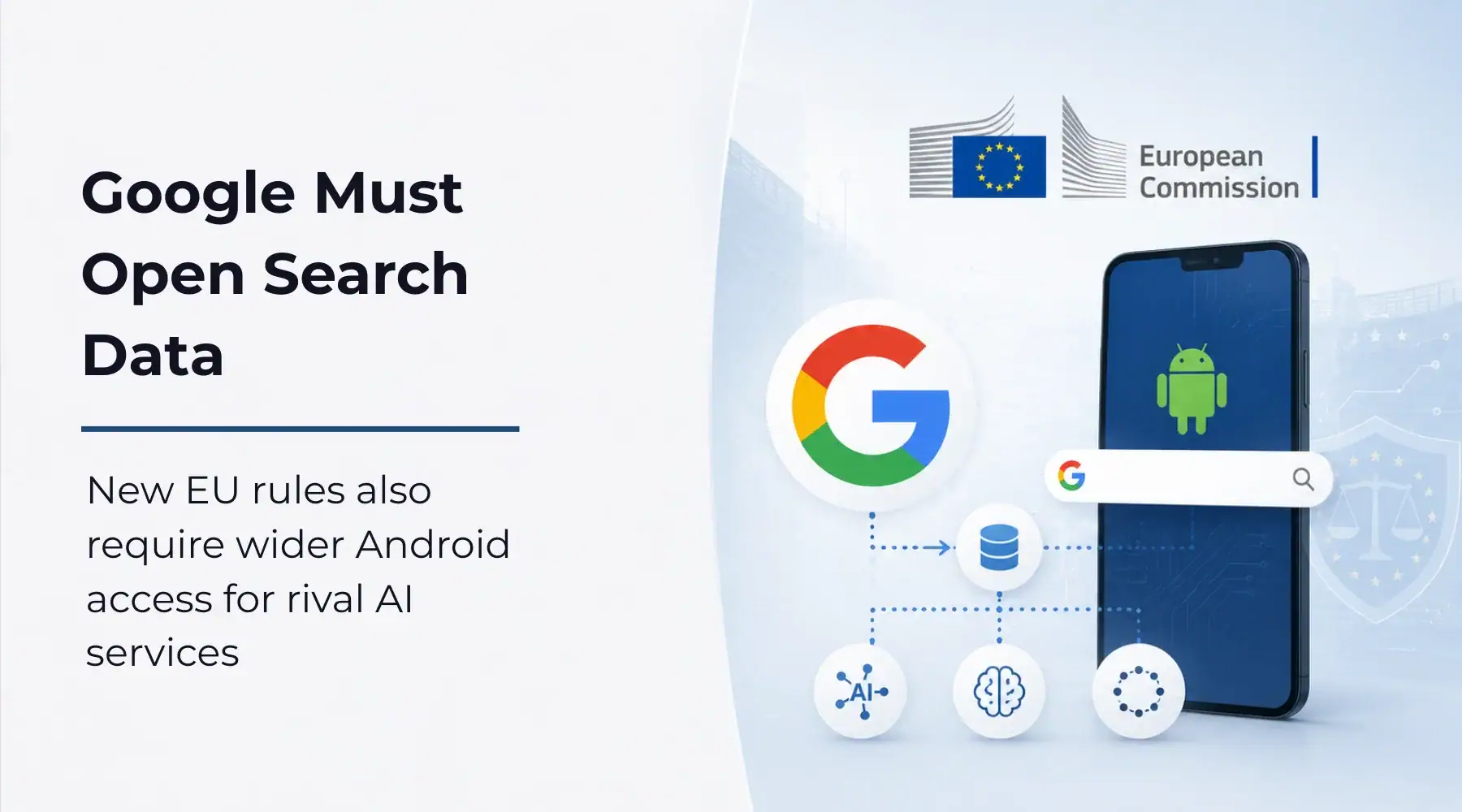
The European Commission has issued two sets of binding measures requiring Google to give competing AI services greater access to Android features and provide eligible search providers with anonymised Google Search data.
Announced under the Digital Markets Act on 16 July 2026, the European Commission’s measures are intended to create fairer conditions for services competing with Google Search and Google’s AI products, including Gemini. AI assistants that provide search functionality may also qualify for access to the shared data.
Key Takeaways: What Google Must Change
- Google must share anonymised ranking, query, click and view data with eligible competing search engines.
- AI chatbots offering search functionality can qualify for access.
- Recipients may use the data to improve search technology, but not to train general-purpose AI models or build unrelated advertising and profiling services.
- Third-party AI assistants must receive access to 11 Android features currently available more extensively to Google services such as Gemini.
- Most Android interoperability measures must be implemented through Android 18 by 1 August 2027.
- The Search data requirements will be introduced through several milestones running into January 2027.
Search Data Rules Now Include AI Chatbots
Under the Digital Markets Act, Google is required to share anonymised search data with eligible online search engines on fair, reasonable and non-discriminatory terms.
The information covered by the Commission’s measures includes ranking, query, click and view data generated through both free and paid search. This may include queries entered by users, language and device information, the URLs they view, their interactions with results and the positions in which those results appeared.
Google will not be required to share its algorithms or underlying search technology. Instead, the objective is to give competitors access to some of the large-scale behavioural data that Google uses to develop and improve its own Search services.
Teresa Ribera, Executive Vice-President for Clean, Just and Competitive Transition
Our decision will help smaller competitors, search engines, or AI assistants, to compete and provide that choice, while protecting the user’s privacy.
The Commission said Google’s previous approach had not provided competitors with sufficiently useful access. Its initial proposal reportedly removed between 90% and 100% of unique queries from the dataset and excluded AI chatbots providing search services. According to the Commission, this resulted in no meaningful uptake among potential recipients.
The new decision confirms that AI chatbots offering search functionality can be eligible. Recipients could use the data to improve query understanding, indexing, ranking and retrieval systems. This includes helping an AI service locate current information from the web when grounding an answer.
There are also clear limitations. The shared data cannot be used to train general-purpose AI models, improve unrelated services such as consumer profiling or advertising, or systematically reproduce Google’s results rather than develop an independent search product.
Access Will Be Limited to Eligible Search Providers
The decision does not make Google Search data openly available to every AI company, publisher or developer. Applicants must provide an online search engine service as a genuine economic activity in the EU or qualify as a credible new entrant. The Commission’s criteria include minimum user or investment requirements, as well as restrictions covering security, sanctions and where the information is processed.
Recipients will also have to pass independent audits before receiving the data, followed by further checks during the access period. Google must remove direct identifiers and apply technical and contractual protections intended to reduce the risk of individual users being identified. Google will be permitted to charge for access under a formula based primarily on the incremental cost of preparing, storing and distributing the dataset, together with a reasonable return on the capital required to provide it.
Android Measures Cover 11 AI Features
The second decision focuses on the position of competing AI assistants within the Android ecosystem. The Commission estimates that Android devices are used by around 60% of European mobile users. It argues that alternative AI assistants currently have more limited access to operating-system features than Google’s own services, making it more difficult for them to offer comparable experiences. Google will have to support interoperability across 11 Android features. These cover areas such as voice activation, contextual information, actions within other apps, screen automation, system controls, on-device AI models and background execution.
Users could eventually choose another AI assistant for tasks currently associated closely with Gemini or Google Assistant. Examples given by the Commission include activating a preferred service through a voice command, sending messages, adding items to a shopping list, changing device settings or carrying out multi-step actions inside another app. Most of the measures must be implemented in Android 18 by 1 August 2027. Support for multiple assistants using always-on voice activation concurrently has a later deadline of 1 August 2028, through Android 19.
What This Could Mean for Affiliates and Publishers
The Search data decision could help alternative search engines and AI-led discovery services produce more relevant results. In its guidance, the Commission said more credible search alternatives could create additional traffic sources and greater competition within digital advertising. That is the potential opportunity for affiliates. A less concentrated search market could give publishers more platforms through which their content, comparisons and recommendations are discovered.
However, greater competition between search providers does not automatically mean a return to click-led discovery. Rival AI services may use improved retrieval systems to provide stronger answers within their own interfaces, potentially creating more visibility without generating an equivalent increase in visits. The recent AI search attribution gap report highlighted the same measurement problem. Publisher content can influence AI-generated recommendations even when the user does not follow a trackable affiliate link.
Publishers will therefore still need to monitor visibility and influence beyond conventional organic clicks. The fundamentals set out in Google’s AI Search guidelines for affiliates also remain relevant: useful information, clear page structure, original evidence and crawlable content give search and retrieval systems stronger reasons to use a page.
The Decision Does Not Settle the Publisher Dispute
The measures address competition between Google and other search or AI providers. They do not directly resolve disputes about Google’s use of publisher content inside AI Overviews and AI Mode. Those concerns sit alongside the European Publishers Council’s antitrust complaint against Google, which focuses on matters including publisher traffic, content use, licensing and the lack of an opt-out that does not also affect Search visibility.
Giving competing AI services better data may reduce Google’s structural advantage, but it does not establish compensation for publishers, require AI platforms to produce outbound clicks or introduce a shared attribution system. The new measures should therefore be viewed as one part of the EU’s wider examination of Google Search and AI competition rather than a complete answer to the commercial pressures facing publishers.
What Happens Next
Google will implement the Search data and Android requirements in stages:
- By the end of August 2026: Google must provide the European Commission with an eligibility application form and publish information explaining how competing search providers can apply for access.
- By September 2026: Google must make test datasets and template licence agreements available to potential recipients.
- By November 2026: Google must finalise the anonymised Search dataset that eligible providers will be able to access.
- By January 2027: Google must submit its pricing offer for access to the Search data.
- From August 2027: Most of the required Android interoperability features must be available through Android 18. Some measures, including support for multiple AI assistants using always-on voice activation, have a later deadline in 2028.
The European Commission will monitor Google’s implementation over the next two years, with the company required to provide regular progress reports. For affiliates and publishers, the main question is whether access to Google’s data helps alternative search engines and AI assistants become meaningful sources of discovery. The decision may create greater competition, but its effect on publisher traffic and affiliate measurement will depend on how those services use the data and display their results.
Everflow
Connect
Tradedoubler
Connect
1win Partners
Connect
Shopnomix, a Nomix Group Company
Connect
Huffson Group
Connect
Kawaii Partners
Connect
Trackdesk
Connect
Share your expertise and expand your reach and become a content contributor with us today!
Contact Us To Find Out More