Claude’s AI Watermarks Could Change How Affiliate Content Is Policed
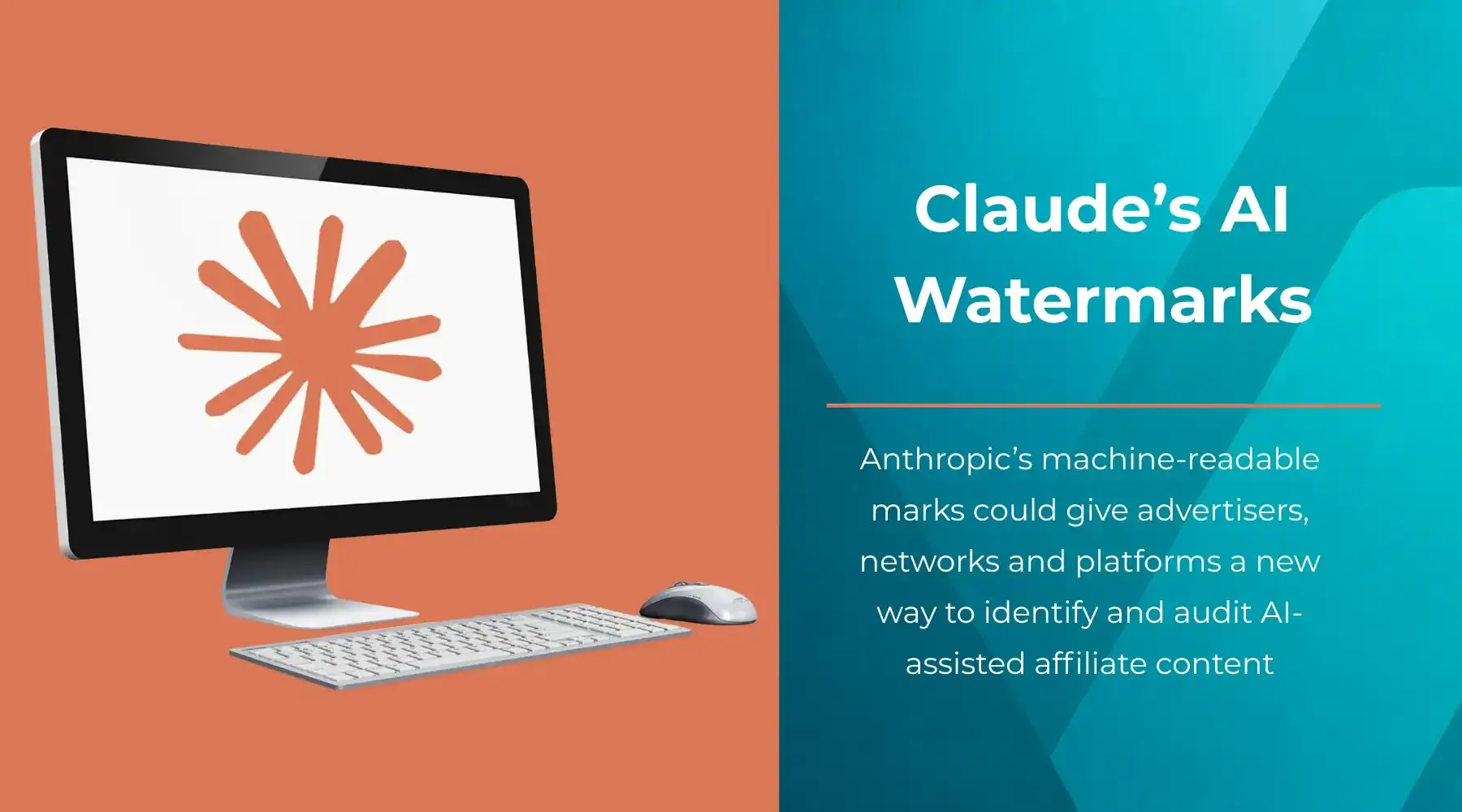
Anthropic is adding invisible, machine-readable watermarks to text generated by supported Claude models, alongside signed provenance metadata for supported files. For affiliate publishers, agencies and advertisers, this means AI-assisted content created with Claude could become easier to identify and audit.
The watermark will not conclusively prove AI authorship or automatically affect search rankings. However, it could influence content-disclosure policies, partner agreements and how affiliate networks assess AI-generated promotional material.
Key Takeaways: What Claude’s AI Watermarks Mean for Affiliates
- Supported Claude models will embed imperceptible, machine-readable watermarks into generated text.
- Claude will add signed C2PA provenance metadata to supported image and file formats.
- The markings will extend beyond the Claude chatbot to its API, business products and supported cloud deployments.
- Although prompted by the EU AI Act, Anthropic intends to apply the technology worldwide.
- A detected watermark may show that Claude processed the content, but it will not conclusively prove AI authorship.
- There is no evidence that Claude’s watermark will cause a Google search penalty.
- Affiliate businesses should document how AI is used across their content supply chains and establish clear review and disclosure policies.
How Claude’s AI Watermark Works
Anthropic says supported Claude models will weave an imperceptible watermark directly into generated text without changing its meaning, quality or readability.
Because the watermark forms part of the text itself, it should remain present when content is copied and pasted. It may also survive some subsequent editing.
For supported files, Claude will use the Coalition for Content Provenance and Authenticity’s C2PA standard. This attaches digitally signed information about a file’s provenance and can help users determine whether it has been altered after being processed by Claude.
According to Anthropic’s official guidance, new Claude models launched in the EU from 2 August 2026 will support machine-readable marking from launch. The company is still working to extend support to older models and says more detailed detection guidance will follow.
The markings will not be limited to people using the Claude chatbot. They will apply at model level across Claude, Claude Platform’s API, Claude Code, Claude Cowork and Claude Tag. Text generated using supported models through AWS, Google Cloud and Microsoft Foundry will also carry the watermark.
Why Anthropic Is Introducing Watermarks
The change follows the implementation of new transparency requirements under the EU AI Act.
Anthropic has signed the EU AI Act’s Article 50(2) Code of Practice on Transparency of AI-Generated Content. The code requires providers to make certain AI-generated and AI-manipulated content identifiable in a machine-readable format.
For publishers and program managers, the EU AI Act transparency rules for affiliates raise practical questions about when AI use must be disclosed and who is responsible for ensuring compliance.
Although the regulations originate in Europe, Anthropic intends to apply its marking system wherever supported Claude models are available. Affiliate businesses outside the EU may therefore encounter marked content when using Claude directly or through another platform.
This is another example of European regulation influencing global product design. Rather than maintaining separate European and international versions of Claude, Anthropic is building transparency technology into the model itself.
What Claude’s Watermark Means for Affiliate Content
Generative AI is already embedded in many affiliate content workflows. It can be used to draft reviews, rewrite merchant descriptions, summarise product specifications, localise articles, create promotional emails and generate social media copy.
The challenge is no longer simply deciding whether to use AI. Building trust into AI affiliate marketing also requires publishers and program managers to consider how automation affects content quality, attribution and editorial accountability.
Until now, identifying AI involvement has largely depended on voluntary disclosure, stylistic judgement or third-party AI detectors. A model-level watermark introduces a more direct provenance signal.
Once Anthropic releases its detection tools or enables third parties to recognise the marks, publishers could face greater scrutiny over how Claude is used within their content operations.
That scrutiny is already extending across social platforms. LinkedIn and Snapchat are reducing the reach of low-value AI content, showing how platforms are beginning to distinguish between useful AI assistance and mass-produced automated material. Neither platform is banning AI outright, but both are placing greater value on original input and human oversight.
Advertisers and affiliate networks may eventually incorporate watermark detection into content audits, particularly when contracts require original, human-reviewed or transparently labelled material. A brand that prohibits fully automated promotional content could potentially identify copy that has passed through Claude, even when the publisher has not disclosed that involvement.
Publishers should therefore know which models their employees, freelancers and agencies are using. “AI-assisted” may no longer be a sufficiently precise description when different tools produce different provenance signals and compliance implications.
Detection Will Not Prove AI Authorship
A Claude watermark will not establish that Claude wrote an entire article.
A publisher might use Claude only to proofread, translate, format or summarise an original piece of work. The finished output could still carry a watermark even though the underlying research, argument and language originated with a person.
The content might also have been altered after Claude processed it. A detected mark cannot show which passages were generated by the model or how much human editing took place before publication.
Equally, the absence of a watermark will not prove that content is human-written. Anthropic acknowledges that a mark may become undetectable when text is heavily edited, paraphrased, translated or combined with other material. Very short passages may also be too small to produce a reliable signal.
Image provenance metadata has similar limitations. It can be removed through screenshots, format conversion, re-saving or platforms that strip metadata during upload.
Watermark detection should therefore be treated as a signal rather than a verdict. Affiliate networks and advertisers risk penalising legitimate publishers if they use it as automatic proof of undisclosed AI authorship.
This distinction is especially important when AI disclosure and affiliate advertising overlap. As regulators and platforms examine AI-generated endorsements, the context in which synthetic content is used can matter as much as the technology that produced it.
Will Claude’s Watermark Affect Google Rankings?
There is currently no evidence that Claude’s watermark will trigger a Google search penalty.
Google’s public guidance has focused on whether content is useful, original and created for people—not simply whether automation played a role in producing it. Anthropic has not suggested that its watermark is intended to influence search rankings.
The distinction is important. A watermark might help identify that Claude processed a piece of text, but it cannot measure whether the content contains original reporting, accurate product information or useful first-hand experience.
Publishers should avoid mechanically rewriting content simply to remove a watermark. Doing so could reduce accuracy and readability without adding anything useful for the reader.
The same principle runs through Google’s AI search guidelines for affiliates: using AI does not remove the need for trusted sources, substantive information and content that gives search systems a reason to retrieve a page.
The more immediate considerations surrounding Claude’s watermark are commercial transparency, editorial standards and compliance with partner agreements.
What Affiliate Businesses Should Do Now
Affiliate publishers and agencies should begin by documenting where generative AI enters their content workflow. This includes checking whether Claude is used directly, through its API or inside third-party platforms.
Businesses should also establish internal rules that distinguish between different forms of AI assistance. Using Claude to correct grammar is not equivalent to asking it to produce an unverified product review or customer endorsement.
Affiliate teams should consider taking the following steps:
- Record which AI tools and models are approved for content production.
- Require freelancers and agencies to disclose material AI use.
- Define which tasks require human editorial review.
- Retain source material for prices, specifications and promotional claims.
- Check advertiser and network agreements for originality or disclosure requirements.
- Create a manual review and appeals process before acting on watermark detections.
- Monitor Anthropic’s forthcoming technical documentation and detection tools.
Human review remains particularly important in affiliate content. Product specifications, prices, offer conditions and performance claims can change quickly, while generated copy can confidently reproduce inaccurate or outdated information.
A watermark may identify the tool involved, but it does not verify that the content is correct.
The Bottom Line: AI Content Provenance Is Becoming an Affiliate Issue
Anthropic’s watermark will not eliminate low-quality AI content or provide a foolproof authorship test.
It does, however, move the affiliate industry closer to a world in which evidence of AI involvement can travel with the content itself. That could give advertisers, networks and publishing platforms a new way to examine material produced across increasingly automated content operations.
For affiliate businesses, provenance may need to be managed alongside disclosures, substantiation and editorial quality—not after publication, but throughout the content supply chain.
Everflow
Connect
Tradedoubler
Connect
1win Partners
Connect
PIN-UP Partners
Connect
Shopnomix, a Nomix Group Company
Connect
V.Partners
Connect
Huffson Group
Connect
Kawaii Partners
Connect
Share your expertise and expand your reach and become a content contributor with us today!
Contact Us To Find Out More