LinkedIn and Snapchat Crack Down on Low-Value AI Content
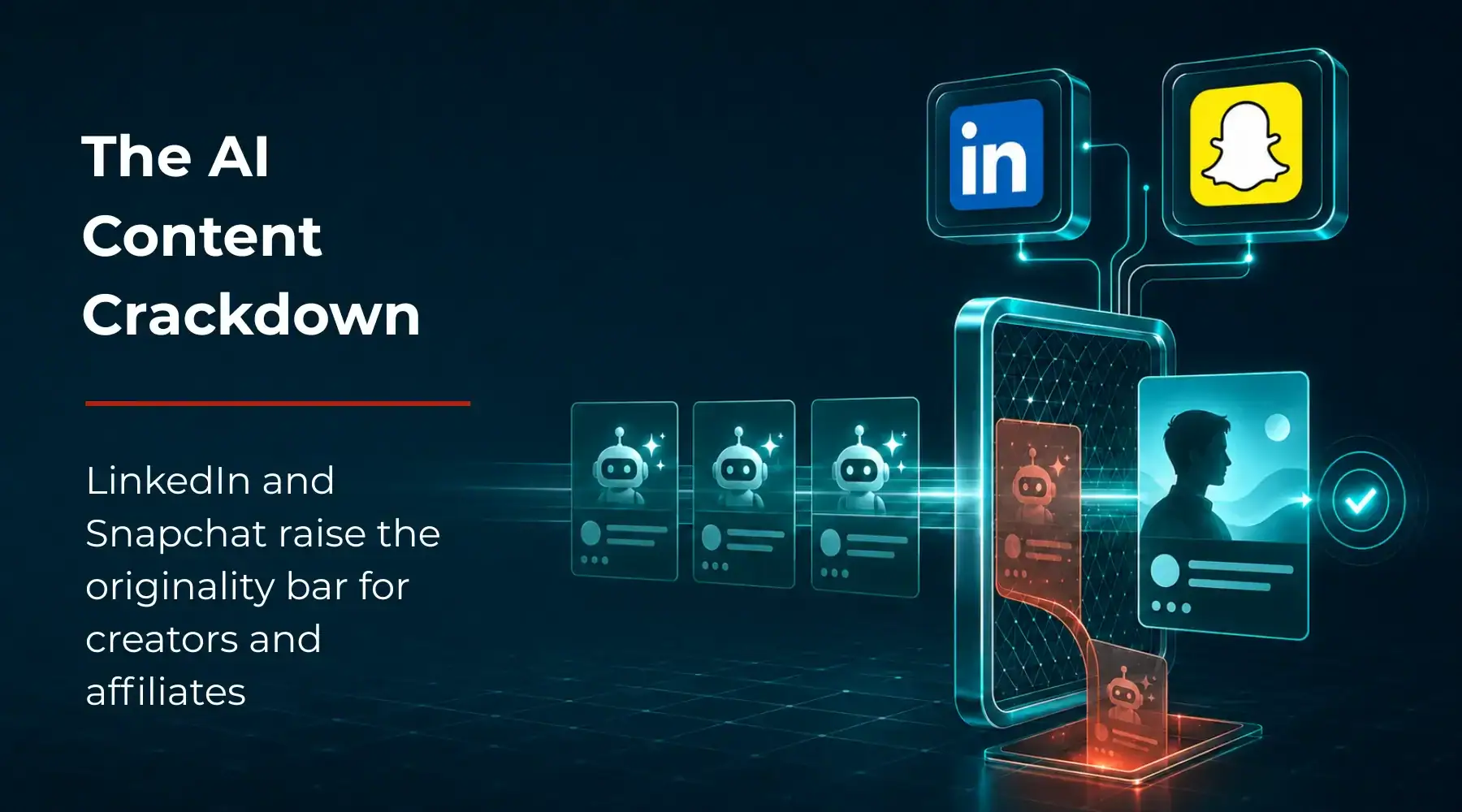
LinkedIn and Snapchat are introducing stronger measures against low-value AI-generated content as social platforms place greater emphasis on human perspectives, original production, and authentic engagement.
Snapchat will no longer recommend wholly AI-generated videos through Spotlight, while LinkedIn is expanding user reporting and automated detection for posts and comments considered generic or heavily automated.
Neither platform is banning AI-assisted content. The distinction instead centers on how the technology is used and whether the finished material offers enough original value to warrant wider distribution.
What the Platform Changes Mean for Affiliates and Creators
- Wholly AI-generated videos are no longer eligible for recommendation on Snapchat Spotlight.
- Snapchat will continue recommending content edited or enhanced using its AI tools.
- LinkedIn members will be able to report posts and comments that appear to be “AI slop.”
- LinkedIn is expanding classifiers designed to identify generic or low-quality content.
- Mass-produced posts and automated comments could face lower distribution.
- Affiliates can still use AI, but human expertise, original footage, and editorial review are becoming more important.
Snapchat Prioritises Human-Made Spotlight Videos
Snapchat announced on 31 July that wholly AI-generated videos would no longer qualify for recommendation through Spotlight. The company said its recommendation systems would increasingly prioritize “authentic, human-made creativity” as repetitive synthetic videos become more common across online platforms.
Snapchat had already signaled this direction in April, when it said users would begin seeing fewer synthetic AI videos and widely syndicated posts in Spotlight. The latest announcement turns that broader preference into a clearer eligibility rule. However, the restriction does not cover every use of AI. Content enhanced or edited through Snapchat’s AI creative tools can remain eligible for recommendation and will include transparency indicators, according to the official Snapchat announcement. This leaves creators with room to use AI for editing or visual enhancement while making it more difficult to build reach through videos generated entirely by automated tools.
For affiliates, the difference is important. A creator could still use AI to improve an original product demonstration, add effects, or streamline production. A channel publishing fully synthetic promotional videos at scale, however, may find that its content is no longer distributed through Spotlight recommendations.
LinkedIn Adds User Signals to Its AI Content Controls
LinkedIn is taking a different approach by combining automated detection with feedback from members. The platform is expanding an option that allows users to report a post or comment when it “seems like AI slop.” These reports will provide additional signals for LinkedIn’s classifiers, which are being trained to identify low-quality or heavily automated material.
Hari Srinivasan, LinkedIn’s chief product officer, said the company is testing private notifications within creator analytics dashboards when members perceive content as inauthentic or overly reliant on AI.
Srinivasan explained:
We want members to get feedback from real humans on what sounds authentic—not just have an AI detector review it and get it wrong.
LinkedIn has made an important distinction between AI use and low-value content. The company acknowledges that many users apply AI to refine their own ideas and may still be publishing genuine personal perspectives. To reflect that distinction, LinkedIn is removing its “enhance your post” feature and replacing it with a proofreading tool designed to correct writing without changing the user’s voice. It is also expanding measures against automated engagement, including comments created and posted at scale.
The platform previously said content that appears AI-generated and lacks a clear perspective is less likely to be distributed beyond the author’s immediate network. Its official update on authentic conversations said early testing identified generic content correctly 94% of the time.
AI Assistance Is Not the Main Target
The two approaches differ, but the underlying signal is similar.
Snapchat is drawing a line based on how much of a video was created by AI. LinkedIn is focusing more heavily on generic language, repetitive contributions, automation, and the absence of a recognizable human perspective.
In both cases, simply labelling content as AI-generated may not protect its reach. Transparency can address disclosure requirements, but it does not automatically make repetitive or low-value material suitable for recommendation.
These changes add further evidence that AI-generated content may be reaching a monetization wall. Platforms are not removing AI from the creative process, but they are becoming less willing to distribute or reward content that appears automated from beginning to end.
What Affiliates Should Review Before Publishing AI Content
Affiliates and program managers using AI-assisted social content should review both the production process and the value added before publication.
Relevant questions include:
- Does the post contain first-hand knowledge, testing, or a genuine opinion?
- Is the video based on original footage or entirely generated material?
- Has a person reviewed the accuracy and promotional claims?
- Are automated tools being used to publish repetitive posts or comments at scale?
- Would the content remain useful if the AI-generated presentation were removed?
This is particularly important for affiliate campaigns built around high posting volume. A larger content library will offer limited commercial value if platforms reduce its reach before users can see or engage with it.
The changes also arrive as the EU AI Act’s transparency requirements take effect. Disclosure and originality should therefore be treated as separate checks: one explains how content was produced, while the other determines whether it provides enough value to earn distribution.
For affiliates, creators, and brands, AI remains a useful production tool. The safer long-term approach is to use it to support research, editing, and creative execution while keeping experience, judgment, and original input at the center of the finished content.
Everflow
Connect
Tradedoubler
Connect
1win Partners
Connect
PIN-UP Partners
Connect
Shopnomix, a Nomix Group Company
Connect
V.Partners
Connect
Huffson Group
Connect
Kawaii Partners
Connect
Share your expertise and expand your reach and become a content contributor with us today!
Contact Us To Find Out More