Getting Affiliates and Partnerships on LinkedIn: The Room Strategy
This analysis continues our ELEVATE Education series examining practical strategies for affiliate and performance marketing success, straight from the stage of our summer London event …
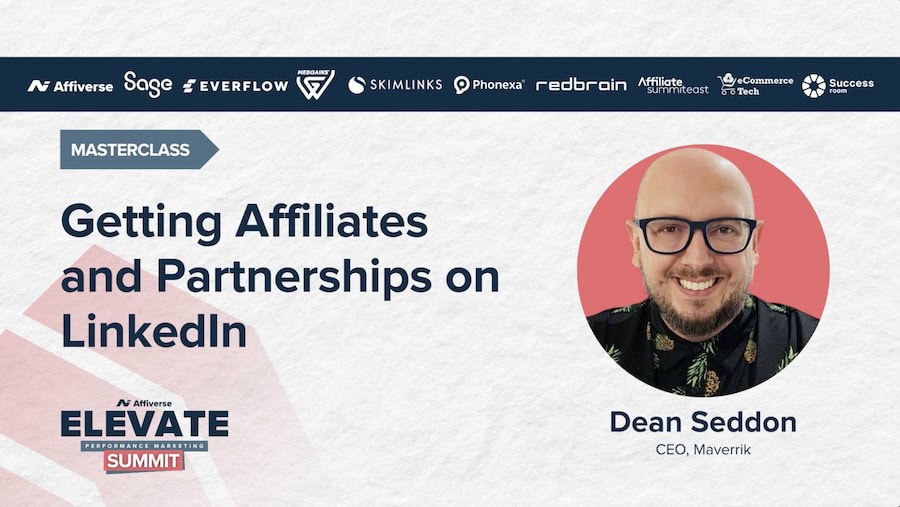
When someone who’s been invited into LinkedIn’s own offices to train their clients tells you that most people are using the platform completely wrong, it’s worth sitting up and listening. Dean Seddon, CEO of Maverrik, opened his masterclass at ELEVATE 2025 with characteristic straight-to-the-point talking: marketers think about LinkedIn like a channel, when they should be thinking about it like a room full of people.
This fundamental shift in perspective underpins everything that makes LinkedIn partnership development successful. Building on our ELEVATE Education series covering performance marketing’s reality check, B2B partnership strategies, media buyer partnerships, and digital PR for AI-era visibility, Dean’s session revealed why relationship-first thinking consistently outperforms broadcast-based approaches on LinkedIn.
Watch This Masterclass In Full Now…
The Room Reality: Why 97% of LinkedIn Users Don’t Post
Dean’s opening statistics immediately challenged conventional LinkedIn wisdom. Despite having 1.1 billion users, only 3% of the platform’s user base actually posts content. “Most of the people are having chats, scrolling, and stalking,” he explained, revealing the hidden reality behind LinkedIn’s apparent activity.
This insight fundamentally alters how performance marketers should approach the platform. While content marketing and thought leadership have their place, the real business happens in conversations with individuals who may never post publicly but represent significant partnership opportunities.
“There’s 10 people on LinkedIn that could probably bring you a million pounds worth of revenue, traffic, whatever you want. There’s 10 right there right now. What’s your plan?” Dean challenged his audience. The question cuts to the heart of most LinkedIn strategies: they focus on reaching everyone rather than building meaningful relationships with the specific individuals who matter.
The room analogy proves particularly powerful when considering partnership development. “How would you in this room today do the most business?” Dean asked, pointing to three distinct approaches: being on stage (content creation), being “that person” firing out hundreds of DMs (spam tactics), or “working the room” through genuine one-on-one conversations.
The STAR Framework: Strategic Relationship Development
Dean’s systematic approach to LinkedIn partnership building revolves around his STAR framework: Search, Track, Actions, and Routines. This methodology treats relationship development as a strategic process rather than opportunistic outreach.
The Search component leverages LinkedIn Sales Navigator’s advanced filtering capabilities to identify specific individuals within target organisations. Dean demonstrated this by searching for partnership roles at Forbes, revealing multiple potential contacts across different departments and seniority levels.
However, identification represents only the beginning. The Track element involves creating what Dean calls “buckets” within Sales Navigator – organised lists that allow systematic relationship development over extended periods. “One of my biggest clients spent about a million quid with me over the last five years. I was building a relationship with him on LinkedIn for four years,” Dean revealed, emphasising the long-term nature of meaningful partnerships.
The tracking system enables strategic movement of prospects through relationship stages, from initial identification through various engagement levels toward eventual partnership discussions. Sales Navigator’s feed functionality then provides real-time updates on each prospect’s activity, enabling natural conversation entry points.
The Video Message System That Converts at 30%
Perhaps the most actionable element of Dean’s presentation involved his systematic approach to personalised video outreach. Despite admitting the technique feels “really flipping weird,” he demonstrated conversion rates that justify the initial discomfort.
The system revolves around three-slide PowerPoint presentations with identical frameworks but customised assets for each prospect. “The copy’s the same, and all I do is go change the logo, change the text, drop in a screenshot,” Dean explained. This approach maintains personalisation while enabling systematic execution.
The three-slide limit proves crucial for maintaining attention spans in LinkedIn’s fast-paced environment. Each video follows the same structural approach while incorporating visual elements specific to the target company, creating perceived personalisation without requiring completely custom content creation.
Dean’s most compelling case study involved a reluctant 60-year-old salesperson who initially resisted the video approach. After creating 140 individual videos, the salesperson secured 43 meetings – representing a 30% conversion rate from outreach to scheduled conversations.
“If somebody’s worth a million quid, it’s worth two minutes of your time,” Dean argued, addressing the scalability concerns that immediately arise among performance marketers. His philosophy prioritises high-value, unscalable activities over automated approaches when dealing with significant partnership opportunities.
Advanced Sales Navigator Features for Partnership Development
The masterclass revealed several underutilised Sales Navigator capabilities that enhance partnership development beyond basic prospect identification. The buyer intent feature represents perhaps the most powerful tool for prioritising relationship-building efforts.
This functionality tracks company-level engagement with your organisation across LinkedIn, providing scoring based on activities like company page visits, profile views, and content engagement. “You could upload that list in there and track them to see, are their relationships getting better? Are they getting warmer? Are they getting cooler?” Dean demonstrated.
The organisational mapping capabilities allow comprehensive relationship development within target companies. Rather than focusing solely on obvious partnership contacts, users can identify multiple stakeholders across departments, building broader institutional relationships that support long-term partnership success.
The platform’s feed customisation based on tracked prospects enables natural conversation participation. Instead of broadcasting content hoping for engagement, users can inject themselves into ongoing conversations where their target partners are already active.
Three Priorities for LinkedIn Partnership Development
1. Abandon Broadcast Thinking for Strategic Relationship Building
Stop treating LinkedIn like a content distribution channel and start using it as a relationship development platform. Identify the 10-20 individuals who could genuinely transform your partnership portfolio, then develop systematic approaches for building meaningful connections over months or years rather than seeking immediate results.
2. Implement the STAR Framework with Sales Navigator
Use Sales Navigator’s advanced search capabilities to identify prospects, create organised tracking systems through custom lists, develop specific action sequences for relationship development, and establish consistent routines for engagement. This systematic approach prevents prospects from falling through cracks while enabling strategic relationship progression.
3. Master Personalised Video Outreach Despite Initial Discomfort
Develop template-based video messaging systems that maintain personalisation while enabling systematic execution. Create three-slide frameworks adaptable to different prospect types, invest the two minutes per prospect for genuine customisation, and focus on conversation initiation rather than immediate sales outcomes.
The fundamental insight from Dean’s masterclass extends beyond tactical LinkedIn usage toward a broader understanding of partnership development in digital environments. Success requires treating individual relationships as strategic assets worth sustained investment rather than viewing platforms as mass communication channels.
If you want to learn from the people who are actually changing how affiliate marketing works, get your tickets here for ELEVATE 2026 and learn directly from the industry’s most innovative minds.
Everflow
Connect
Tradedoubler
Connect
1win Partners
Connect
Shopnomix, a Nomix Group Company
Connect
Huffson Group
Connect
Kawaii Partners
Connect
Trackdesk
Connect
Share your expertise and expand your reach and become a content contributor with us today!
Contact Us To Find Out More