From ELEVATE Stage to Strategy: Media Buyer Partnership Essentials
The conversations that matter most happen when practitioners drop the marketing speak and share what actually works. That’s exactly what unfolded during our ELEVATE Summit, where industry leaders opened up about their real-world challenges and breakthrough strategies. We’re committed to extending this knowledge beyond the event itself through our ELEVATE Education series. After exploring performance marketing’s evolving landscape and B2B partnership complexities, we’re turning our attention to one of affiliate marketing’s most misunderstood channels: media buyer partnerships.
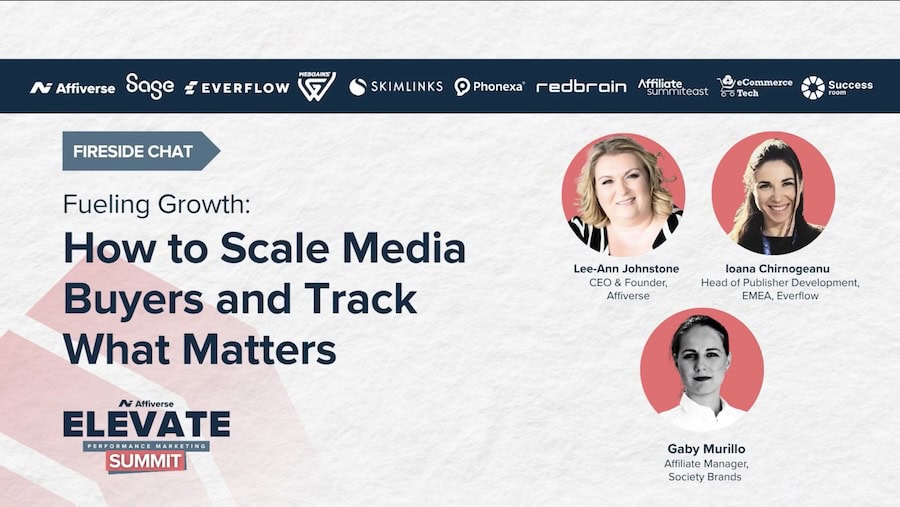
This fireside chat featured Ioana Chirnogeanu, Head of Publisher Development EMEA at Everflow, in conversation with Gaby Murillo, Affiliate Manager at Society Brands. With Gaby’s unique perspective from both sides of the equation—having previously worked as a media buyer spending $1-2 million monthly before transitioning to brand-side affiliate management—their discussion revealed the critical foundation work most brands overlook when entering media buyer partnerships.
Watch this fireside chat in full now…
The Readiness Reality Check: Why Most Brands Aren’t Prepared
The conversation opened with a stark reality check that many brands rushing into media buyer partnerships prefer to ignore. Gaby’s experience from both perspectives highlighted a fundamental issue: “When brands are thinking about starting to get media buyers, they need to make sure that they are ready, and that they have the capacity to actually manage these people.”
This readiness extends far beyond having a product to promote. The technical infrastructure requirements alone eliminate many brands from serious consideration. “You need to make sure that you have landing pages, that they are fit to pay media, because it’s not the same as what’s working for you internally and for your internal media buying team or an agency – that’s what affiliates actually need,” Gaby explained.
The demographic considerations add another layer of complexity. Native media buying, for instance, typically attracts older audiences compared to internal social media campaigns. Brands must adapt their messaging and creative approach accordingly, requiring dedicated resources and strategic thinking rather than simply repurposing existing materials.
Perhaps most critically, the technical capacity for proper tracking setup cannot be underestimated. Different media buyers require different configurations, and the partnership’s success hinges entirely on accurate data flow. As the discussion revealed, affiliates “have very little time” and “20 different companies every day reaching out” to them. They prioritise partnerships where technical setup is seamless and tracking is immediately functional.
Beyond Last-Click Thinking
The conversation delved deep into one of performance marketing’s most persistent challenges: accurate attribution and measurement. Ioana emphasised the strategic foundation required before any partnership begins: “You should have very well defined in mind what you are trying to achieve. Where are you as a brand in the funnel? What is your brand equity? What do you want to do?“
This strategic clarity becomes crucial when working with external media buyers who operate on fundamentally different margins than internal teams. Unlike in-house campaigns where brands control the full customer journey and can leverage retargeting, media buyers work with limited data sets and must optimise for immediate performance.
The quality assessment metrics revealed interesting insights into how successful partnerships actually measure success. Gaby identified two critical indicators: “chargebacks that we get, that’s very important… average order value and chargebacks, that’s what I look in to.” These metrics provide far more meaningful partnership evaluation than simple conversion rates or volume metrics.
The discussion also highlighted how different traffic sources yield varying performance characteristics. Native platforms like Taboola might deliver lower average order values but provide massive scale, while smaller native platforms could produce higher AOVs with limited volume. Understanding these nuances allows brands to set appropriate expectations and compensation structures.
The Competitive Collaboration Paradox
One of the most valuable segments addressed a concern that prevents many brands from pursuing media buyer partnerships: fear of cannibalising internal efforts. Gaby’s perspective from both sides offered reassuring clarity: “In-house media buyers have a big advantage. They have the whole data sets. And paid media, they don’t. They just get whatever you give them.”
This data asymmetry actually creates complementary rather than competitive dynamics. Internal teams can leverage the customer acquisition efforts of media buyers through retargeting and lifecycle marketing, while media buyers bring testing capabilities and audience insights that internal teams might never discover.
The relationship becomes genuinely collaborative when brands embrace transparency about what’s working internally. “Once you build that relationship with affiliates, like, guys, I can share this with you. Just use it as inspiration. These are the angles that are working for us, but then you need to come up with your own angles,” Gaby explained.
This collaborative approach often yields unexpected benefits. She shared how media buyers frequently develop winning angles that brands then implement in their internal campaigns, creating a continuous feedback loop of creative optimisation.
The Economics of Entry: Test Budgets and Sustainability
The practical reality of media buyer partnerships requires understanding the economics from both perspectives. The rising cost of media across platforms—from Google’s increasing expense to “crazy high” CPMs in native advertising—has fundamentally altered the partnership landscape.
Gaby provided specific guidance on test budget expectations: “The budget that we keep internally for testing is like three times the offer payout. And then we can do that for three days.” This formula provides a concrete framework for brands planning their partnership investments.
However, the sustainability question extends beyond initial testing. The discussion revealed how successful brands proactively share performance improvements with their media buyer partners. One brand Gaby highlighted exemplified this approach: “They come to you, like we are doing some optimisations and we managed to increase the average order value by, I don’t know, 10%, so we are going to increase your payout without us coming to them.”
This proactive approach to partnership optimisation creates the long-term relationships that both sides ultimately seek, moving beyond transactional testing toward strategic partnerships.
Three Key Takeaways for Media Buyer Partnership Success
1. Build Technical and Creative Infrastructure Before Recruitment
Successful media buyer partnerships require dedicated landing pages optimised for paid traffic, robust tracking systems, and creative assets tailored to different demographics and platforms. Brands attempting to repurpose internal marketing materials typically fail to attract serious media buyers who prioritise partnerships with immediate testing capabilities.
2. Implement Comprehensive Quality Monitoring Systems
Traditional conversion rate metrics inadequately assess media buyer partnership value. Implement monitoring for chargebacks, average order values, and customer lifecycle metrics. Use spy tools and compliance monitoring to ensure creative quality while building automated alerts for performance outliers that might indicate fraudulent traffic.
3. Embrace Proactive Partnership Optimisation
Long-term media buyer relationships require ongoing investment in partnership development. Share internal performance insights, implement partner suggestions for landing page improvements, and proactively increase payouts when backend optimisations improve unit economics. This approach creates sustainable partnerships that scale beyond initial testing phases.
The complexity of media buyer partnerships demands significant preparation and ongoing management, but the rewards justify the investment for brands willing to approach them strategically. As the discussion demonstrated, success requires treating these relationships as genuine business partnerships rather than simple traffic acquisition channels.
This analysis builds on insights from our previous ELEVATE coverage, continuing our commitment to sharing actionable intelligence from industry leaders.
If you want to learn from the people who are actually changing how affiliate marketing works, get your tickets now for ELEVATE 2026 and hear directly from the industry’s most innovative minds.
Everflow
Connect
Tradedoubler
Connect
1win Partners
Connect
Shopnomix, a Nomix Group Company
Connect
Huffson Group
Connect
Kawaii Partners
Connect
Trackdesk
Connect
Share your expertise and expand your reach and become a content contributor with us today!
Contact Us To Find Out More