X to Replace Creator Revenue Sharing With Original Content Rewards
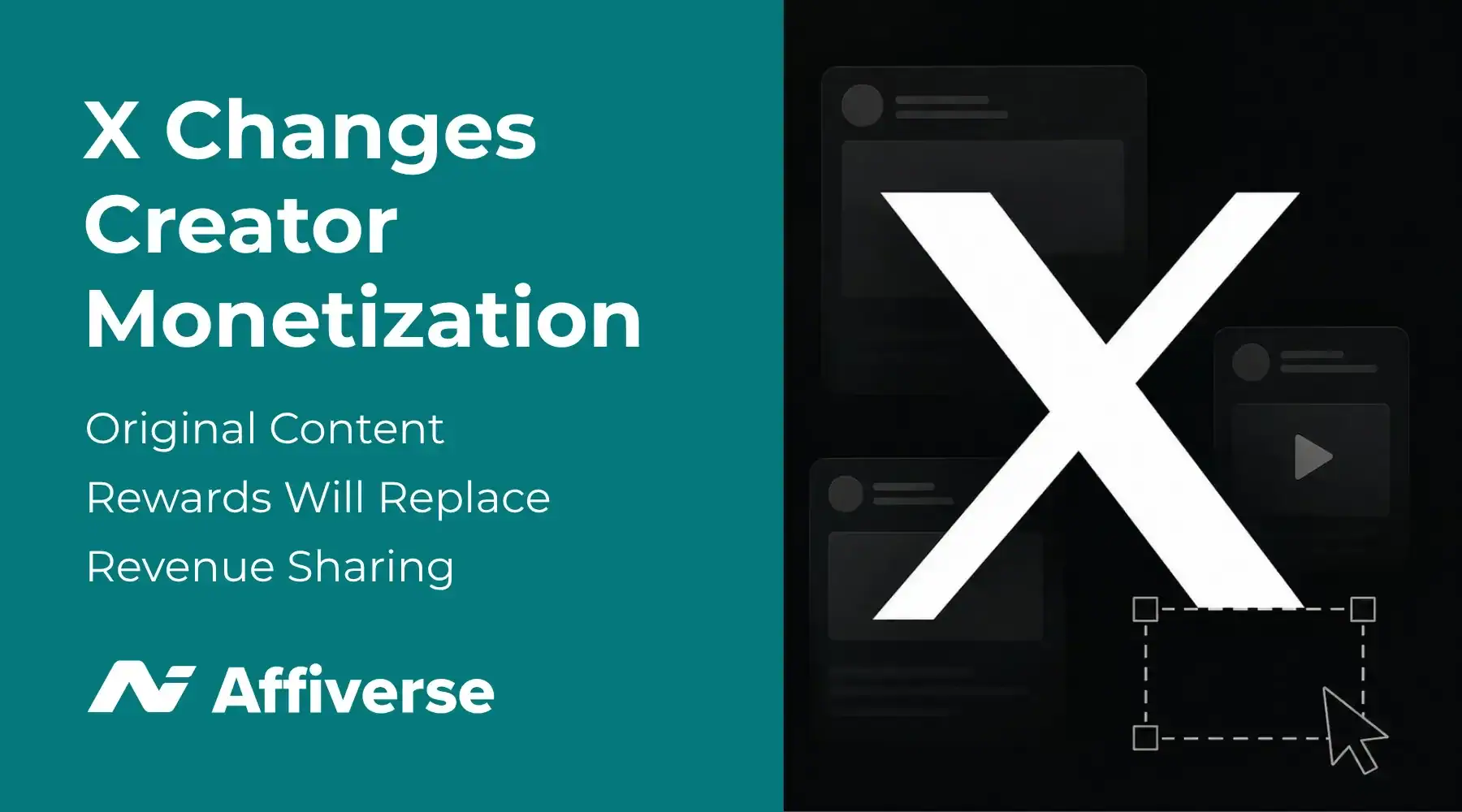
X will retire its Creator Revenue Sharing program on September 7, 2026, and begin rolling out applications for a replacement called Original Content Rewards the following day. The new program will pay eligible creators based on qualified impressions generated by content they personally produce. For affiliate marketers, the change creates another potential revenue stream alongside commissions, but it also introduces stricter rules covering originality, automation, and the impressions that qualify for payment.
Key Takeaways: X Shifts to Original Content Rewards
- X stopped accepting new Creator Revenue Sharing applications on August 7, 2026.
- Existing members can continue earning through September 7, with a final payment expected around September 11.
- Applications for Original Content Rewards will begin rolling out to existing Revenue Sharing members on September 8.
- Applicants need at least 500 verified followers and 500,000 verified-user Home Timeline impressions within the previous 90 days.
- Copied, aggregated, minimally modified, cross-platform and certain automated content will not generate qualifying impressions.
- X has not published a fixed payment rate for qualified impressions.
- Affiliates will still need to disclose commercial relationships and measure commissions separately from X payouts.
X Will Retire Creator Revenue Sharing on September 7
X stopped accepting new applications for Creator Revenue Sharing on August 7. Creators already enrolled can continue earning through September 7 and will receive final scheduled payments for the closing period.
Access to Original Content Rewards will begin rolling out on September 8. Existing Revenue Sharing members will not automatically transfer into the replacement program. They must meet the new eligibility requirements and submit a separate application through Creator Studio.
Creators who have already completed identity verification and connected a valid payment method will not need to repeat those steps. However, accounts with monetization paused because of an earlier policy violation will not initially be eligible to apply.
How Original Content Rewards Changes X Monetization
The two programs use different thresholds and definitions for monetizable activity.
| Requirement | Creator Revenue Sharing | Original Content Rewards |
|---|---|---|
| New applications | Closed from August 7 | Rollout begins September 8 |
| Impression threshold | Five million organic impressions within three months | 500,000 verified-user Home Timeline impressions within 90 days |
| Follower threshold | 500 verified followers | 500 verified followers |
| Reply impressions | Previously contributed to the program | Excluded from the application threshold |
| Content requirement | High-quality content and meaningful interaction | Content must meet X’s definition of original |
| Minimum payment | $30 | $30 |
The lower headline impression threshold does not necessarily make the new program easier to enter. Only verified-user impressions generated in the Home Timeline count toward the 500,000 requirement, while impressions on replies are excluded.
Applicants must also hold an active X Premium, Premium+ or Premium Business subscription, be at least 18 years old, live in a supported country and maintain an account in good standing. Meeting those requirements allows a creator to apply but does not guarantee admission. X says applications will normally be reviewed within three business days.
What Counts as a Qualified Impression?
Under the Original Content Rewards rules, earnings will be based on unique impressions from Premium users viewing original content in the Home Timeline. At least 50% of the post must be visible for the impression to qualify.
Repeated views of the same post from one account will not be counted more than once. Paid, promoted, fraudulent or artificially generated impressions are also excluded.
Approved creators will receive payments every two weeks, provided their accounts and content remain eligible. X has not disclosed a fixed rate per impression or explained how different content formats may affect the final payment.
X Sets a Higher Standard for Original Content
X defines original content as material personally written, filmed, designed, or produced by the creator. Posts, articles, images, and videos can all qualify.
Commentary and analysis can also be considered original when the creator adds a genuine perspective, expertise, or context. This distinction is important for affiliates because a product review, comparison, or explanation may qualify even when it discusses material produced by a merchant or another source.
Content will not qualify when the creator’s contribution is minimal or absent. X specifically excludes:
- Content copied from another creator or source
- Reuploads taken from X or another platform
- Content reproduced with only minor changes
- Aggregated material without substantial original framing
- Cross-platform reposts uploaded by someone other than the original creator
- Content created or posted using automated means
- Posts that solicit likes, replies, follows or reposts
- Misleading content or posts that receive a helpful Community Note
Content focused exclusively on monetization coaching, monetization discussions, or maximizing platform payouts is also ineligible.
X notes that qualifying as original does not establish that a creator has permission to use someone else’s intellectual property. Affiliates using merchant images, video clips or other campaign assets will still need the appropriate rights or licenses.
What Original Content Rewards Means for Affiliates
The new model could favor affiliates who publish firsthand reviews, original demonstrations, market analysis, and informed product commentary. Reposting merchant copy or adding an affiliate link to a lightly edited promotional asset is less likely to satisfy the originality standard.
The rules around automation require particular attention. X says content created or posted through automated means is ineligible, but its current documentation does not explain how this applies to standard scheduling tools or approved publishing platforms. Affiliate teams using automated social workflows should review their processes as more guidance becomes available.
Original Content Rewards may provide an additional income source, but it should not be treated as predictable revenue until creators can assess actual acceptance rates and payments. The replacement also reinforces the risk of building too much affiliate income around one social platform, as eligibility rules, account access and payout models can change with limited notice.
Commercial disclosures remain necessary. A post may meet X’s originality requirements while still failing advertising or endorsement rules. This distinction is especially important for AI-generated endorsements and affiliate links, where material connections should be disclosed clearly and conspicuously.
Affiliates in regulated sectors must also consider X’s separate advertising policies. The removal of Kalshi affiliate badges following changes to X’s gambling-promotion rules shows how platform monetization eligibility and permission to promote a particular product are separate questions.
Important Questions Remain
X has not published a standard payout formula, estimated earnings per qualified impression, or information showing how articles, images, videos, and text posts will be weighted.
The platform has also not fully explained how it will distinguish acceptable publishing tools from prohibited automated posting. These details could materially affect affiliates and publishers operating planned social calendars at scale.
Original Content Rewards may provide an additional income source, but it should not be treated as predictable revenue until creators can assess actual acceptance rates and payments. The replacement also reinforces the wider risk of building too much income around one platform, as eligibility rules and payout models can change with limited notice.
Note: This is a developing story. Affiverse will update this page as Original Content Rewards begins rolling out and X publishes further guidance on eligibility and payouts.
Everflow
Connect
Tradedoubler
Connect
1win Partners
Connect
PIN-UP Partners
Connect
Shopnomix, a Nomix Group Company
Connect
V.Partners
Connect
Huffson Group
Connect
Kawaii Partners
Connect
Share your expertise and expand your reach and become a content contributor with us today!
Contact Us To Find Out More