impact.com Shortens Overdue Payment Window for Brand Accounts
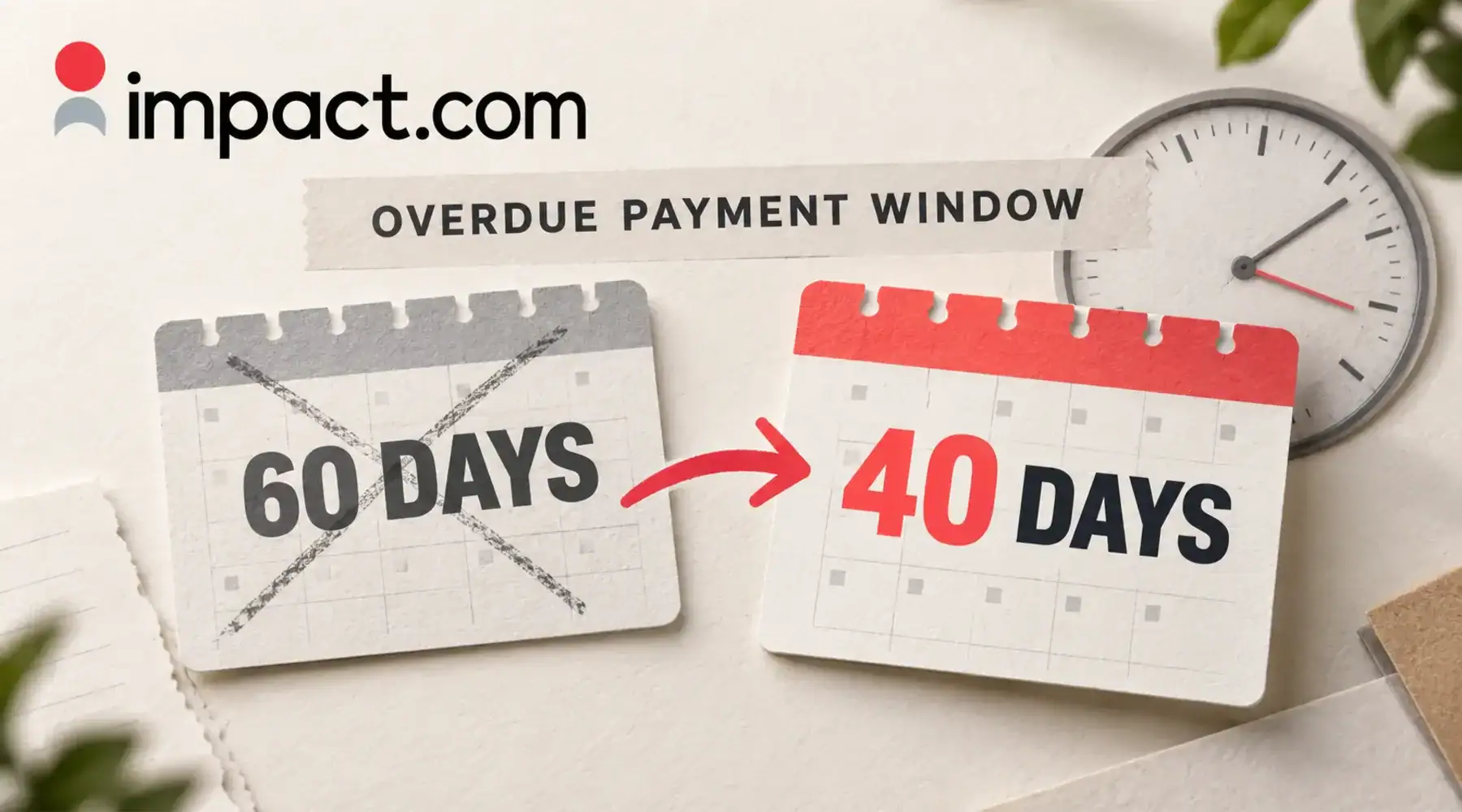
impact.com has reduced the point at which brand accounts can be suspended for overdue payments from 60 to 40 days.
The policy took effect on October 1, 2026, and applies when either impact.com platform fees or payments owed to partners remain overdue. The earlier intervention increases pressure on brands to settle outstanding balances, but it does not guarantee that affiliates will receive payment within 40 days.
Key Takeaways: impact.com Changes Its Overdue Payment Policy
- Brand accounts can now be suspended when payments are more than 40 days overdue, compared with 60 days previously.
- The policy covers overdue impact.com fees and payments owed to partners.
- Suspended brands receive limited platform access but can still deposit funds and contact support.
- Tracking, reversals, subscriptions, and FTP processes continue during suspension.
- Full access is restored once enough money has been deposited to cover the overdue balance.
- The change does not mean impact.com advances unpaid commissions or guarantees payment by day 40.
- APMA research found that 51% of publishers experienced a moderate-to-significant business impact from payment problems.
What Happens When a Brand Reaches 40 Days Overdue?
impact.com’s updated account-suspension documentation states that a brand account will be automatically suspended when impact.com fees or partner payments are more than 40 days overdue.
Suspension limits what the brand can do inside the platform:
| Restricted During Suspension | Continues Operating |
|---|---|
| General access to the impact.com platform | Affiliate-link and conversion tracking |
| Campaign and account management | Transaction reversals |
| Most routine platform activity | Subscriptions |
| FTP processes |
The brand can still log in, contact support, and add money to its funding account. Full access is restored automatically after the deposited funds have been applied and the overdue balance has been covered.
Further delays can result in the account being referred to collections or placed at risk of deactivation.
The fact that tracking continues is commercially important. A suspended advertiser may continue recording affiliate activity and generating partner costs even though its existing balance remains unpaid.
Suspension Does Not Guarantee Payment Within 40 Days
The new threshold should not be interpreted as a 40-day payment promise.
impact.com explains that partner payments pass through several stages, including transaction locking, invoicing, and the payment schedule agreed with the brand. Once a payment becomes due, the platform checks whether the advertiser has deposited enough money to cover it.
If the brand’s account does not contain sufficient funds, the partner payment is marked as overdue. impact.com does not state that it will cover the difference itself.
The platform’s finance documentation for brands also explains that impact.com fees take priority when money is added to a funding account. Remaining funds are then applied to overdue partner payments, beginning with the oldest amounts.
The policy therefore moves enforcement forward by 20 days, but payment still depends on the advertiser funding its account.
Why Earlier Enforcement Matters to Publishers
The Affiliate and Performance Marketing Alliance said the change is intended to encourage the minority of brands that do not settle invoices within 30 days to pay sooner.
Anthony Clements, impact.com UK and DACH Country Manager, said:
Delayed payments hurt creator and publisher trust.
APMA research found that 51% of publishers said payment problems had a moderate-to-significant effect on their businesses. When asked what better cash flow would allow them to do, 39% said they would increase acquisition spending, 31% would enter new markets or verticals, and 29% would create or scale content.
These findings explain why payment speed is more than an administrative issue. Affiliates may finance content, paid traffic, technology, and staff before earning the commission attached to that activity.
Affiverse previously examined these pressures when the APMA introduced its Advertiser Payments Code of Conduct. The voluntary framework calls for clearer validation periods, predictable payment processes and better communication when problems arise.
What Affiliates Should Check
Partners using impact.com should continue checking the payout schedule agreed in each advertiser contract. They should also distinguish between commissions that are still being validated, payments scheduled for a future date and balances already marked as overdue.
When a payment becomes overdue, the platform advises partners to review its status and contact the advertiser for an expected payment date.
Affiverse’s webinar on attracting and retaining affiliates through better payment experiences also explains why visibility matters alongside speed. A known delay with a clear resolution date is easier for a publisher to manage than an unexplained or repeatedly changing payment schedule.
impact.com’s revised policy gives brands 20 fewer days before platform restrictions begin. It creates an earlier enforcement point, but reliable affiliate payments will still depend on advertisers validating transactions, funding their accounts, and communicating clearly when delays occur.
Everflow
Connect
Tradedoubler
Connect
1win Partners
Connect
PIN-UP Partners
Connect
Shopnomix, a Nomix Group Company
Connect
V.Partners
Connect
Huffson Group
Connect
Kawaii Partners
Connect
Share your expertise and expand your reach and become a content contributor with us today!
Contact Us To Find Out More