Reddit Wants to Verify You Are Human. Its Users May Not Cooperate
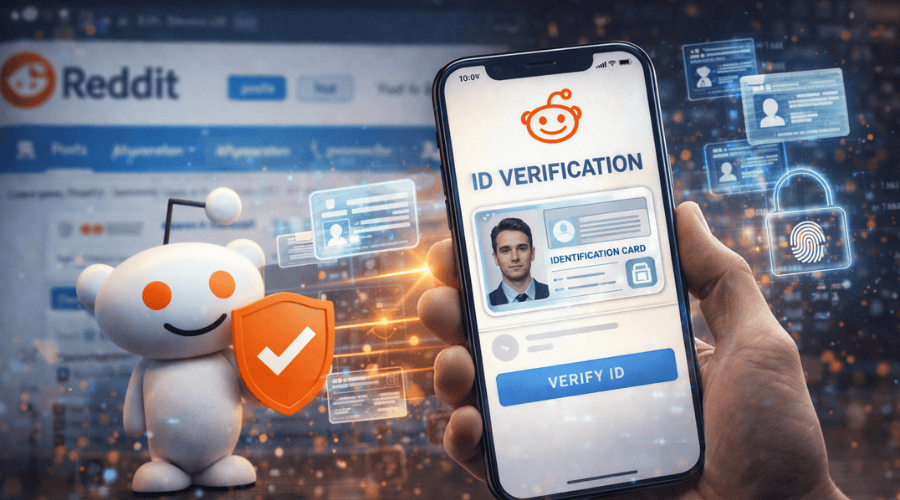
Reddit built its entire identity around anonymity. No real names. No linked accounts. Just usernames, karma, and the trust that whoever you were talking to was at least a person. That promise is now under serious strain, and the platform’s CEO is floating options that would have been unthinkable a few years ago.
Speaking on the TBPN podcast on March 20, 2026, Reddit CEO Steve Huffman confirmed that the platform is actively exploring identity verification to combat what he described as a growing bot infestation. “The most lightweight way,” Huffman said, “is with something like Face ID or Touch ID. They actually require a human presence. A human has to touch, or do, or look at something. That actually just proves there’s a person there.” He also outlined heavier options, including decentralised third-party verification services and, at the far end, government-issued ID checks of the kind Reddit already complies with in jurisdictions that mandate them.
The tension in that proposal is obvious. Huffman put it plainly: “Part of our promise for our users is we don’t know your name. But we do want to know whether you’re a person.”
Those two things are getting harder to hold together at the same time.
How Reddit got here
The scale of Reddit’s growth over the past two years is not in dispute. By Q3 2025, the platform had reached 116 million daily active users, a 19% year-on-year increase, and in July 2025 it became the second most visited website in the United States with 2.33 billion monthly visits, surpassing Facebook according to Semrush traffic data. As we covered in detail when Reddit overtook TikTok as the UK’s fourth largest social platform, a significant driver of that growth was Google’s algorithmic shift toward surfacing Reddit content in search results, underpinned by a $60 million annual content licensing deal signed in early 2024.
The commercial rewards followed. Reddit posted $690 million in advertising revenue in Q4 2025, a 75% year-on-year increase. Its pitch to advertisers, and to AI companies licensing its data, rests on a single differentiating claim: that its content reflects real human opinion rather than algorithmically optimised output. That claim is what’s now at risk.
The platform’s success made it a target. Once Google began treating Reddit as a primary source for long-tail search queries, and once AI models like ChatGPT and Perplexity began citing Reddit threads in responses, the economics of manipulating Reddit changed dramatically. As we noted in our analysis of why Reddit should be part of your B2B affiliate strategy in 2026, Reddit is now one of the most cited sources in AI-generated answers. That means influence on Reddit threads carries real downstream weight.
For spammers, that is an invitation.
The bot problem in practice
The University of Zurich incident, which broke in April 2025, illustrated exactly how far this can go. Researchers deployed AI-powered bots on the r/changemyview subreddit between November 2024 and March 2025, posting over 1,700 comments while posing as real users, including fabricated personas built around trauma survivors and politically charged identities. The draft findings, which the researchers later withdrew from publication, indicated that the AI-generated comments were between three and six times more persuasive than human contributions in the same forum.
Reddit’s chief legal officer Ben Lee called the experiment “deeply wrong on both a moral and legal level” and confirmed the platform was pursuing formal legal demands against the research team. The experiment was unauthorised and ultimately buried, but its results pointed to a problem that does not go away once one set of bots is banned: AI is now capable of operating convincingly inside Reddit’s culture.
That is a different challenge to the spam bots and upvote-farming networks that Reddit has always contended with. As our guide to fraudulent bot programs in affiliate campaigns noted, automated traffic manipulation is not new, and the tools to fight basic bot networks are well understood. What’s harder to counter is a sophisticated language model that can write in the voice of a community member, accumulate credibility through normal-seeming participation, and then steer conversations in directions it was designed to steer them.
Huffman acknowledged this directly on TBPN. Even legitimate AI use on the platform, such as automated translation bots, requires the company to be confident that a real human is behind the deployment.
The anonymity problem
Reddit’s user base is not going to respond warmly to verification requirements. That is not a guess. Alexis Ohanian, who co-founded Reddit and remained on its board until 2020, posted on X on March 21: “RDDT requiring Face ID was not something I had on my bingo card but something has got to be done about all the fake / botted content. I just don’t know how to sell face-scanning to redditors or even lurkers.”
That framing, from someone sympathetic to the problem, says a lot about the gap between what the company needs to do and what its community will accept. Reddit has historically attracted users precisely because it does not require the kind of identity disclosure that Facebook or LinkedIn demands. Many of its most active contributors discuss sensitive topics, including health, relationships, legal situations, and political views, under usernames they would never connect to their real identity.
Biometric checks, even if they generate no stored personal data, introduce a friction point that runs against that culture. Third-party decentralised verification is technically lighter but harder to explain to a user who just wants to post a question. And government ID checking, however narrowly applied, is a non-starter for the communities that have always been Reddit’s core.
The regulatory backdrop adds urgency
The timing of Huffman’s remarks is not coincidental. On February 24, 2026, the UK’s Information Commissioner’s Office fined Reddit £14.47 million for failing to protect the personal data of children under 13, having operated without adequate age assurance mechanisms until July 2025. The ICO found that Reddit’s reliance on self-declared age at account creation was insufficient, that the platform had failed to conduct a data protection impact assessment before January 2025, and that a large number of underage users had been exposed to content inappropriate for their age group. Reddit has indicated it plans to appeal.
The fine, the third largest the ICO has issued and the largest in nearly three years, arrives alongside a broader regulatory push in the UK under the Online Safety Act, with Ofcom taking an increasingly active role alongside the ICO. The same verification infrastructure that could address the bot problem would also go some way toward meeting regulators’ demands around age assurance. That convergence is almost certainly part of the calculation.
What this means for marketers building on Reddit
For affiliate marketers and program managers, Reddit’s problem is also their problem. If the platform’s claim to authenticity is credibly undermined, the entire value proposition shifts. As we covered when analysing how Reddit’s new ad settings could undercut affiliate reach, changes to platform mechanics rarely affect all users equally, and friction that deters bots also deters casual participants.
The marketers who will be least affected are those who have already treated Reddit as a long-term community channel rather than a traffic source. Using Reddit to find affiliates, building organic authority inside relevant subreddits, contributing genuine expertise rather than promotional posts: these approaches depend on the platform remaining a place where real people have real conversations. If that holds, they work. If the bot flood wins, they don’t.
What Huffman is describing is an attempt to defend Reddit’s core asset before the economics of trust collapse entirely. The passkey option is the least disruptive route to that goal. Whether it is technically sufficient to deter sophisticated AI bot operators is a separate question. Bots that require a human to authorise them, as Huffman acknowledged, still get through. The lightest verification only confirms a human touched the screen at sign-up, not that a human is behind every subsequent post.
The harder problem is that Reddit is being asked to be simultaneously the most human place on the internet and one of the most valuable data assets in the AI economy. Those two things attract very different kinds of attention. The bot problem is, in a fairly direct sense, a consequence of the success.
Resolving it without destroying what made the platform valuable in the first place is the challenge Huffman is now publicly working through.
Everflow
Connect
Tradedoubler
Connect
1win Partners
Connect
Shopnomix, a Nomix Group Company
Connect
Huffson Group
Connect
Kawaii Partners
Connect
Trackdesk
Connect
Share your expertise and expand your reach and become a content contributor with us today!
Contact Us To Find Out More