PewDiePie Launches Odysseus, a Self-Hosted AI Workspace for Privacy-First Creators
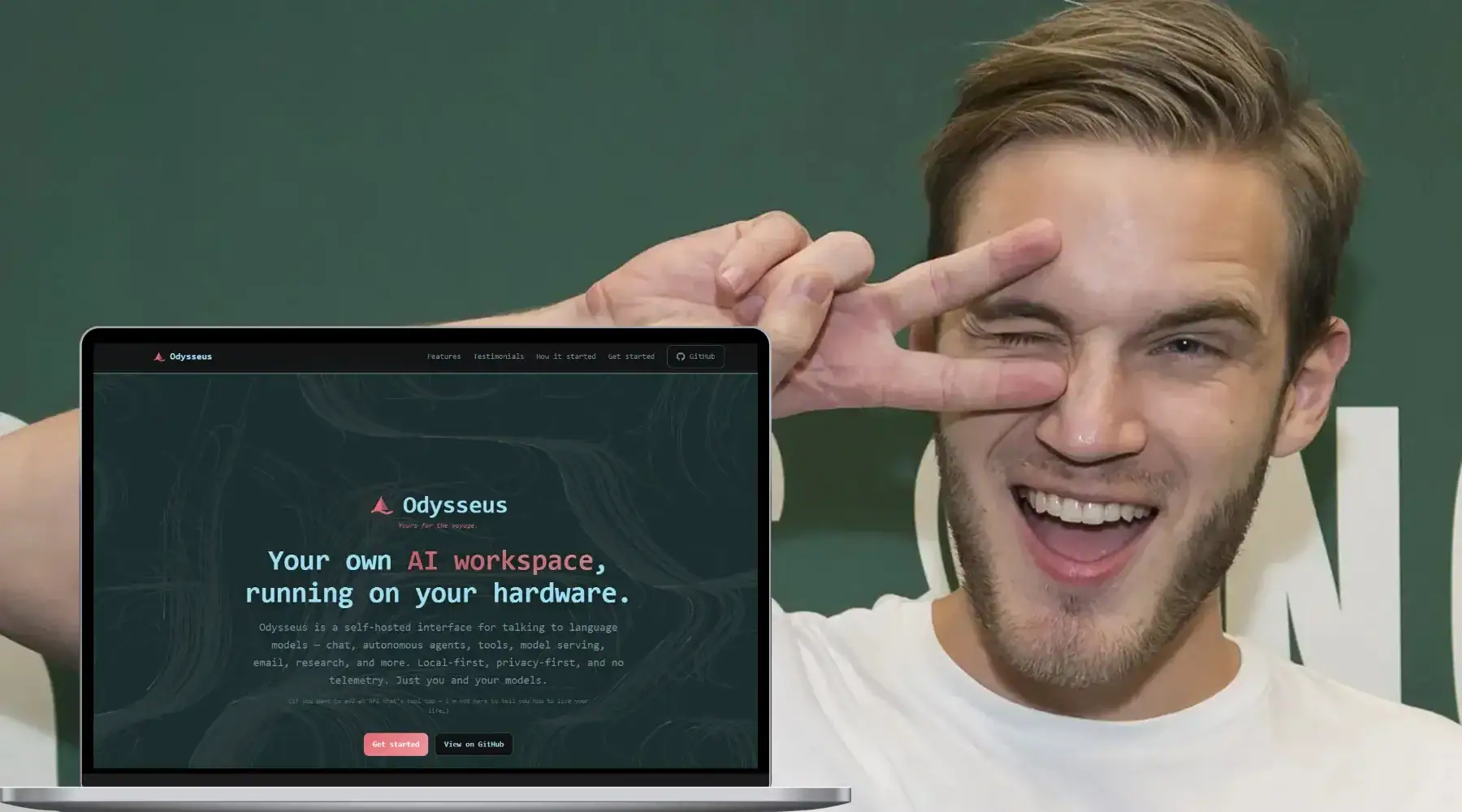
PewDiePie has launched Odysseus, a free, open-source AI workspace built for users who want to run AI tools on their own hardware. The project moves beyond a simple chatbot interface. Odysseus brings chat, autonomous agents, tools, model serving, email, research, documents, memory, and model comparison into one self-hosted workspace.
The official project page describes it as “local-first, privacy-first, and no telemetry,” with users able to run local models or connect external APIs when needed. For creators, publishers, and affiliate teams, the launch lands at a familiar pressure point. AI now touches research, content planning, competitor checks, email drafting, briefs, and workflow automation. Most of those tasks still run through third-party cloud tools. Odysseus takes a different route. Your machine. Your models. Your setup.
Key Takeaways: Odysseus Puts AI Control Back in the User’s Hands
- PewDiePie has launched Odysseus, a free, open-source, self-hosted AI workspace.
- The platform runs on users’ own hardware, with optional external API connections.
- Features include chat, agents, research, email support, model comparison, documents, memory, and local model management.
- For creators and affiliate teams, Odysseus points to rising interest in private, owned AI workflows instead of fully cloud-based subscription stacks.
What Is Odysseus?
Odysseus gives users a self-hosted interface for working with language models. The platform supports chat, autonomous agents, built-in tools, model serving, email, research, and more, according to the official project page. That makes it closer to a full AI workspace than a single-purpose assistant.
Users can talk to local models, connect endpoints, run agents, manage documents, compare outputs, and build persistent memory across conversations. The project also puts privacy near the front of its pitch. Odysseus runs on the user’s machine and against the endpoints they choose. The official page says it has no telemetry and supports optional external integrations when users decide to add them. The GitHub repository lists Odysseus as a self-hosted AI workspace and shows the project under an MIT license, placing it in the same broader conversation as other open-source AI tools entering creator and marketer workflows.
What Features Does Odysseus Include?
Odysseus covers a wide feature set, but the core idea stays fairly simple: bring AI tasks into one private workspace.
The platform includes:
- Chat and autonomous agents: Users can run multi-turn chats and use agents that plan tasks, call tools, and work through steps.
- Built-in tools: Odysseus supports tools for bash, files, web access, and memory, along with MCP server connections that users can switch on or off.
- Cookbook model recommendations: Cookbook gives hardware-aware model suggestions and supports one-click serving across more than 270 catalogued models. For users experimenting with local AI, that can reduce some of the guesswork around which model their machine can handle.
- Email assistant: The platform can summarize emails, draft replies, auto-tag messages, and help triage spam over IMAP/SMTP.
- Deep Research: Odysseus can gather and read sources before producing a written report.
- Model comparison: The Compare feature lets users send one prompt to several models and review the answers side by side.
- Workspace tools: The platform also includes documents, notes, tasks, memory, image galleries, and themes.
It’s a lot. Maybe too much for casual users. But for AI power users, the appeal is clear: fewer separate tools, more control, and less dependence on one cloud platform. That same shift toward practical, task-based AI can also be seen in tools such as Google Pomelli, which packages AI around marketing workflows for smaller teams.
Why This Matters for Creators and Affiliate Teams
Creators and affiliate teams already use AI in daily work. They use it to draft content ideas, summarize research, prepare briefs, review competitor pages, plan campaigns, write emails, and organize documents. This shift is already visible among smaller businesses too, with recent research showing that small businesses now use AI as part of everyday social media production. For small teams, AI often acts like an extra pair of hands, especially when there’s no dedicated research, strategy, or production support.
But those workflows usually sit inside cloud-based SaaS products. Prompts, files, internal notes, campaign plans, and drafts pass through third-party systems. For most teams, that trade-off feels acceptable because the tools work quickly and require little setup. Odysseus appeals to a different type of user.
A creator with technical confidence may want to keep long-term memory, documents, research, and private project data closer to home. A small publisher may want to test local AI without adding another monthly subscription. An affiliate team working with sensitive campaign notes may want more say over where its internal knowledge lives.
That doesn’t make Odysseus a plug-and-play replacement for mainstream AI tools. Setup still matters. Hardware matters too. Local models can vary in quality, and teams may still need external APIs for stronger performance or specific tasks. Still, the direction feels relevant. AI workflows are starting to look less like one chatbot tab and more like an operating layer for content, research, planning, and communication.
A Creator-Led Challenge to AI Subscription Stacks
PewDiePie announced the launch through a YouTube video titled “MY trillion $Dollar Project is finally OUT!”, published on May 31, 2026. In the video, he positioned Odysseus as an alternative to major AI platforms and cloud-based AI subscriptions. That framing fits into a wider conversation around paid platform tools, including Meta’s paid Plus plans for Instagram, Facebook and WhatsApp. But it needs some restraint.
Odysseus doesn’t need to “beat” ChatGPT, Claude, Gemini, or other mainstream tools to become interesting. It serves another lane: users who want to own more of the workspace around their AI use.
For PewDiePie, the move also shows how creator-led projects can stretch beyond content, merch, subscriptions, and courses. This is workflow software. It’s technical. It asks more from users than a standard SaaS product, but it also gives them more room to shape the system around their own habits. Creators and independent operators don’t just want more AI output. Some want more control over the machine producing it.
Affiverse Take: AI Workflows Are Moving Closer to Ownership
Odysseus probably won’t become the default AI tool for everyday marketers overnight. It asks users to care about hosting, models, hardware, endpoints, and maintenance. Plenty of teams won’t want that burden. But the launch still says something useful about where AI workflows are heading.
Creators and small teams now build real operating systems around AI: saved prompts, research files, writing workflows, internal notes, campaign documents, email habits, and memory. For affiliate teams already testing AI tools for affiliate marketing, that stack can quickly become part of how daily work gets planned, produced, and reviewed. Once that stack becomes central to daily work, ownership starts to matter.
PewDiePie’s Odysseus puts that question in plain view. Who owns the workspace: the platform or the person using it?
Everflow
Connect
Tradedoubler
Connect
1win Partners
Connect
Shopnomix, a Nomix Group Company
Connect
Huffson Group
Connect
Kawaii Partners
Connect
Trackdesk
Connect
Share your expertise and expand your reach and become a content contributor with us today!
Contact Us To Find Out More