Adobe Study Shows Small Businesses Are Using AI to Scale Social Content
Small businesses now use AI as part of everyday social media production, according to Adobe’s study on how small businesses maximize ROI with AI tools.
The study found that 38% of surveyed small business owners use AI for social media content creation, making it the leading use case in the report. Another 28% use AI for social advertising, pointing to a practical shift in how smaller brands produce, test, and publish campaign assets.
This doesn’t read like casual experimentation. For many small businesses, AI now supports the work that eats up hours every week: writing posts, creating visuals, adapting creative formats, and keeping feeds active across multiple platforms.
Key Takeaways: AI Is Moving Into Small Business Social Workflows
- AI has become a practical social content tool for small businesses, with 38% of surveyed owners using it for social media content creation.
- Social advertising has also entered the AI workflow, with 28% using AI to support paid social campaigns.
- Visual output remains a major use case, as 40% use AI to improve creative quality and 52% say AI imagery has improved engagement metrics.
- For affiliates and creators, speed matters most, as AI helps smaller brands produce more campaign variations, repurpose assets, and test content faster.
- Adobe’s findings should be framed carefully, since the research comes from Adobe’s Firefly team and relies on self-reported small business responses.
Social Content Is Becoming a Leading AI Use Case
Social media punishes slow creative teams. Small businesses feel that pressure more sharply because they rarely have large design teams, paid media departments, or agency support. Adobe’s study suggests AI has started to fill that gap.
| How Small Businesses Use AI for Social Content | Finding |
|---|---|
| Social media content creation | 38% |
| Social advertising | 28% |
| Estimated annual time saved | 175 hours |
That moves AI beyond experimentation and into campaign production. It helps smaller brands create more posts, test more ideas, and adapt assets without starting from scratch every time. A small brand can now produce several visual concepts for one campaign, rewrite captions for different audiences, resize assets for platform-specific placements, and adjust tone across channels. The result: faster cycles between idea, asset, post, and performance readout.
That puts Adobe’s findings close to the same SME automation trend Affiverse covered when Google introduced an AI marketing tool designed to help small and medium-sized businesses generate campaign assets from a website URL. The time-saving figure needs some care. Adobe’s 175-hour estimate should be treated as a directional signal rather than a universal benchmark. Still, it gives the report a clear commercial hook: AI saves time in places where small businesses usually run thin.
AI Visuals Are Helping Small Brands Compete for Engagement
The report also points to visual quality as a major reason small businesses turn to AI. According to Adobe’s study, 40% of surveyed small business owners use AI to improve visual or creative output, while 52% said AI-generated imagery improved social media engagement metrics.
The engagement gains were spread across several areas:
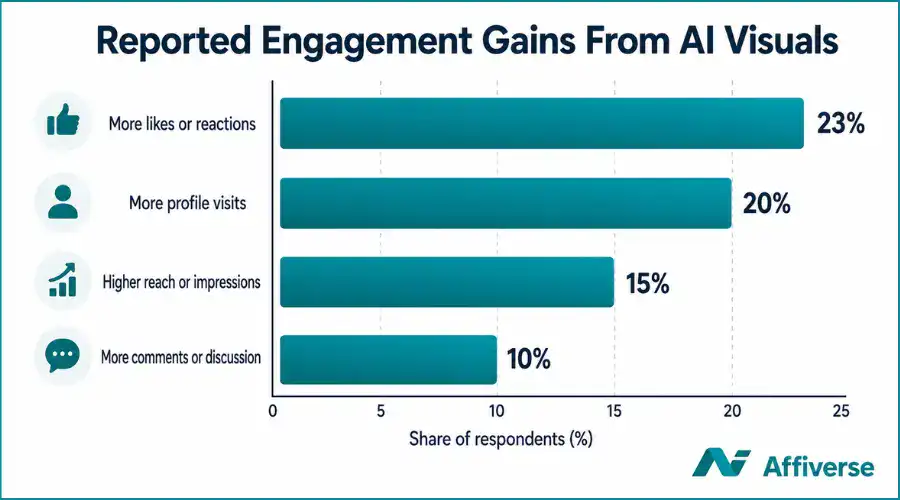
Those findings need careful framing. They come from Adobe’s Firefly research, and Adobe sells AI creative tools. The figures also reflect what small business owners reported, rather than independent platform performance data. Still, the pattern makes sense. Better visuals can help smaller brands look more polished in crowded feeds. AI gives them a way to produce more creative variations without waiting on design bottlenecks or spending heavily on external support.
The platform-level results also show where small businesses noticed the strongest impact:
- Facebook: 51%
- Instagram: 30%
- Business websites and blogs: 24%
That split feels telling. Facebook may no longer carry the same cultural shine as newer social platforms, but small businesses still rely on it for local reach, customer updates, and paid promotion. AI-assisted creative gives those businesses more material to work with.
What This Means for Creators and Affiliate Marketers
For creators, affiliates, and partner marketers, the Adobe study points to a more competitive creative environment. The main shift is speed: small businesses can now create, adapt, and test more campaign assets without relying on a full creative team.
- Small brands can behave more like media brands: AI gives smaller businesses a way to produce regular visuals, repurpose posts, and test campaign angles faster. That raises the creative baseline for everyone competing in the same feed.
- Creators may need to prove value beyond content production: If a brand can create polished product images, social graphics, and campaign variations in-house, it may become more selective about creator partnerships. Audience trust, original ideas, distribution, and measurable response become harder to ignore.
- Creator assets can stretch across more campaign formats: A single creator campaign can now feed paid social variations, email visuals, landing page graphics, product explainers, and seasonal edits. That gives partner managers more ways to extend campaign value without asking creators to produce every asset from scratch.
- Affiliates may face faster creative cycles: Brands that move faster with AI may expect partners to respond faster as well. More creative tests. More landing page variants. More campaign refreshes tied to seasonal events, platform trends, and audience segments.
The same pressure already shows up in faceless affiliate marketing, where content quality, speed, and platform fit often matter more than a visible personal brand. It also explains why more teams are testing AI tools for affiliate marketing across content creation, campaign planning, and partner workflows. Creative speed is becoming part of the commercial conversation.
AI Is Becoming Part of Everyday Small Business Marketing
Adobe’s report shows AI settling into the practical side of small business marketing. Social content takes time, and small businesses don’t usually have much of it. AI gives them a way to fill the gap. The bigger question for the affiliate and creator economy isn’t whether AI replaces people. That framing misses the point.
The sharper question is how AI changes the handoff between brands, creators, affiliates, and agencies. A creator may provide the original idea. A brand may use AI to adapt it. An affiliate may test it across landing pages or paid social. An agency may package the results into a wider campaign. Same campaign. More versions. Faster pressure.
Everflow
Connect
Tradedoubler
Connect
1win Partners
Connect
Shopnomix, a Nomix Group Company
Connect
Huffson Group
Connect
Kawaii Partners
Connect
Trackdesk
Connect
Share your expertise and expand your reach and become a content contributor with us today!
Contact Us To Find Out More