Hotel Affiliate Marketing in 2026: Programs, Compliance, and Monitoring

Hotel affiliate marketing connects hotels and booking platforms with publishers or creators who earn commissions for qualifying referrals, usually hotel bookings. A hotel affiliate program needs clear payment terms, reliable booking validation, and checks on how partners advertise rooms. This guide explains how affiliate marketing in the hotel industry works in 2026, how to compare programs, and what hotel affiliate compliance and monitoring should cover.
- How Hotel Affiliate Marketing Works
- Hotel Affiliate Programs to Review in 2026
- Direct Hotel Programs and OTA Affiliate Programs
- From Referral to Booking and Completed Stay
- Where to Find Hotel Chain Affiliate Contacts
- How to Choose a Hotel Affiliate Network
- Hotel Affiliate Compliance and Brand Protection
- Affiliate Disclosures and Gifted Hotel Stays
- Rate and Fee Transparency
- Paid Search and Third-Party Booking Identity
- Privacy and Tracking Controls
- Hotel Affiliate Monitoring and Reporting
- How to Launch or Improve a Hotel Affiliate Program
- 1. Define Goals, Budget, and Responsibilities
- 2. Set Commission and Validation Rules
- 3. Configure and Test the Booking Journey
- 4. Recruit and Onboard Suitable Partners
- 5. Run a Pilot and Review Performance
- How to Measure Hotel Affiliate Marketing Performance
- Build Hotel Affiliate Partnerships With Clear Terms
- Hotel Affiliate Marketing FAQs
How Hotel Affiliate Marketing Works
Hotels and booking platforms work with travel websites, bloggers, and creators to attract guests. These partners, known as hotel affiliates, share tracked links and can earn a commission when their referrals lead to qualifying bookings.
The hotel or booking platform sets the program’s rules, including the commission rate, which bookings qualify, and when affiliates are paid. An affiliate network or tracking platform may provide the links, record referrals, and manage reporting and payments.
Affiverse’s guide to how affiliate links work explains how a booking is connected to the partner who referred the guest.
Hotel Affiliate Programs to Review in 2026
The following examples show different routes into hotel affiliate marketing. They are useful comparisons rather than a ranking of potential earnings.
| Program | Referral route | Public payment information | Booking window |
|---|---|---|---|
| Marriott | Hotel group through Partnerize | Completed qualifying stays; commissions use the net base sales amount. Rate shown in the affiliate console. | Seven days |
| IHG PartnerConnect | Hotel group through CJ | Percentage of room revenue after the guest completes the stay. Confirm the current rate and exclusions. | 14-day lookback |
| Expedia Group Creator Program | Participating OTA brands | Public standard hotel commission of 4% of net transaction value, subject to qualifying completed transactions. | Seven days |
| Booking.com | Awin or CJ according to region | Confirm the commission basis, eligible transactions, and payment conditions in the applicable network offer. | Check the regional offer |
Program information checked October 14, 2026. Eligibility, permitted traffic, and terms can differ by route and market. Expedia’s listed rate applies to the named program; other commercial agreements may differ.
A longer attribution window is useful only if the offer also suits the audience. Compare destination coverage, booking experience, cancellation treatment, and completed-stay earnings before choosing a program.
Direct Hotel Programs and OTA Affiliate Programs
The main differences are where the guest books and which affiliate agreement applies.
Direct hotel programs
- Affiliates send visitors to the hotel’s or hotel group’s booking website.
- The hotel’s affiliate agreement sets commission rates, qualifying bookings, and payment conditions.
- The hotel’s booking process identifies the contact for guest support, changes, and cancellations.
OTA affiliate programs
- Affiliates send visitors to an online travel agency (OTA), where the reservation is made.
- The OTA’s affiliate agreement sets commission rates, qualifying bookings, and payment conditions.
- The booking confirmation and platform’s terms should explain who handles support, changes, and cancellations.
The hotel’s commercial relationship with the OTA is separate from the publisher’s affiliate agreement. Joining an OTA affiliate program does not automatically create a direct partnership with each hotel listed on the platform.
From Referral to Booking and Completed Stay
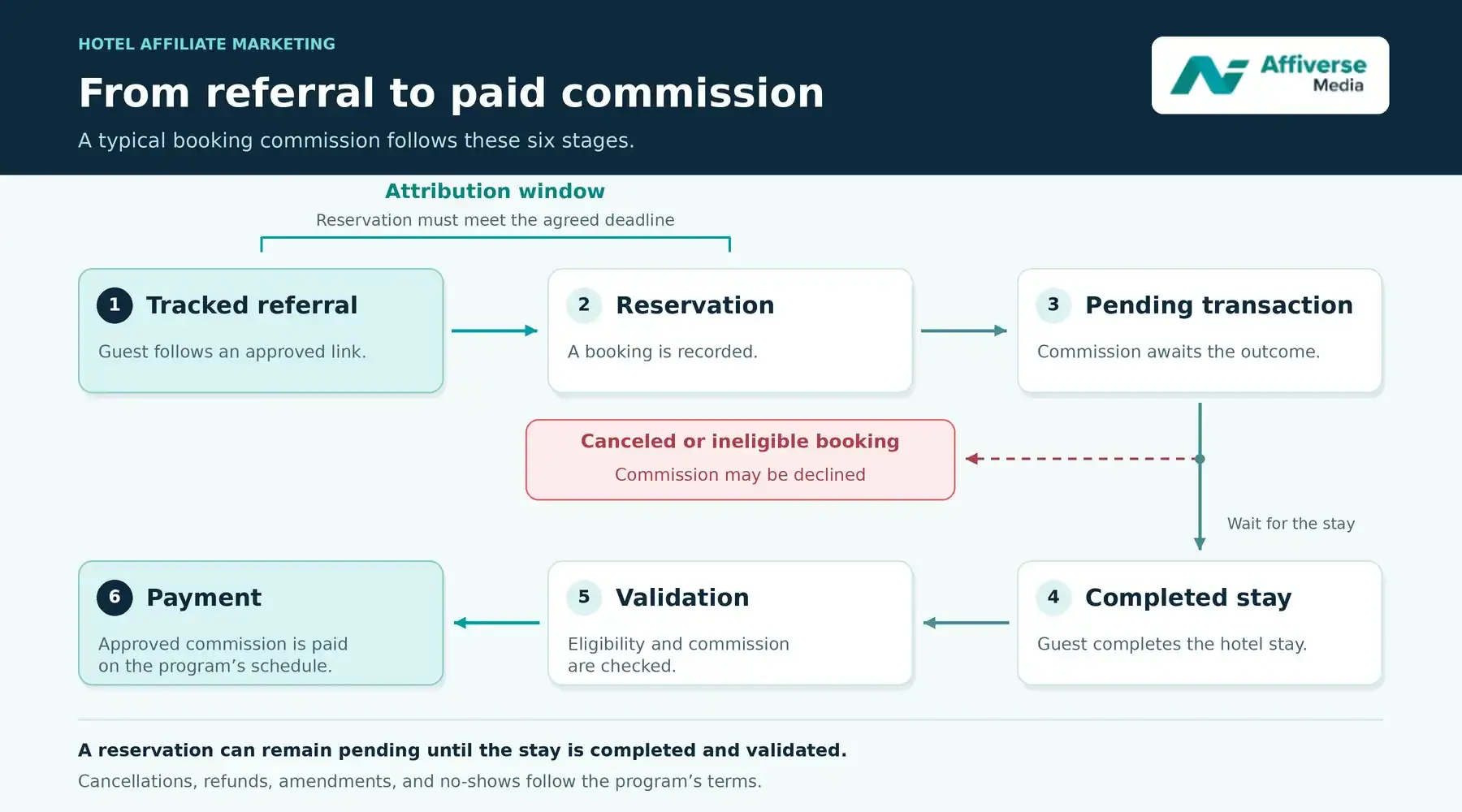
A typical booking commission moves through several stages: tracked referral, reservation, pending transaction, completed stay, validation, and payment.
The attribution window determines how soon an eligible booking must be made after the referral. It is different from the time until check-in or payout. A guest might reserve months ahead, leaving the commission pending until the trip is completed.
Read the agreement for cancellations, refunds, amended reservations, and no-shows. A dashboard booking total can include transactions that will never become payable commissions.
Where to Find Hotel Chain Affiliate Contacts
To find the right contact, check the hotel chain’s official website and look for information about affiliate programs or publisher partnerships.
- Use specific search queries. Search for “[hotel chain name] affiliate program” or “[hotel chain name] publisher partnerships.”
- Follow the official application route. If the chain directs applicants to an affiliate network, check its program listing for application instructions, eligible markets, and contact options.
- Ask who manages publisher partnerships. If you cannot find an affiliate page, use the official contact form to ask whether the chain accepts affiliate referrals and which team handles applications.
Check that the contact handles affiliate referrals. Hotel chain corporate partnerships may cover business travel or group bookings, while travel-agent commission schemes can have separate eligibility requirements.
How to Choose a Hotel Affiliate Network
The right hotel affiliate network depends on whether you manage a program or promote hotel offers. Check the services, program access, and payment terms relevant to your role.
For Affiliate Managers
- Check booking integration. Can the network connect referrals to the booking engine and receive reliable updates for amended reservations, cancellations, and completed stays?
- Assess the publisher base. Look for travel publishers and creators whose audiences match your target guests. Ask how the network helps you find and recruit suitable partners.
- Review reporting and validation. Check whether you can distinguish pending bookings from approved commissions, investigate attribution issues, and reconcile transactions with booking records.
- Compare costs and payment handling. Review setup and ongoing fees, supported currencies, payment schedules, and who handles affiliate payouts.
- Confirm responsibilities and support. Establish who maintains tracking, validates stays, monitors partner activity, and resolves disputes. Confirm which services the provider includes and what your team must manage.
For Publishers and Creators
- Check the available hotel programs. Look for offers that match your audience’s destinations, budgets, and travel interests. Confirm which properties and markets qualify.
- Review approval and promotional rules. Joining a network does not guarantee acceptance into every hotel’s program. Check each advertiser’s application requirements and permitted traffic sources.
- Understand attribution and commissions. Check the referral window, which bookings qualify, and how commission is calculated. Confirm whether different booking types or promotional methods have different terms.
- Check validation and payment conditions. Find out when commissions become approved, how cancellations or booking changes affect earnings, and whether payout thresholds apply.
- Assess tools and support. Review the available links, reporting, and promotional materials. Confirm who can help with tracking problems, missing transactions, and payment questions.
Hotel Affiliate Compliance and Brand Protection
Hotel affiliate compliance covers program rules and the advertising, pricing, and privacy requirements that apply in each market. Publishers should understand these requirements, while affiliate managers should provide clear instructions and check partner activity.
Affiliate Disclosures and Gifted Hotel Stays
Under US FTC guidance, unexpected connections that could affect an endorsement’s credibility should be disclosed clearly and conspicuously. These can include affiliate commissions, paid promotions, and complimentary stays.
Place disclosures close to the recommendation and explain that you can earn commission. The phrase “affiliate link” alone may be unclear. An illustrative disclosure covering both a gifted stay and commission is: “This hotel provided my stay. I earn a commission from eligible bookings made through these links.”
Rate and Fee Transparency
The US FTC’s lodging pricing guidance requires known, calculable mandatory fees to be included in the upfront total. Display that total more prominently than other prices, except the final payable amount.
Government taxes and optional extras may be excluded upfront. Explain excluded charges, including their purpose and amounts, and disclose the final payable amount before requesting payment. Show that amount at least as prominently as the upfront total. Check dates, occupancy, and cancellation conditions too.
Paid Search and Third-Party Booking Identity
Confirm the program’s rules for brand bidding, trademarks, domains, coupon claims, images, and sub-affiliates.
Ads and landing pages should make clear whether guests book with the hotel or a third-party seller. Explain who handles payments, booking changes, and refunds.
Affiverse’s coverage of possible FTC action over Priceline’s affiliate hotel advertising explores third-party seller oversight in a B2B distribution relationship. That arrangement differs from a publisher referral program; allegations do not establish liability.
Privacy and Tracking Controls
Review what information each tracking tool collects, who receives it, and which consent requirements or exceptions apply.
Moving processing to a server does not automatically remove privacy obligations. The UK ICO’s tracking guidance explains how the rules apply.
Hotel Affiliate Monitoring and Reporting
Hotel affiliate monitoring should connect commercial reporting with checks on partner advertising and the guest experience. High booking volume deserves scrutiny if the same partner generates repeated complaints about identity, fees, or support.
Begin by recording approved domains, promotional channels, relevant accounts, and any permitted sub-affiliate distribution. Assign someone to investigate alerts rather than leaving responsibility with an unnamed team.
The following schedule is a suggested starting point. Adapt it to campaign activity, staffing, and previous issues.
| Check | Evidence to retain | Suggested review | Responsible role |
|---|---|---|---|
| Ads and seller identity | Ad copy, destination URL, landing page | Onboarding and campaign changes | Affiliate manager |
| Prices and booking conditions | Displayed total, offer details, cancellation terms | Offer changes and regular sampling | Manager and revenue team |
| Disclosures and hotel claims | Approved content and disclosure placement | Before paid posts and periodic checks | Content or compliance lead |
| Links and tracking | Mobile checks, referral records, booking-status tests | Launch and site changes | Technical owner |
| Sub-affiliates and traffic | Approved domains and disclosed distribution partners | Onboarding and source changes | Affiliate manager |
| Booking quality and complaints | Completed stays, reversals, complaint patterns | Weekly triage and monthly review | Manager and support team |
Automation can help identify broken links, expired offers, and unusual traffic patterns. Human review is still useful when an ad’s wording or a booking site’s identity could confuse a guest.
For practical checks on partner vetting and suspicious traffic, see Affiverse’s webinar on preventing affiliate fraud.
Resolving Affiliate Compliance Issues
Record the partner, URL, date, finding, and supporting evidence. Explain the required correction, assign a deadline appropriate to the issue, and verify the result.
Serious or repeated problems may justify pausing affected activity or ending a relationship under the agreement. Any commission adjustment should follow the actual terms. Keep a record of the response and resolution so recurring problems can be identified.
How to Launch or Improve a Hotel Affiliate Program
For affiliate managers, a successful launch starts with clear objectives, workable commercial terms, and reliable tracking. Begin with a manageable partner group, review completed-stay results, and expand when the team can support the program.
1. Define Goals, Budget, and Responsibilities
Decide what the program should achieve, such as attracting guests from new markets, generating direct bookings, or filling selected dates. Set measurable targets and identify who manages recruitment, tracking, validation, and partner support.
Include commissions, network fees, software, creator production fees, and program management in the budget. Commission alone does not describe the full acquisition cost.
For an existing program, use current results to identify the main problem before changing rates or recruiting more partners.
2. Set Commission and Validation Rules
Document eligible revenue, commission rates, attribution windows, excluded booking types, cancellations, refunds, validation periods, and payment schedules. Explain permitted promotional methods and make the terms available before partners invest in campaigns.
Define the calculation basis clearly. In a hypothetical program paying 5% of eligible room revenue, a qualifying completed stay generating $500 in eligible revenue would earn $25 in commission.
Longer stays can increase commission when they generate more eligible revenue. Repeat bookings must still meet the agreement’s attribution and eligibility rules.
Managers can also test seasonal incentives or higher rates for qualifying completed-stay volume. Define eligible stay dates, thresholds, duration, and payment conditions in advance, and check that the incentive fits the program budget.
3. Configure and Test the Booking Journey
Connect referral tracking to the booking system and test links on mobile and desktop. Confirm that visitors reach the intended property or destination and that qualifying reservations appear correctly in reporting.
Use agreed test transactions to check booking amendments, cancellations, and completed-stay updates. Confirm how duplicate records are handled and which system determines payable commission.
Resolve discrepancies before partners begin promoting, and assign responsibility for ongoing tracking checks.
4. Recruit and Onboard Suitable Partners
Choose publishers and creators whose audiences match the hotel’s location and guest profile. Assess audience geography, content quality, booking intent, and promotional methods.
Our podcast on the five-step flywheel for affiliate partnerships covers relevant outreach and tailored onboarding.
Supply approved images, room information, amenities, accessibility details, offer conditions, and a contact for factual questions. Explain how to create links, read reports, and raise commission queries.
Where practical, arrange property tours, staff interviews, or approved experiences that help creators produce original content. Agree filming permissions, factual checks, and image or video usage rights before publication.
For creators, consider whether a production fee alongside booking commission suits the work involved. Affiverse’s analysis of travel creators and trackable bookings discusses these compensation and measurement questions.
5. Run a Pilot and Review Performance
Start with a small partner group and review tracked bookings, completed stays, cancellations, approved commissions, and total program costs. Allow for the delay between reservation and completed stay when judging results.
Ask partners about broken links, outdated offers, reporting problems, and booking barriers. Use those findings to improve content, support, and commercial terms before expanding.
Continue reviewing partner activity and paying approved commissions on schedule. Our podcast on building smarter affiliate programs explores partner management and measured program growth.
How to Measure Hotel Affiliate Marketing Performance
Report clicks, reservations, completed stays, approved commissions, and paid commissions separately. Each answers a different operational question.
Useful measures include:
- Cancellation and reversal rates: Track canceled reservations and reversed commissions separately, with reasons recorded where available.
- Eligible net revenue and stay value: Revenue that remains after the program’s exclusions and booking adjustments.
- Total acquisition cost: Track all channel costs, and divide them by eligible completed bookings to calculate cost per booking.
- Guest complaints by partner: Patterns involving unexpected fees, booking identity, changes, or support.
Publishers should also assess earnings per click using confirmed commission and a consistent click cohort. State whether figures are per click or per 100 clicks. Affiverse’s guide to essential affiliate performance metrics explains the broader measures.
Allow for the gap between reservation and travel dates when comparing partners. Assisted-conversion analysis can inform content decisions, but commission credit follows the agreed attribution rules. Attributed bookings alone do not prove that every reservation was an additional sale the hotel would otherwise have missed.
Build Hotel Affiliate Partnerships With Clear Terms
Hotel affiliate marketing works best when partners understand what qualifies for commission and have accurate information to promote. Publishers and creators should choose offers that fit their audiences, while affiliate managers should provide clear terms, reliable tracking, and ongoing support.
Measure results through qualifying completed stays, approved commissions, and program costs. Keep reviewing content accuracy and partner activity as the program grows.
Hotel Affiliate Marketing FAQs
What Is a Hotel Affiliate and How Does the Program Work?
A hotel affiliate refers potential guests through approved links or another agreed tracking method. The hotel or booking platform pays a commission when the referral meets its program conditions. Depending on the arrangement, payment may require an eligible reservation, a completed stay, and transaction validation.
How Much Do Hotel Affiliate Programs Pay?
There is no single industry rate. Payment depends on the advertiser, booking route, eligible revenue, and agreement. Expedia Group’s Creator Program publicly lists a standard 4% hotel commission, while Marriott shows its rate in the affiliate console. Compare confirmed earnings and exclusions alongside the percentage.
Can an Independent Hotel Run an Affiliate Program?
Yes, provided it can track referrals, validate booking outcomes, support partners, and pay agreed commissions. An independent hotel can assess networks, agencies, or tracking software according to its budget and booking system. A small pilot helps establish whether the team can manage the workload and channel costs.
Are Canceled Hotel Bookings Commissionable?
For completed-stay programs, canceled reservations generally do not qualify. Marriott explicitly states that canceled hotel reservations earn no commission. Other programs’ treatment of amendments, refunds, and no-shows should be checked in their terms. A pending transaction in a dashboard should not be treated as confirmed income.
What Should Hotel Affiliate Monitoring Include?
Monitor approved traffic sources, ads, landing pages, disclosures, hotel claims, offer validity, booking conditions, and tracking. Connect those checks with completed stays, commission reversals, and guest complaints. Assign owners to investigate issues and retain a record of corrections so repeated problems can be addressed.
Everflow
Connect
Tradedoubler
Connect
1win Partners
Connect
Shopnomix, a Nomix Group Company
Connect
Huffson Group
Connect
Kawaii Partners
Connect
Trackdesk
Connect
Share your expertise and expand your reach and become a content contributor with us today!
Contact Us To Find Out More