EU Proposes New Disclosure Rules for Influencer Marketing
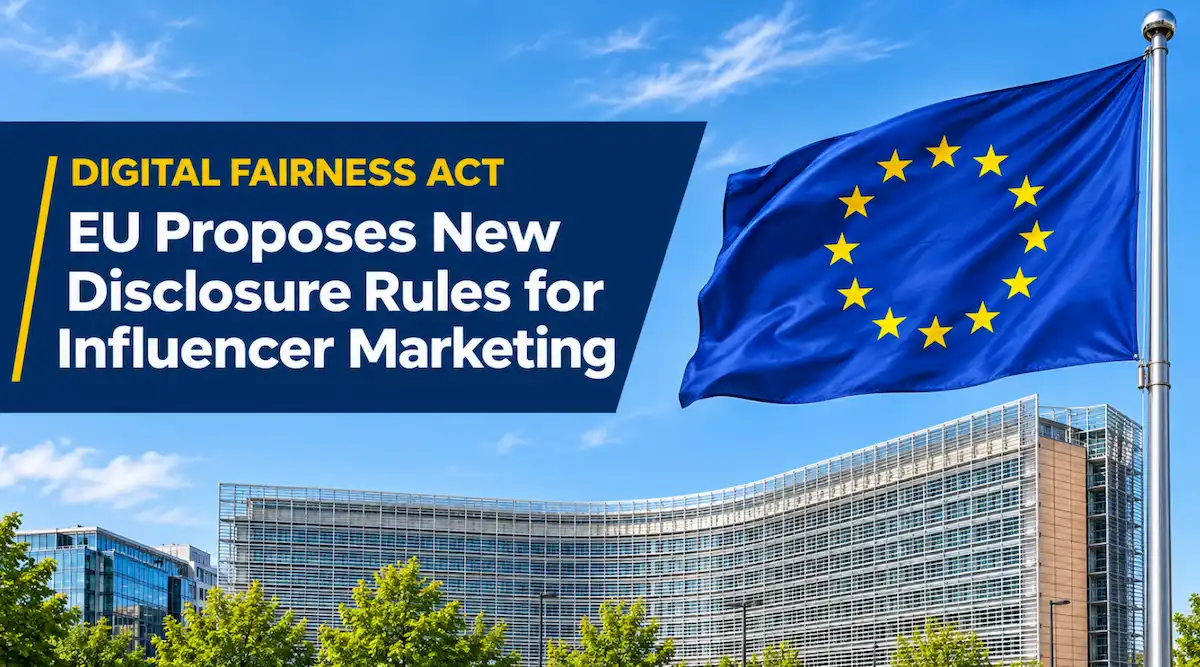
The European Commission adopted and published its Digital Fairness Act proposal on November 11. The draft regulation would set specific wording for influencer ad disclosures and require businesses that use influencer marketing services to ensure that creators comply. The proposal is at the start of the EU legislative process.
The draft would replace the Unfair Commercial Practices Directive and is part of a wider consumer protection package that also addresses subscription cancellation and manipulative online design. It follows the Commission’s earlier consultation on the Digital Fairness Act.
Key Takeaways on Influencer Disclosures
- Each ad would carry the label “advertisement” or “commercial collaboration.”
- Creators would use the disclosure tool provided on covered online platforms.
- Businesses would have to ensure creator compliance, including in campaigns without a contract.
How Article 11 Would Set Ad Disclosure Rules
EU consumer law already requires influencers acting as traders to disclose advertising. That includes affiliate marketing and content created in exchange for products or services, according to the European Commission’s Influencer Legal Hub.
Article 11(1) of the draft would require each commercial communication to carry a clear, prominent, and unambiguous disclosure using “advertisement” or “commercial collaboration.” The disclosure would have to account for the format and intended audience. Recital 54 says the disclosure should go live with the content, appear from the outset in the same medium and language, and remain in place throughout the communication. It also calls for wording the audience can readily understand. For a sponsored video, that points to a disclosure in the video itself that reaches viewers as the clip starts.
Article 11(2) would require creators to make the disclosure using the relevant tool when they publish the promotion on a covered online platform. The draft refers to Article 26(2) of the Digital Services Act (DSA), which provides for a feature that lets users declare when their content is commercial. When a user makes that declaration, the DSA requires the platform to make the commercial nature of the content apparent to viewers in real time. For a campaign that runs across multiple services, a program manager can check how each tool presents the disclosure to viewers.
What the Proposal Would Require of Brands
Under Article 11(6), a business using influencer marketing services would have to ensure through its contract that the creator complies with the proposed regulation. When the parties have no contract, the business would have to take other appropriate measures. Recital 56 gives gifts and invitations as examples of arrangements that may lack a formal contract. It suggests explaining the rules to creators, checking disclosures, and asking for a correction or removal when needed.
The recital says businesses would retain their own liability when they include compliance terms in a creator contract. It describes that responsibility as applying across different types of compensation, including goods, and regardless of how much editorial freedom a creator has.
That duty matters to programs that pay creators on sales. Consider a creator who runs a social media channel as a business, recommends a skincare product, and earns a percentage of each qualifying sale through a tracked link. EU consumer law already requires disclosure of advertising in that arrangement.
Article 2(15) of the proposal defines influencer marketing as a practice in which traders use their popularity with an audience to promote products directly or indirectly in return for payment. The commission is the payment in this example. Under the draft, the creator would use the specified disclosure when publishing the recommendation. A brand that engages the creator for the promotion would need to ensure compliance through their agreement.
Recital 56 identifies companies selling branded products and advertising agencies as examples of businesses that can shape a promotion’s subject and incentives. An agency that commissions creator posts may itself be using influencer marketing services. An affiliate network that runs a program on a brand’s behalf can pass disclosure instructions to creators and flag missing labels for correction if that work is part of its remit.
What Affiliate Teams Should Watch Next
The European Parliament and the Council of the European Union will consider the proposal under the ordinary legislative procedure. Both can seek changes, and both must agree on the text for it to become EU law. The proposal is COM(2026) 1100 final. Its procedure number is 2026/0356 (COD).
As the text progresses, teams can review how they already manage disclosures in creator affiliate programs. Program managers can specify in the campaign brief where the label should appear in each format and who checks the published post. They can also agree who contacts the creator when a disclosure is missing and who verifies that the correction is visible.
Everflow
Connect
Tradedoubler
Connect
1win Partners
Connect
Shopnomix, a Nomix Group Company
Connect
Huffson Group
Connect
Kawaii Partners
Connect
Trackdesk
Connect
Share your expertise and expand your reach and become a content contributor with us today!
Contact Us To Find Out More