Affiliate Marketing Conferences: How to Choose Events Worth Your Time and Budget
To choose an affiliate marketing conference worth your time and budget, compare its audience, meeting opportunities, and full attendance cost against a clear business goal. Whether you want to recruit affiliates, find advertisers, or learn a specific skill, this guide shows you how to assess event fit, check ticket access, build a realistic budget, and measure the results after you return.
- How to Choose an Affiliate Marketing Conference: Key Checks
- Define the Business Outcome Before Choosing an Event
- Check the Audience, Market, and Event Format
- Use a Scorecard to Compare Affiliate Marketing Conferences
- Build Your Affiliate Conference Budget
- Check Affiliate Pass Eligibility and What Your Ticket Includes
- Choose Between Attending, Exhibiting, and Sponsoring
- Check Meeting Access and Follow-Up Capacity
- Measure Affiliate Conference ROI and Partnership Results
- Build Your Upcoming Event Shortlist
- Choose the Conference That Fits Your Business Goals
- Affiliate Conference Planning FAQs
How to Choose an Affiliate Marketing Conference: Key Checks
An affiliate conference is worth attending when its audience and format support a clear business goal at a cost you can justify. Use these checks to assess the opportunity before booking and confirm you have the time and resources to act on it afterward.
When comparing conferences, focus on these five areas:
- Match the audience and market focus to a specific business objective.
- Confirm pass eligibility, meeting access, and the sessions you need.
- Budget for staff time and follow-up alongside tickets and travel.
- Compare attendance, exhibiting, and sponsorship against your expected outcomes.
- Review activated partnerships and commercial contribution after the event.
Define the Business Outcome Before Choosing an Event
Write down the opportunity you want to progress: recruiting suitable publishers, finding advertisers, negotiating terms, or evaluating a tracking supplier.
A publisher expanding into finance needs relevant advertisers and networks. An affiliate manager launching a retail program needs partners whose audiences suit the brand. They could attend the same conference and need different schedules.
Set a useful next step for each meeting, such as a traffic review, onboarding call, or demonstration using your tracking requirements. Learning objectives also need a concrete outcome, such as resolving a measurement problem or comparing approaches to creator payments.
If you are unsure which problem the event should help solve, Lee-Ann Johnstone’s podcast on diagnosing affiliate program problems offers a useful starting point. Identify the issue before choosing sessions or prospective partners.
If you cannot explain what you expect to do differently after attending, refine the brief before booking.
Check the Audience, Market, and Event Format
Inspect the agenda, exhibitor list, published attendee information, and networking arrangements. Use these four checks to assess whether the event fits your business:
- Audience fit: Look for evidence that the companies and decision-makers you need will be present. A headline attendance figure says little about how many relevant contacts you can reach.
- Market and business model: Check the event’s verticals and geographies against your goals. Paid-media content may suit an affiliate testing acquisition channels, while a retail program manager may prioritize meeting publishers. An iGaming gathering could offer limited relevance to a SaaS referral program.
- Event format: Large exhibitions offer more potential contacts, with extra scheduling and travel between meetings. Specialist conferences focus on a vertical. Smaller gatherings may allow longer conversations, but offer fewer alternative contacts if a planned meeting falls through.
- Learning value: Review session descriptions and past recordings for practical methods, supporting evidence, and opportunities for questions. Check whether the material suits your experience level and addresses a current problem. A recognizable speaker does not establish relevance.
Confirm that speaker and company lists apply to the current edition. Previous attendees and sponsors provide background, but should not be treated as this year’s delegate list. Where details are private, ask the organizer about relevant attendee categories and meeting arrangements.
For recruitment-focused trips, our archived Affiliate Drive Time session on assessing whether an affiliate is right for your program connects partner selection with customer demographics and traffic sources. Use those considerations when deciding which companies you want to meet.
Use a Scorecard to Compare Affiliate Marketing Conferences
Apply the same criteria to each shortlisted event. The table below gives you a starting point for comparing two or three options.
| Criterion | What to Check | Evidence to Record |
|---|---|---|
| Audience fit | Relevant companies and decision-makers | Current attendees, exhibitors, or organizer confirmation |
| Market relevance | Your target verticals, geographies, and business models | Agenda topics and participating businesses |
| Meeting access | Opportunities to arrange useful conversations | Pass inclusions, event-app access, and meeting spaces |
| Learning value | Sessions addressing a current business problem | Specific workshops, topics, and speakers |
| Cost and capacity | Affordable participation and time to act afterward | Full budget and staff availability |
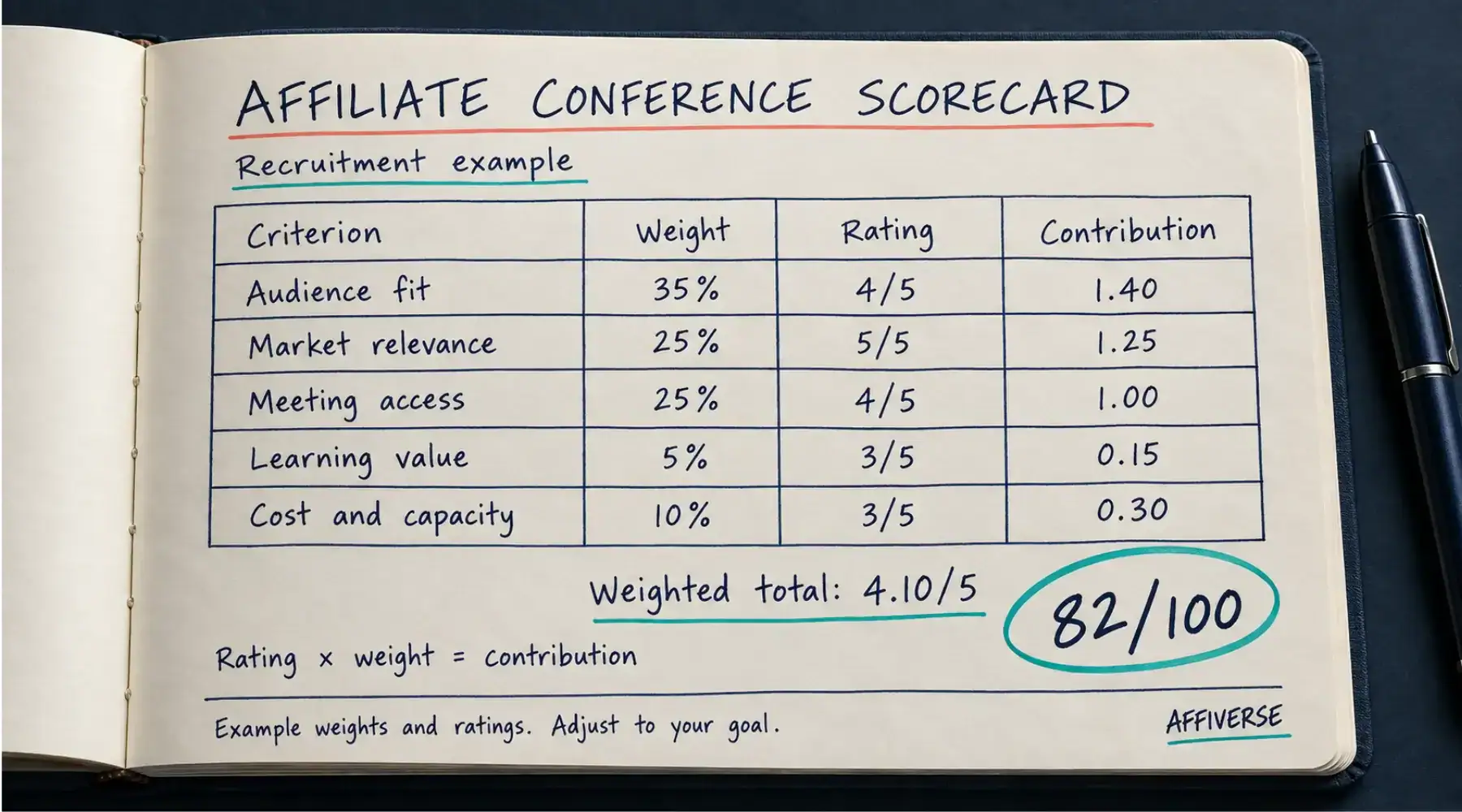
Score each criterion from one to five: one means weak fit, three means adequate fit, and five means strong fit supported by current evidence. Use two and four for intermediate ratings. Leave unknowns unscored until investigated.
For recruitment, illustrative weights are 35% audience fit, 25% market relevance, 25% meeting access, 5% learning value, and 10% cost and capacity. Multiply each rating by its weight and add the results. Ratings of 4, 5, 4, 3, and 3 give 4.1 out of five, or 82 out of 100. Adjust the weights to your objective; these are example assumptions, not industry benchmarks.
When Should You Skip an Event?
Pause booking if relevant participants remain unconfirmed, the sessions are mainly promotional, or you cannot arrange useful meetings. Check recent feedback from attendees with similar goals. For a new event, investigate the organizer, confirmed venue, and booking terms. An attractive destination cannot resolve weak audience fit or a lack of follow-up capacity.
Build Your Affiliate Conference Budget
Build the budget before buying a ticket. Include travel, accommodation, local transport, meals, materials, and any separately priced side events. For international trips, account for exchange rates and entry requirements. Check the final checkout price, taxes, payment fees, and pass inclusions.
Staff time matters as well. Preparation, travel, attendance, and follow-up can consume several working days. Estimate the hours required and assign a consistent hourly cost. For an employee already on salary, that allocation may represent a resource cost rather than an additional cash payment.
Here is an illustrative budget for one attendee. These figures are example assumptions, not typical conference prices.
| Expense | Low spending | Mid spending | High spending |
|---|---|---|---|
| Return flights, including baggage allowance | €100–€200 | €200–€400 | €400–€700 |
| Hotel per night | €70–€110 | €120–€200 | €250–€400 |
| Accommodation: three nights | €210–€330 | €360–€600 | €750–€1,200 |
| Meals per day | €25–€40 | €45–€70 | €80–€120 |
| Meals: four days | €100–€160 | €180–€280 | €320–€480 |
| Airport transfers and local transport | €30–€60 | €70–€130 | €150–€250 |
| Travel subtotal | €440–€750 | €810–€1,410 | €1,620–€2,630 |
The table covers travel expenses only. Add your conference ticket and a contingency allowance to calculate the cash budget. Estimate staff time separately by multiplying the hours needed for preparation, travel, attendance, and follow-up by a consistent hourly cost. Keep both totals visible: cash expenditure helps you plan payments, while allocated time shows the resources the trip requires.
Consider work the trip could delay, such as a campaign launch or partner support. Record that capacity constraint without counting the same staff hours twice. Adjust your contingency to reflect your itinerary, booking flexibility, and costs still awaiting confirmation.
Check Affiliate Pass Eligibility and What Your Ticket Includes
The lowest displayed price may apply to a different attendee category. Confirm whether you qualify as an affiliate, publisher, advertiser, agency, or technology provider. For free or discounted affiliate passes, check verification requirements. Compare app access, workshops, lounges, recordings, and separately registered side events.
For a VIP upgrade, identify the specific access you will use and compare its extra cost. Ask about early-bird or group discounts after confirming the event fits your goals.
Choose Between Attending, Exhibiting, and Sponsoring
Choose how to participate based on your objective, budget, and team capacity. Each option requires a different level of investment and preparation:
- Attending as a delegate: Suitable for targeted recruitment, supplier evaluation, and learning. It gives you flexibility to meet different companies and attend relevant sessions, but useful meetings still need preparation.
- Exhibiting: Consider a stand when you have a clear proposition and enough relevant prospects to justify a staffed presence. Budget for stand space, production, shipping, lead capture, and staff coverage. Check whether the package includes tickets and furniture before estimating extras.
- Sponsoring: Sponsorship can support visibility or access to a defined audience. Confirm the deliverables, placement, duration, and reporting, then assess whether your team can turn that exposure into useful conversations.
If you plan to speak, check the submission process, selection criteria, and any commercial terms. Whatever your participation format, assign responsibility for follow-up before committing the budget.
Check Meeting Access and Follow-Up Capacity
Before booking, establish how you will contact prospective partners. Check when the event app opens, who can use it, and whether your pass gives access to the relevant networking sessions.
Build a short contact list with a reason for each conversation. A request explaining the market, opportunity, or problem you want to discuss gives the recipient enough information to assess its relevance.
Our podcast with Kirsty McCubbin on building valuable affiliate relationships offers useful preparation for these conversations. The relationship-building discussion starts at 10:01 and considers how affiliates can add value to their partners.
Prepare a brief that helps someone assess the partnership: publishers can outline traffic channels and markets; program managers can explain recruitment criteria and commission terms. Share only information you are authorized to disclose.
Leave space between meetings for movement and notes. Record each agreed next step, owner, and deadline. Reserve time afterward for introductions, reviews, and affiliate onboarding so opportunities can progress when the team returns.
Measure Affiliate Conference ROI and Partnership Results
Record event contacts in your CRM or a shared tracker. Affiverse’s guide to CRM and partner-management records within the affiliate data stack explains how to connect contacts, recruitment status, agreed terms, and next steps.
Distinguish new opportunities from existing negotiations that progressed during the trip, and record how each developed afterward.
Calculate Break-Even and Commercial Return
For a separate worked example, assume a total event cost of €3,000, including the ticket, travel, and allocated staff time. If each newly activated partnership contributes €750 during a defined review period, after direct delivery costs and before deducting the event cost, four partnerships would cover the budget.
If five partnerships each contributed €750, their combined contribution would be €3,750. After the €3,000 event cost, the remaining value would be €750, giving a 25% return on the cost used in this example:
ROI = (€3,750 − €3,000) ÷ €3,000 × 100 = 25%
Deduct the event cost once. State the review period and whether allocated staff time is included, and keep the approach consistent across events.
A signed agreement still needs activation and commercial activity. Pipeline forecasts should therefore remain separate from realized contribution. If a deal was already progressing before the conference, avoid assigning all its value to the trip without evidence of the event’s additional effect.
Review Progress at Useful Intervals
Consider reviews at 30, 60, and 90 days, adjusting the schedule to your sales or onboarding cycle. Track follow-up completion, partner activation, commercial results, and unresolved next steps. For learning objectives, record what the team implemented and how it helped. Use the findings when deciding whether to attend again.
Build Your Upcoming Event Shortlist
Use the Affiverse events calendar to find candidates, then assess each event against your goals, budget, and meeting requirements. Upcoming examples illustrate different formats:
- PI LIVE Europe takes place in London on October 19–21, 2026. Check which attendee category and ticket level suit your plans, and confirm access to the meeting formats and sessions you want to use.
- Ace Alliance Horizon & Speed Rome takes place on November 2, 2026, at Leopard Circuit Viterbo near Rome. Its agenda combines iGaming networking, keynote sessions, and activities. Include the journey to the circuit in your schedule.
- Affiliate World Asia takes place in Bangkok on December 9–10, 2026. Assess whether its participating companies and session topics match your acquisition channels and prospective partners. Include flight duration and any additional travel days in your budget.
Apply your budget and audience checks to each option, and confirm dates, access, and booking terms before committing.
Choose the Conference That Fits Your Business Goals
The best affiliate marketing conference for your business is one where you can reach relevant people, progress a clear objective, and justify the full cost. Compare shortlisted events using the same criteria, resolve gaps before booking, and reserve time for follow-up. Afterward, use the results to decide whether the event deserves a place in next year’s budget.
Affiliate Conference Planning FAQs
What Should I Check in Cancellation and Ticket-Transfer Terms?
Check refund deadlines, transfer restrictions, and the organizer’s terms for a postponement or cancellation. Review travel and accommodation conditions separately, since an event-ticket refund may not cover those bookings. Save the terms that applied when you purchased and confirm any unclear conditions with the provider.
Are Affiliate Marketing Conferences Suitable for Beginners?
They can be, if the program matches your experience and you have a specific learning or partnership goal. Look for introductory workshops, first-timer meetups, and accessible networking. Prepare a short explanation of your business.
For practical preparation, watch our archived Affiliate Drive Time training video on building new relationships at affiliate events.
If you are still choosing a niche, compare lower-cost local or virtual options before committing to international travel.
How Many Affiliate Conferences Should I Attend Each Year?
Base the number on your budget and follow-up capacity. Check whether another event reaches new partners or repeats the same audience. Leave time to activate opportunities between trips, and compare the next booking with unfinished work from the previous conference.
When Is a Virtual Pass or Recording Package Useful?
It can suit a clear learning objective when travel would use too much budget or staff time. Check which sessions are included, how long recordings remain available, and whether there is live participation or networking access. Choose the option that lets you complete the task you identified.
What If Negotiations Take Longer Than 90 Days?
Extend the review to match the actual cycle. Track agreed next steps, expected timing, costs, and progress toward activation. Label projected contribution clearly and update the assessment when results become available.
Everflow
Connect
Tradedoubler
Connect
1win Partners
Connect
Shopnomix, a Nomix Group Company
Connect
Huffson Group
Connect
Kawaii Partners
Connect
Trackdesk
Connect
Share your expertise and expand your reach and become a content contributor with us today!
Contact Us To Find Out More