Google is Now Testing AI-generated Headline Rewrites in Standard Search Results
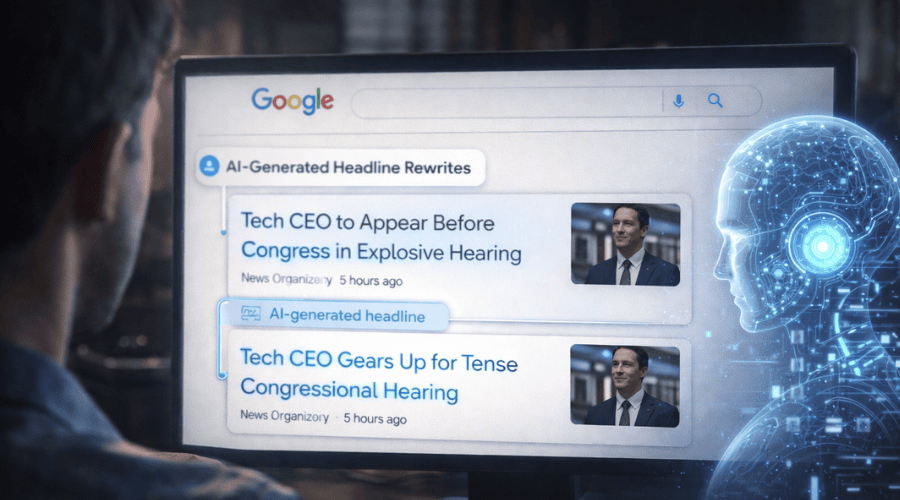
Google has confirmed it is running an experiment in which AI rewrites the title links shown for pages in traditional Search results. The test is currently small and narrow, and Google has not approved it for broader rollout, but the company confirmed the details to The Verge after the publication sought comment.
The experiment goes beyond Google Discover, where title rewriting has already attracted attention. It applies to standard search results and is not limited to news publishers, though news sites are among those affected.
In one documented example, Google replaced the original headline “I used the ‘cheat on everything’ AI tool and it didn’t help me cheat on anything” with the considerably flatter “‘Cheat on everything’ AI tool.” The intent, according to Google, is to better match titles to the user’s search query and improve engagement.
What Google’s own documentation says
This is not the first time Google has modified title links without publisher consent. According to Google Search Central’s documentation on title links, first published in 2021 and still current, Google’s generation of title links is “completely automated” and draws from a range of page signals. These include the HTML title element, visible on-page headings, Open Graph title tags, anchor text from inbound links, and structured data markup.
The documentation frames this as an effort to “best represent and describe each result.” In practice, that framing gives Google wide discretion to substitute a publisher’s chosen headline with whatever its systems determine to be more relevant to a given query.
What’s new about this experiment is the use of generative AI to produce those substitutions, rather than selecting from existing on-page text. Google noted the experiment may not rely on generative AI if it ever reaches full launch, but offered no explanation of how that would work in practice.
Why this matters to affiliate publishers
For publishers whose revenue depends on click-through traffic from search, headline performance is not a trivial concern. A headline drives the decision to click. It carries tone, intent, and brand voice. When Google replaces it with a shorter, AI-generated version, publishers lose control over the single most visible element of their content in the results page.
Sean Hollister, senior editor at The Verge, put it plainly: “This is like a bookstore ripping the covers off the books it puts on display and changing their titles.” He continued: “We spend a lot of time trying to write headlines that are true, interesting, fun, and worthy of your attention without resorting to clickbait, but Google seems to believe we don’t have an inherent right to market our own work that way.”
Louisa Frahm, SEO director at ESPN, responded to the news on LinkedIn: “After 10+ years in news SEO, I’ve come to find that a headline is the most prominent element for attracting readers in timely windows, to provide a targeted synopsis that elevates your brand voice. If that vision gets altered and facts are misrepresented, long-term audience trust will be compromised.”
Both reactions point to the same concern: a rewritten headline does not just reduce clicks, it changes what readers think they are clicking on. For publishers in affiliate-adjacent verticals, where review intent and buying intent are often embedded in the headline itself, the downstream effect on conversion could be significant.
This is not an isolated development
It would be a mistake to treat this as a one-off experiment likely to be quietly abandoned. The Verge noted that a similar test in Google Discover later became a permanent feature. Google has a documented pattern of trialling changes at small scale before rolling them into the core product without announcement.
The broader trajectory is consistent with what we have covered at length. Google is reducing the number of decisions publishers can make about how their content appears in its products. Earlier changes addressed meta descriptions, title tags, and snippet text. AI-generated headlines are the logical next step in that progression.
As we reported in our analysis of Google’s AI Mode expansion, organic click-through rates from position one have already fallen from 28% to 19% following the rollout of AI Overviews, a 32% decline. That figure reflects what happens when the search result page itself answers a query before the user reaches a publisher. A rewritten headline introduces a second vector of loss: even when a user does see a publisher’s result, the headline they see may not be the one the publisher wrote.
The zero-click problem and its implications for attribution are compounding. When 58% of searches already end without an external click, publishers need every element of their search presence to be as sharp as possible. Handing headline control to an AI does not support that.
What publishers and affiliate marketers should do
The practical options here are limited, but they are not zero.
Publishers can make their structured data as explicit as possible. Google’s own documentation lists title elements, H1 tags, og:title meta tags, and WebSite structured data as inputs to its title link generation. A well-structured, unambiguous title hierarchy gives the AI system less reason to improvise, and may reduce the frequency of substitutions.
Writing headlines that already align with search query phrasing is a related tactic. If the AI is rewriting titles to better match queries, headlines that already reflect the language users type into search have a natural advantage. This does not mean stripping personality or brand voice from every headline, but it does mean that SEO-aware writing is now doing double duty. Our coverage of how Google evaluates AI-assisted content is useful context here, particularly around E-E-A-T signals that establish authorial identity and page credibility.
More fundamentally, the experiment is another signal that organic search traffic is a diminishing and increasingly unpredictable input for any publisher’s business. As we have argued in our coverage of the search challenge facing affiliates, the publishers who fare best in this environment are those who have built audiences that do not depend on Google’s goodwill to find their content. Email lists, direct return visitors, and brand recognition that drives navigational search are all forms of audience ownership that headline rewrites cannot touch.
The value of building a brand as an affiliate has always been about resilience. That argument has become more concrete with every change Google makes to its results page.
Google’s crackdown on mass-produced SEO content has already prompted wholesale restructuring at major digital publishers. As we covered in our analysis of the shockwaves running through affiliate media, the publishers most exposed are those whose traffic model depends on a stable, predictable relationship with Google’s results page. That relationship is now actively unstable at the headline level.
What to watch
Google described this as one of many routine experiments, but that framing is not reassuring given its track record. The Discover precedent, where a similar test became a standard feature, is the more useful reference point.
Affiliate publishers in content-heavy verticals, particularly those in news, review, and comparison categories, should track their title link performance in Search Console. If Google is overriding your headlines, that data will show it. And if you see substitutions changing the intent of your headlines, notably from transactional to informational or from specific to generic, the effect on click quality may be as consequential as the effect on click volume.
For affiliate program managers evaluating publisher partnerships, this is worth factoring into how you assess content publishers who rely heavily on Google traffic. A publisher whose business model assumes headline control in search results is operating on an assumption that Google is actively testing against heading into 2026. The two-tier publisher ecosystem Google is building, where large media brands receive compensation and smaller publishers absorb algorithmic risk, makes that exposure more pronounced.
Everflow
Connect
Tradedoubler
Connect
1win Partners
Connect
PIN-UP Partners
Connect
Shopnomix, a Nomix Group Company
Connect
V.Partners
Connect
Huffson Group
Connect
Kawaii Partners
Connect
Share your expertise and expand your reach and become a content contributor with us today!
Contact Us To Find Out More