YouTube Raises YPP Thresholds and Adds $500 Affiliate Boost Bonus
From February 1, 2027, YouTube will double the watch-time and Shorts-view thresholds for new creators seeking advertising and Premium revenue through the YouTube Partner Program. Applicants will need 8,000 qualified watch hours within 365 days or 20 million qualified Shorts views within 90 days, alongside 1,000 subscribers.
YouTube has also confirmed a limited-time Affiliate Partnerships Boost bonus for invited US creators. Between August 22 and October 31, 2026, eligible creators can earn $500 for each qualifying Short or video under six minutes that a participating brand selects and runs as an advertisement.
Shopping, fan funding and Creator Partnerships thresholds remain unchanged. The bonus provides another potential affiliate revenue route, but uploading and tagging an eligible video does not guarantee payment. A participating brand must select and boost the content.
Key Takeaways for Creators and Affiliate Managers
- From February 1, 2027, new creators will need 1,000 subscribers and either 8,000 qualified watch hours or 20 million qualified Shorts views to access advertising and Premium revenue.
- Creators already receiving advertising and Premium revenue will not need to meet the higher entry thresholds, but must accept the updated terms by January 31, 2027.
- Invited US creators can earn $500 when a participating brand boosts an eligible affiliate Short or video under six minutes between August 22 and October 31, 2026.
- Posting affiliate content alone does not qualify for the bonus; the video must be selected and boosted by an eligible brand for at least one day.
- Each qualifying video can receive one $500 bonus, even if more than one brand chooses to boost it.
- YouTube Shopping, fan funding and Creator Partnerships retain their existing lower thresholds.
- Affiliate managers should assess creators using attributable clicks, conversions and sales rather than advertising eligibility alone.
What YouTube Is Changing
The new thresholds form part of the first significant update to the YouTube Partner Program (YPP) since 2018. According to YouTube’s announcement, more than three million creators currently participate in the program.
Two separate threshold changes are particularly relevant:
- New creators applying for advertising and Premium revenue sharing will still need 1,000 subscribers, but they will also need either 8,000 qualified watch hours over the previous 365 days or 20 million qualified Shorts views over 90 days. That is double the current requirement of 4,000 watch hours or 10 million Shorts views.
- To earn from the Shorts Creator Pool each month, creators will need to maintain 10 million qualified Shorts views over the previous 90 days.
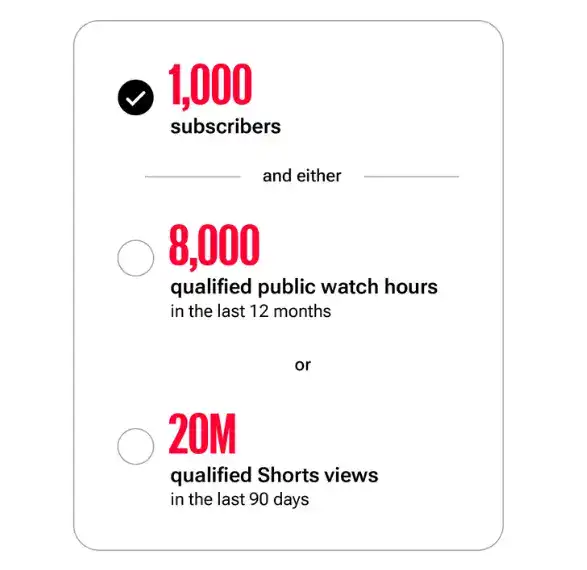
The two Shorts figures perform different jobs. The 20 million-view threshold is an entry route for new creators seeking advertising and Premium revenue sharing. The 10 million-view threshold determines whether a creator already in YPP can earn Shorts advertising and subscription revenue in a given month.
A channel that falls below the 10 million-view Shorts threshold will remain in YPP and can continue earning from long-form videos. Its Shorts revenue sharing will restart automatically once it crosses the threshold again.
The changes take effect on 1 February 2027. The higher entry thresholds will not affect the YPP status of existing members, and creators already earning advertising and Premium revenue will not have to meet them again. Existing creators are not, however, exempt from every part of the update.
According to YouTube’s detailed guidance, creators must review and accept the relevant updated contract modules in YouTube Studio by 31 January 2027 to continue earning from those monetization features. A creator who misses the deadline will remain in YPP but will stop earning from the associated features until the relevant terms are accepted.
YouTube is also introducing new channel-activity requirements. From 1 February 2027, a channel will be considered active if it records 1,000 qualified watch hours in 365 days, reaches one million qualified Shorts views in 90 days, or uploads two long-form videos or five Shorts every 90 days. Channels that fall below the requirements will receive a 90-day opportunity to restore active status.
Premium Lite and Direct Shorts Advertising
From February 1, 2027, YouTube will expand Premium Lite to every country where YouTube Premium is available. The creator pool for Premium Lite will represent 60% of net subscription revenue, while the corresponding Premium pool will represent 30%.
Each pool will be distributed among creators according to member watch time and views. Creators will then receive the existing revenue share from the amount allocated to them: 55% for long-form videos and 45% for Shorts.
YouTube is also introducing a separate advertising arrangement for Shorts. When an advertiser targets a group of five or fewer channels, eligible creators can receive a direct 45% revenue share from those placements. This payment will be made in addition to their standard earnings from the wider Shorts Creator Pool.
These changes create additional potential sources of creator income. For developing channels, however, YouTube’s decision to retain the lower eligibility thresholds for Shopping, fan funding and Creator Partnerships may be more commercially relevant, as these features remain available before a creator qualifies for advertising and Premium revenue.
YouTube Launches $500 Affiliate Partnerships Boost Bonus
YouTube has now published the terms of its Affiliate Partnerships Boost bonus, which allows participating brands and sellers to use existing YouTube Shopping content as advertising creative.
From August 22 to October 31, 2026, invited US creators can receive $500 for each qualifying Short or video-on-demand upload under six minutes that an eligible brand boosts for at least one day. Creators must opt into Affiliate Partnerships Boost and tag a participating seller or brand, but tagging a product does not guarantee that the content will be selected.
Each individual video can earn one $500 bonus, even if multiple brands boost it. Qualifying content cannot contain copyrighted music or YouTube Shopping Sounds and must comply with YouTube’s Community Guidelines, Google Ads policies and Shopping program requirements.
YouTube says qualifying bonuses will be paid through AdSense no later than December 31, 2026, where they will appear as an “Affiliate Boost Bonus.” Creators must also include appropriate disclosures when publishing content involving commercial relationships.
The program brings affiliate content and paid advertising closer together. A video created to generate YouTube Shopping sales can also become advertising creative if a participating brand selects it. Creators should review the content-use, tagging and disclosure requirements before opting in, particularly where agreements with other brands may limit how their content can be reused.
Shopping Remains on a Different Monetization Track
The new figures do not raise every YPP threshold. Instead, YouTube is preserving (and widening) the distinction between access to advertising revenue and access to earlier-stage earning tools.
Eligibility thresholds for fan funding, YouTube Creator Partnerships, and YouTube Shopping will remain unchanged. In eligible markets, creators can enter the expanded YPP with 500 subscribers, three public uploads during the previous 90 days, and either 3,000 qualified watch hours in 365 days or three million qualified Shorts views in 90 days. Individual features carry additional eligibility rules and may not be available in every market.
This follows YouTube’s wider investment in native affiliate commerce. As Affiverse reported when the YouTube Shopping Affiliate Program launched in the UK, eligible creators can tag products in long-form videos, Shorts and livestreams and earn commission from qualifying sales. The minimum subscriber threshold for eligible UK creators is 500, although subscriber numbers are not the only eligibility requirement.
The latest decision widens the existing gap between YouTube’s monetization tracks. Larger or more established channels may earn from advertising, subscriptions, Shopping and brand deals. Smaller channels may have access to commerce and audience-funded tools while remaining outside the main advertising-revenue tier.
That does not guarantee that affiliate income will compensate for delayed access to advertising revenue. Shopping performance depends on category, audience intent, product availability, commission rates, and attribution terms. A creator with strong viewing figures may generate few sales, while a smaller channel producing detailed reviews or tutorials may convert more effectively.
Why Affiliate Managers Should Pay Attention
Affiliate teams should not use advertising eligibility as a shortcut for deciding whether a YouTube creator is commercially valuable.
The new thresholds make that approach even less reliable. A channel below 8,000 qualified watch hours may still reach a focused audience at the point of purchase. Product comparisons, demonstrations, setup guides, and problem-solving videos can continue attracting search traffic and sales long after publication.
Program managers should review creators using measures tied to the job the content needs to do. Those measures may include product clicks, conversion rate, confirmed sales, average order value, returns, and the revenue generated over the full life of a video. Subscriber totals and recent views provide useful context, but neither proves purchasing influence.
The change may also affect how creator partnerships are priced. Creators who cannot yet earn advertising revenue may place more value on affiliate commission, product samples, and paid brand work. Brands should not treat that as a reason to push all commercial risk onto the creator. A hybrid arrangement combining a production fee with performance-based commission can recognize the cost of making the content while retaining an incentive for sales.
Affiliate managers should also check whether their program can support the longer lifespan of YouTube content. Commission changes, discontinued products, broken landing pages, and out-of-stock items can reduce the value of a video that continues receiving views. Reliable feeds, current product information, and clear communication with creators become part of performance management.
What Creators Should Do Before February 2027
Creators already earning advertising and Premium revenue do not need to requalify under the higher entry thresholds. They must, however, accept the relevant updated monetisation modules by 31 January 2027 to continue earning from those features. They should also check the new activity requirements and monitor their rolling performance if Shorts revenue forms a material part of their income.
Early reaction within creator communities is divided. Some experienced long-form creators argue that 8,000 annual watch hours remains achievable with a consistent publishing schedule and content aimed at a defined audience. Newer creators counter that doubling the requirement could add months to the journey. Concern is more consistent among Shorts creators, who regard maintaining 10 million qualified views every 90 days as considerably less predictable. These discussions are anecdotal, but several practical recommendations recur across r/PartneredYouTube and r/NewTubers:
- Choose a primary route. Several creators view long-form watch hours as more controllable than repeatedly chasing viral Shorts. Channels suited to reviews, tutorials, or explainers can focus on a sustainable publishing schedule and videos capable of accumulating qualified watch time over several months.
- Monitor qualified performance. Shorts-first creators should track qualified views across the rolling 90-day window rather than relying on total channel views. A channel that is not comfortably above 10 million should avoid treating Shorts Creator Pool payments as dependable monthly income.
- Test whether Shorts viewers convert. Creator experiences suggest that Shorts can introduce a channel to new audiences, but those viewers do not automatically watch longer videos. Creators should use their analytics to see whether Shorts viewers progress to long-form content, product links, or other commercial actions rather than assuming that reach will transfer.
- Use the remaining time carefully. Creators close to the current advertising threshold can try to qualify before February, but volume should not come at the expense of originality or audience value. Reaching the numerical threshold still leads to YouTube’s standard channel review.
- Build revenue outside AdSense. Experienced creators repeatedly recommend combining platform revenue with affiliate links, sponsorships, memberships, and owned products. In discussions about affiliate marketing, creators advise matching products closely to the subject of the video, mentioning relevant links within the content and keeping links on high-traffic videos current.
The last point is particularly relevant to affiliate teams. A review, comparison, or tutorial does not need to generate enormous viewing figures to influence purchases. Creators should track clicks, confirmed sales, and conversion rates so they can identify which videos produce commercial value and use that evidence when approaching brands.
Not every income source will suit every channel. The aim is to build a manageable mix around the audience’s interests, rather than adding monetization features for their own sake. Recent changes to YouTube Creator Music already showed how platform decisions can alter the economics of individual videos. The new YPP thresholds make the same point at channel level: access to platform revenue cannot be treated as fixed infrastructure.
Affiliate Revenue Moves Closer to the Centre
YouTube is not replacing advertising with affiliate marketing. It is widening the existing gap between the scale required to share in platform advertising revenue and the scale required to start earning through commerce.
For creators, that may make income diversification more important earlier in a channel’s development. For brands and affiliate managers, it creates an opportunity to work with relevant creators before they reach the largest audience milestones.
The practical question is no longer simply whether a creator has qualified for YouTube advertising. It is whether that creator can help a defined audience make a purchasing decision—and whether the brand has the tracking, commission structure, and operational support to reward that contribution properly.
Everflow
Connect
Tradedoubler
Connect
1win Partners
Connect
PIN-UP Partners
Connect
Shopnomix, a Nomix Group Company
Connect
V.Partners
Connect
Huffson Group
Connect
Kawaii Partners
Connect
Share your expertise and expand your reach and become a content contributor with us today!
Contact Us To Find Out More