Google Changes Site-Reputation Enforcement in the EEA: What It Means for Affiliate Publishers
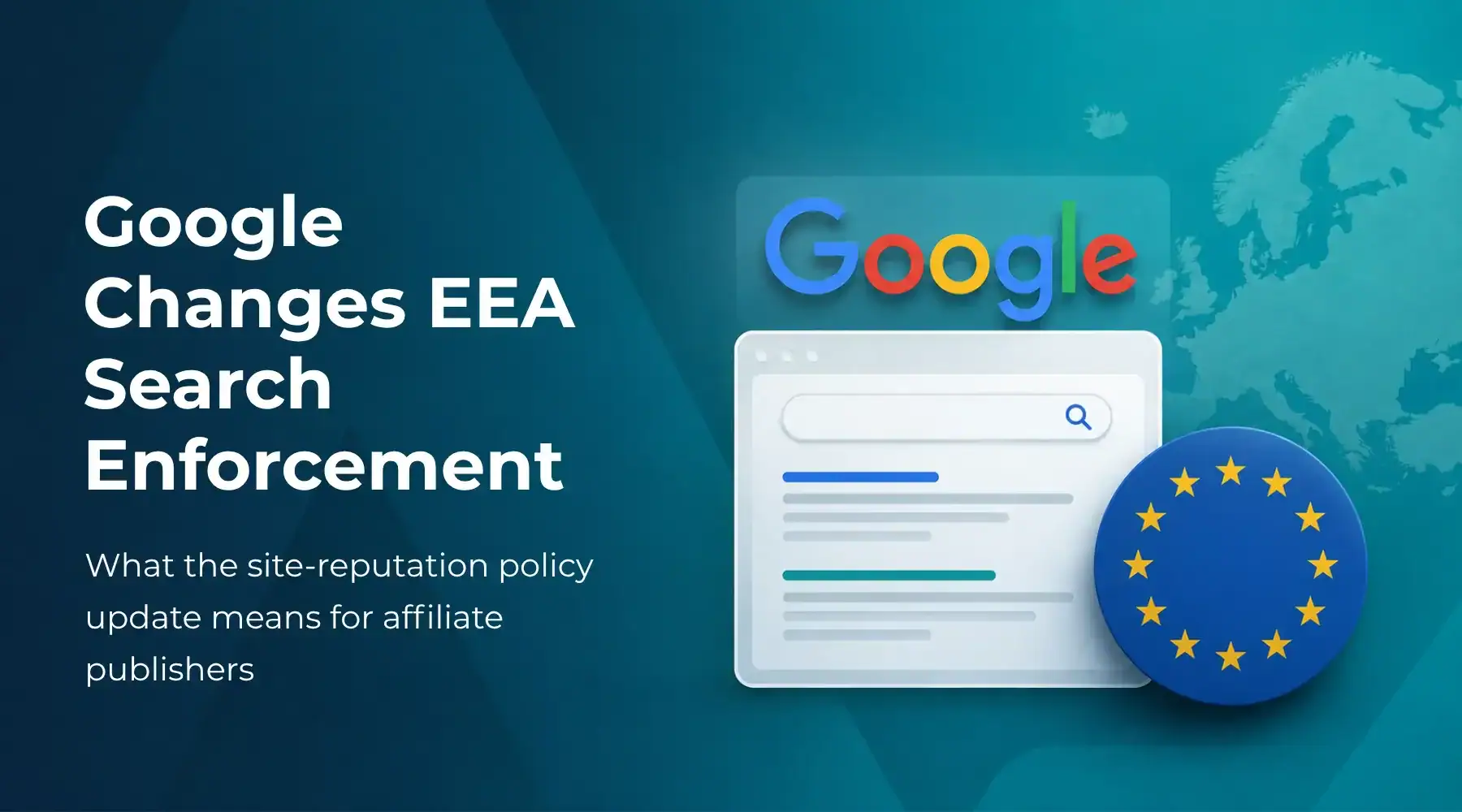
Google has changed how its site-reputation policy affects search results in the European Economic Area (EEA), altering the treatment of third-party commercial content hosted by publishers. From August 30, manual actions under the policy no longer affect results shown to EEA searchers, according to Google’s official announcement. For affiliate publishers and their partners, this removes one source of search demotion in those markets. It does not promise a return to previous rankings, traffic, or revenue.
Key Takeaways: Google’s EEA Site-Reputation Change
- August 30, 2026: The change took effect for searches within the EEA.
- The distinction concerns the searcher’s location, not simply the publisher’s headquarters.
- Affected content may still be assessed separately from its host website.
- Affiliate links and third-party authorship do not automatically breach the policy.
- Editorial integration and actual performance remain important when evaluating publishing partnerships.
What Changes Inside and Outside the EEA
Google announced the adjustment on August 28 following discussions with the European Commission. For searchers outside the EEA, manual actions continue to affect the relevant portion of a website. Inside the EEA, that manual-action impact does not apply, although affected sections may eventually rank independently.
This means one page can receive different treatment across geographic audiences. A publisher should therefore avoid reading a single sitewide traffic figure as evidence that the change has helped or harmed its entire business.
The distinction also matters commercially: an affiliate partnership serving several markets cannot be assessed solely through its performance in one country.
Why Publisher Partnerships Attracted Regulatory Scrutiny
The European Commission opened its investigation in November 2025, examining whether Google provided fair, reasonable, and non-discriminatory access to publishers under the Digital Markets Act.
The Commission said its monitoring indicated that websites carrying commercial partners’ content were being demoted. It questioned whether the policy restricted publishers’ ability to monetize content, innovate, and work with third-party providers.
That dispute sits behind the broader uncertainty facing large affiliate publishers. The commercial question is whether a partnership gives readers useful content or principally offers access to another website’s established search visibility. Those are different propositions, even when both generate commissions.
Affiliate Content Is Not Automatically a Violation
Google’s updated site-reputation guidance distinguishes third-party content published mainly to exploit a host’s ranking signals from legitimate editorial collaboration.
Its examples of acceptable practices include appropriately treated affiliate links, syndicated reporting, and editorial contributions. A freelancer’s involvement is not, by itself, evidence of abuse.
Google also describes a global human-review approach considering whether content is sufficiently integrated with the publication. Factors include presentation, quality, identifiable editorial responsibility, and duplication elsewhere.
For affiliate managers, that makes the publishing arrangement itself relevant. Who owns the editorial decisions? Is the content developed for that publication’s readers? Can visitors identify who is responsible for it? These are useful questions when assessing a potential partner, rather than relying only on domain-level traffic estimates.
Independent Ranking Does Not Mean Instant Recovery
The detailed guidance says previous manual actions will no longer penalize pages in EEA results. However, those pages may be categorized separately from the main domain; that outcome is not automatic.
Google also clarifies that separation does not immediately remove the main site’s ranking signals. Its systems learn to rank the sections independently over time, and the previous manual action is not itself used as an EEA ranking signal.
The business implication is uncertainty rather than a guaranteed rebound. A revised enforcement process cannot establish how much traffic a particular review, comparison, or coupon page will attract, or whether additional visits will convert into approved commissions.
What Affiliate Teams Should Check Next
Publishers can use Google’s Manual Actions report to inspect the issue and affected page patterns. Reconsideration requests remain available, with supporting explanations and evidence of changes where appropriate.
For performance analysis, a useful starting point is to:
- Separate EEA and non-EEA audiences.
- Compare affected commercial sections with the rest of the publication.
- Track affiliate clicks, approved conversions, and revenue alongside search visibility.
Keep this development separate from the August spam update, which completed on August 21. Overlapping timing does not establish which change caused an individual page’s movement.
For now, partnership forecasts should be based on observed results, not an assumption that previously lost traffic will return.
Everflow
Connect
Tradedoubler
Connect
1win Partners
Connect
PIN-UP Partners
Connect
Shopnomix, a Nomix Group Company
Connect
V.Partners
Connect
Huffson Group
Connect
Kawaii Partners
Connect
Share your expertise and expand your reach and become a content contributor with us today!
Contact Us To Find Out More