CreatorIQ Unveils Q: What Its AI Update Means for Creator Marketing
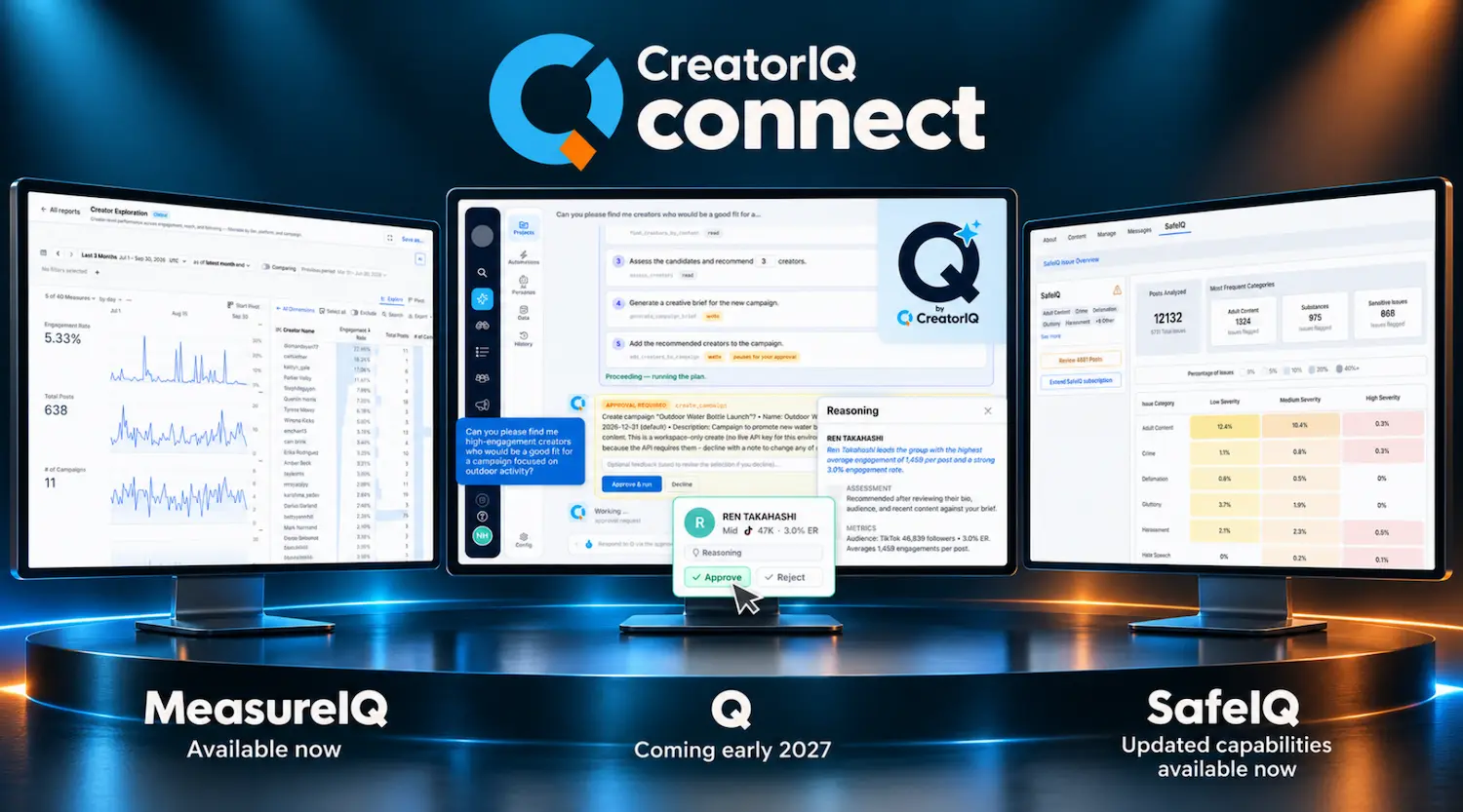
CreatorIQ has unveiled Q, an AI system intended to help marketers carry out creator-program tasks, alongside MeasureIQ analytics and updates to SafeIQ content monitoring. Announced at CreatorIQ Connect on October 13, the release combines tools available now with broader automation planned for early 2027. For affiliate and creator teams, the distinction is between analyzing performance, reviewing partners, and allowing software to act on their behalf.
Key Takeaways: Available Tools and the 2027 Roadmap
- MeasureIQ and updated SafeIQ are available now; Q’s full capabilities are planned for early 2027.
- MeasureIQ supports 32-plus KPIs across 37-plus reporting breakdowns, with a conversational analytics agent.
- SafeIQ adds wider web monitoring and heatmaps showing risk by category and severity.
- CreatorIQ says its underlying Creator Graph processes 280 million social posts daily, drawing on more than a decade of creator and campaign data.
How Q, MeasureIQ and SafeIQ Fit Together
The October 13 announcement places the products under Applied Creator Intelligence, CreatorIQ’s AI insights layer.
| Product | Main purpose | Availability announced |
|---|---|---|
| Q | Carry out creator-marketing workflows within organizational controls | First analytics deployment in MeasureIQ; full capabilities planned for early 2027 |
| MeasureIQ | Analyze creator-program data and build reports | Available now |
| SafeIQ | Assess creator content and reputation against brand standards | Existing product with new capabilities available now |
Behind that layer sits the Creator Graph, which connects creator identities across accounts and platforms with content, partnerships, and campaign outcomes. CreatorIQ says it draws on more than a decade of data.
This structure addresses a familiar operational problem: the same creator can appear in several systems under different handles. Connecting those identities can help teams understand the relationship across campaigns, provided their records are matched correctly.
What Q Is Intended to Do
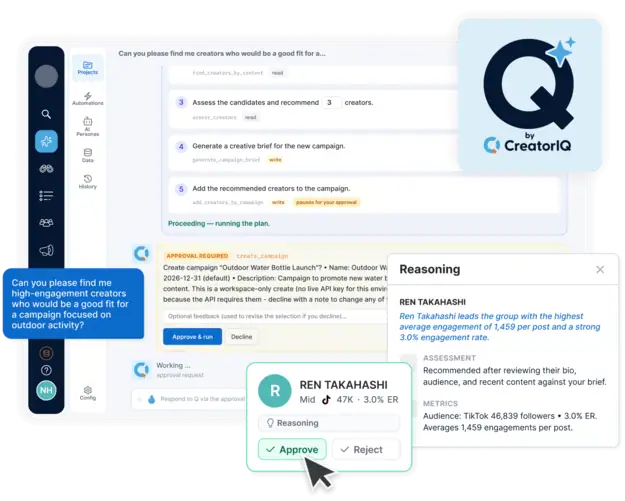
Q’s planned role is to turn a marketer’s stated goal into actions across CreatorIQ. The announced scope includes creator discovery, list building, recruitment, and campaign setup.
“Agentic” describes software that can carry out steps toward a goal using connected tools. The practical question is which actions it can take, using whose permissions, and when approval is required.
CreatorIQ says Q operates within organizational divisions, markets, and approval thresholds. It also describes Q as compatible with Model Context Protocol, or MCP, which allows AI applications to connect with external tools and data.
Teams would still need to confirm the supported connections and permissions for their own setup.
Chris Harrington, CEO of CreatorIQ:
Enterprises don’t need more AI. They need AI they can trust with their budgets and their brands.
For now, the live deployment is the analytics agent inside MeasureIQ. Broader recruitment and campaign-execution capabilities belong to the early-2027 roadmap.
Affiverse’s podcast on AI-assisted affiliate program management explores the related operational shift: reducing reporting and administrative work while managers retain responsibility for commercial decisions.
MeasureIQ: Asking Questions Across Program Data
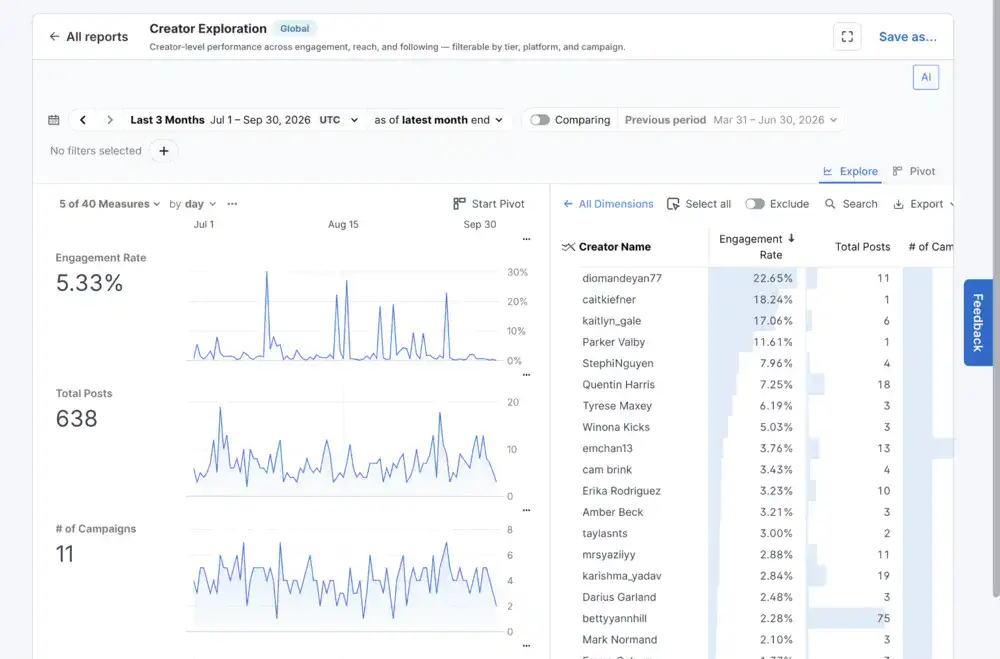
MeasureIQ brings together campaign, creator, content, paid-media, and payment data. Its analytics agent responds to plain-language questions with answers and charts, while users can also build reports through filters and other reporting tools.
The platform supports comparisons by creator tier, platform, campaign, content type, region, and tags. Nine reporting templates provide starting points for tasks such as program overviews and creator analysis. Reports can be exported to CSV, Excel, or Parquet.
An illustrative question might be: which creators produced the strongest results for a particular product category last quarter, and how did paid support affect the comparison?
Answering that usefully requires an agreed definition of “strongest.” Engagement, attributed orders, approved revenue, and profit measure different outcomes.
Affiliate teams assessing the product should establish which sales, returns, commission, and customer records are present in their configuration. A creator analytics dashboard needs those connections to answer transactional questions.
Our guide to the affiliate data stack explains how tracking, CRM, reporting, and finance records contribute different parts of that picture.
SafeIQ: Content Review and Wider Reputation
SafeIQ was first announced in October 2025. Its underlying approach combines analysis of text, audio, and visuals, with findings assessed against a brand’s own suitability standards.
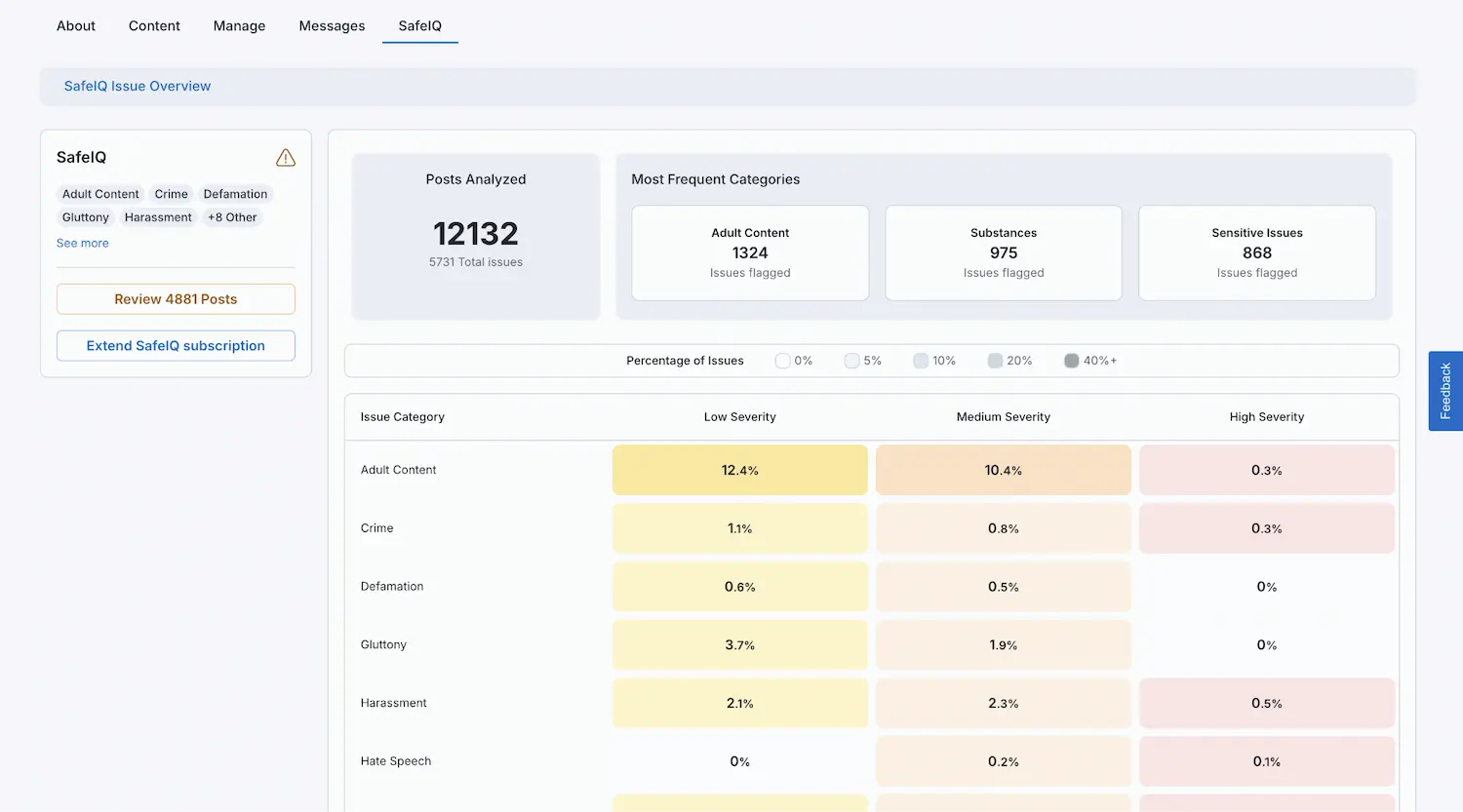
The updated SafeIQ offering adds web monitoring for information about a creator beyond their own posts. New heatmaps organize findings by category and severity, helping reviewers see where concerns concentrate.
Existing functions include Lookback for historical content checks and Monitoring for ongoing partner activity. Findings include context and timestamps, and CreatorIQ says the system adapts to reviewers’ decisions.
The company claims SafeIQ can reduce review of a 40-minute video to about one minute. That is a vendor performance claim; actual review time will depend on the content, standards, and decisions required.
For an affiliate program, suitability review can inform recruitment and ongoing relationships. Transaction validation, suspicious traffic checks, and commission approval still require their own evidence.
Affiverse’s podcast on AI affiliate fraud and partner vetting discusses those wider partner-quality questions, including synthetic content and suspicious engagement.
How Affiliate Teams Could Evaluate the Update
Consider a retailer planning creator activity across several markets. In an illustrative workflow, SafeIQ could support the review of shortlisted partners, while MeasureIQ organizes campaign results. Once Q’s broader functionality is released, its proposed role would include helping discover creators and prepare subsequent campaigns within approved rules.
Each handoff would depend on the retailer’s configured connections, reporting definitions, and approval process. The team would need to decide who accepts a creator recommendation and who can commit campaign resources.
A useful evaluation would begin with one defined task and a known dataset:
- MeasureIQ: Rebuild an existing campaign report, compare totals with approved records, and investigate discrepancies. Assess calculation accuracy, time saved, and whether colleagues can reproduce the result.
- SafeIQ: Review a sample of creators against documented brand standards, then compare the tool’s findings with human decisions. Record both missed issues and unnecessary flags.
- Future Q workflows: Map which actions require approval, who owns exceptions, and how completed actions will be checked. Assign clear responsibility for recruitment recommendations, outreach, and campaign commitments.
What Teams Should Consider Before Adoption
CreatorIQ’s announcement outlines the products’ roles and rollout timing. Teams evaluating the update can use a demonstration to explore how the tools would fit their existing processes.
Practical questions include feature access, pricing, supported data connections, content and language coverage, permissions, and the scope of Q’s initial release. CreatorIQ describes SafeIQ as an add-on product, so teams should confirm which capabilities their package includes.
For affiliate teams, a demonstration using their own reporting definitions and review criteria would help assess day-to-day fit. It would also help them plan around the capabilities available now and those scheduled for Q’s broader release in 2027.
Everflow
Connect
Tradedoubler
Connect
1win Partners
Connect
PIN-UP Partners
Connect
Shopnomix, a Nomix Group Company
Connect
V.Partners
Connect
Huffson Group
Connect
Kawaii Partners
Connect
Share your expertise and expand your reach and become a content contributor with us today!
Contact Us To Find Out More