Google Tests Local Coupons That Charge Retailers on Redemption
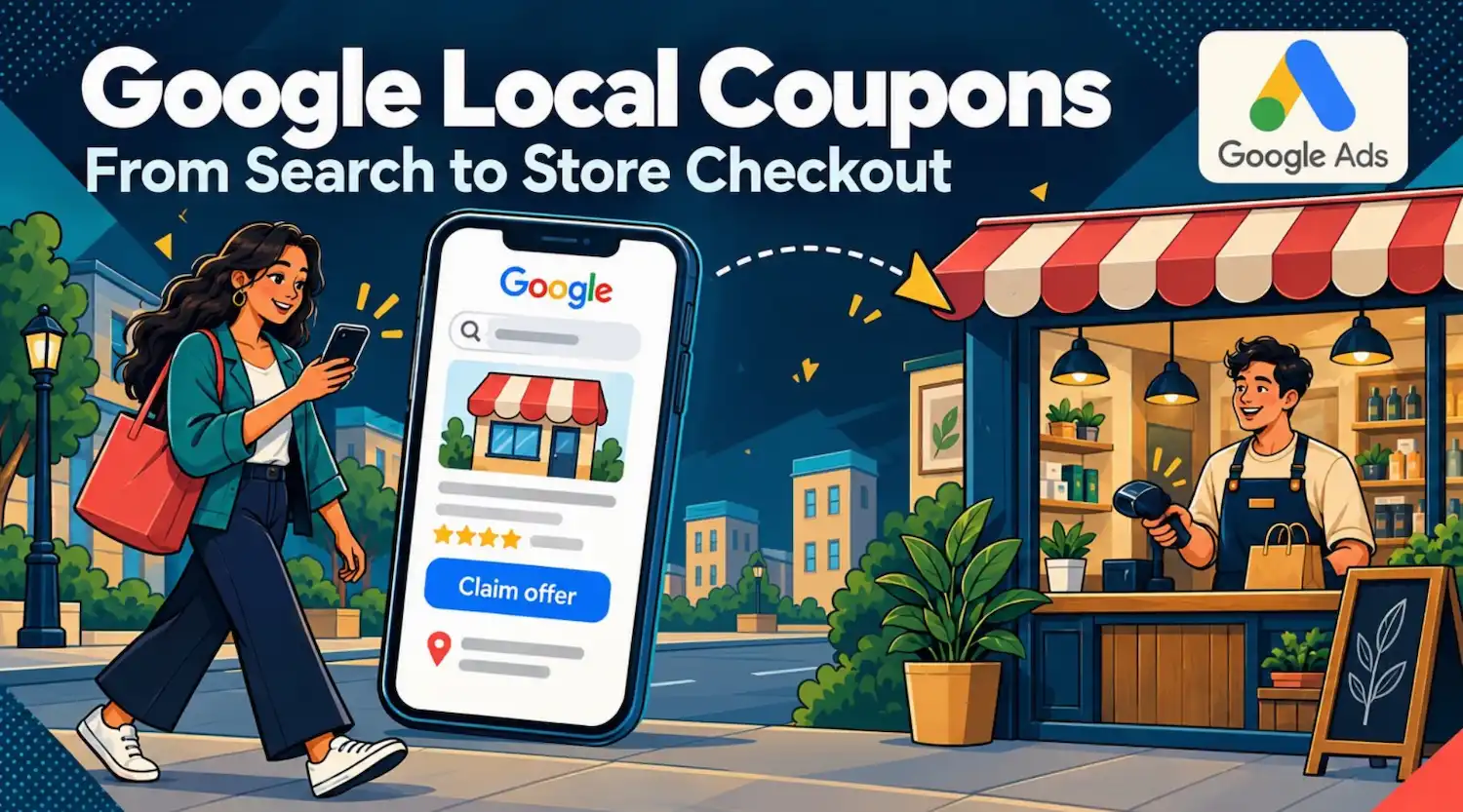
Google is piloting Local Coupons, a Search advertising format that lets nearby shoppers claim retailer discounts and redeem them in physical stores. Retailers pay Google when a coupon is used at checkout. For affiliate and performance teams, the pilot offers another way to assess the cost of driving store purchases, alongside familiar questions about how much credit a recorded redemption should receive.
Key Takeaways: Google’s Local Coupons Pilot
- Payment follows redemption: Google and its partners describe a model where retailers pay when shoppers use their coupons in store.
- Access is limited: Lightspeed describes its integration as a closed beta for selected US accounts.
- Sales lift needs separate analysis: A recorded redemption does not establish whether the purchase would have happened without the offer.
From Google Search to the Store Checkout
Google Customer Solutions Vice President Selin Song introduced the pilot with a video showing how shoppers move from a Search offer to an in-store discount. Her announcement, shared by Clover, names Clover and Lightspeed Commerce as early partners.
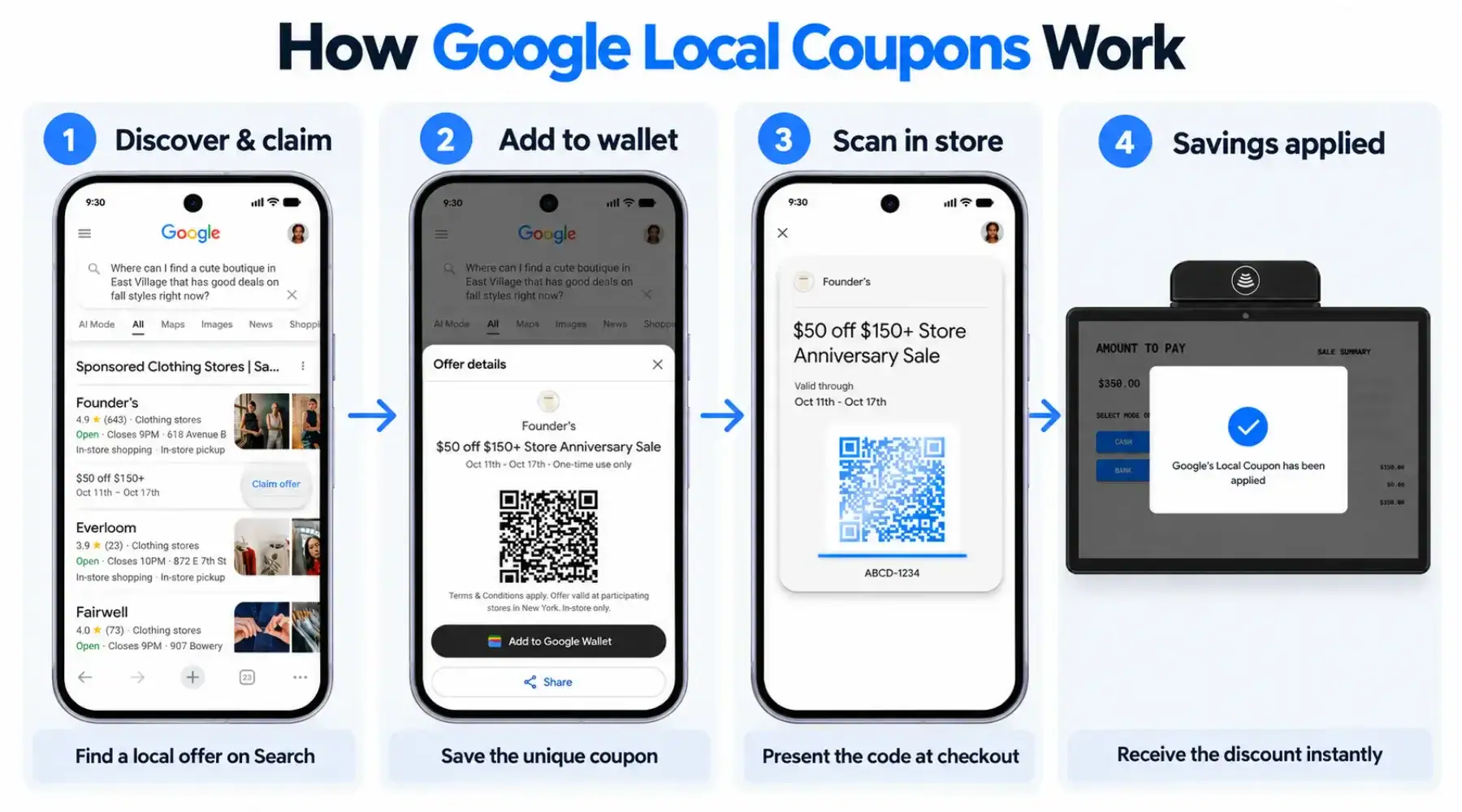
The demonstration shows four steps:
- Discover and claim the offer. A shopper finds a promotion within sponsored local store results on Search and selects “Claim offer.”
- Save it to a wallet. The offer details display a unique code, promotion terms and an “Add to Google Wallet” button.
- Present the code in store. The shopper opens the saved coupon and presents its QR code to be scanned at checkout.
- Receive the discount. Once the coupon is accepted, the savings apply to the purchase.
The example shown offers $50 off a purchase of $150 or more. Its terms include validity dates, a one-time-use restriction, and participating-store conditions. These details belong to the demonstration offer.
How Retailers Set Up and Pay for Offers
According to Lightspeed’s setup documentation, eligible retailers create and manage campaigns through Retail POS, with a bid per redemption and a monthly spending cap.
Google handles monthly billing, while Lightspeed says it charges no fee for launching or running the campaign. If nobody redeems a coupon, the advertising bill is zero.
The Lightspeed setup also requires a verified Google Business Profile with details matching the retailer’s location information.
A Familiar Payment Principle for Affiliate Teams
Paying against a recorded purchase already exists in affiliate marketing. Awin’s card-linked offers documentation describes a cost-per-sale model connecting online and offline activity. Customers activate offers through banking or rewards platforms, and purchase transactions are passed to Awin.
Local Coupons uses a different redemption process, but the commercial comparison is relevant. A retailer running search advertising alongside affiliate, cashback, and loyalty partnerships could compare the cost and customer mix each route delivers.
That comparison needs to account for the discount funded by the retailer as well as the advertising charge or partner commission. Paying after redemption changes when an advertising cost arises; profitability still depends on the economics of the purchase.
Affiverse’s podcast with James Bannerman on card-linked offers explores related questions around acquisition, retention, and building offers alongside an existing affiliate program.
A Redemption Records One Part of the Journey
Consider an illustrative shopper who discovers running shoes through a creator, reads a publisher’s comparison, and later searches for a nearby store. They claim Google’s coupon and use it at checkout.
The redemption connects the offer to that transaction. Establishing how the creator, publisher, and search ad influenced the decision requires a wider view of the journey.
Brands would also need to assess whether the offer attracted a new customer, brought back a lapsed buyer, or discounted a purchase an existing customer already intended to make. A completed redemption can support transaction reporting, but measuring additional sales requires a comparison with what would likely have happened without the campaign.
How Teams Could Evaluate the Pilot
For brands comparing Local Coupons with affiliate and loyalty activity, a useful assessment would cover:
- Total acquisition cost: Include the advertising fee, customer discount, and any overlapping partner costs.
- Customer mix: Compare new, returning, and lapsed customers where the available data supports those distinctions.
- Additional sales and margin: Use an appropriate test or comparison group to assess changes in purchases and profit.
- Credit and sale validation: Establish how overlapping channel contributions, returns, and canceled purchases will be handled.
These are evaluation criteria for the retailer’s measurement plan. They should not be assumed to be built-in features of Google’s pilot.
Lightspeed Confirms an Invitation-Only US Pilot
Lightspeed’s announcement confirms that it is partnering with Google Ads to test Local Coupons with eligible merchants in an invitation-only US pilot. Retailers can promote offers on Google Search and pay when a shopper redeems a single-use code at their Lightspeed point-of-sale system. The company says further availability updates will follow.
Local Coupons is distinct from Google’s automated promotions, which extract website offers for eligible Search and Performance Max campaigns. That feature concerns how promotions are sourced and attached to ads; Local Coupons introduces the in-store redemption workflow described by Google and its partners.
Our earlier coverage of Google’s AI search advertising and shopping updates explains the broader move toward placing offers closer to purchase decisions. For affiliate teams, the practical comparison is how Google’s pilot performs alongside existing affiliate and loyalty partnerships, accounting for the customer discount, acquisition costs and additional sales.
Everflow
Connect
Tradedoubler
Connect
1win Partners
Connect
PIN-UP Partners
Connect
Shopnomix, a Nomix Group Company
Connect
V.Partners
Connect
Huffson Group
Connect
Kawaii Partners
Connect
Share your expertise and expand your reach and become a content contributor with us today!
Contact Us To Find Out More