Google Appeals EU Search-Data Rules Designed to Help AI Rivals
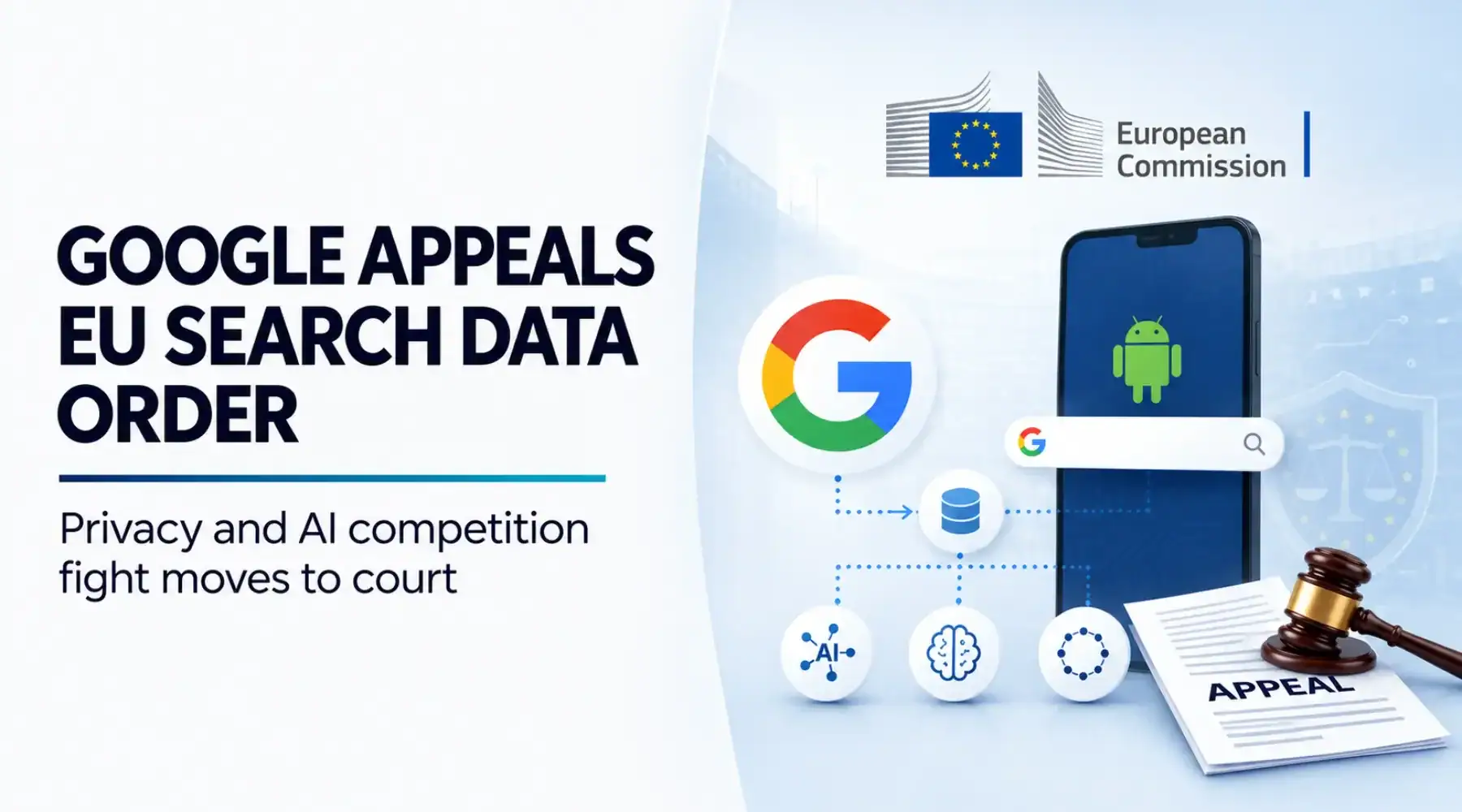
Google has filed two legal challenges against European Commission decisions requiring it to share anonymized Search data with eligible rivals and give competing AI services access to Android features.
The company says the measures risk user privacy and device security. The Commission argues that its safeguards prevent individual search histories from being reconstructed while giving search engines and AI assistants information that could help them compete.
Key Takeaways: Google Challenges the EU’s AI Competition Measures
- Google filed two challenges with the EU’s General Court on September 28.
- One concerns anonymized Google Search data for eligible search engines and AI chatbots.
- The second covers access to 11 Android features currently available more extensively to Google services.
- Google says the requirements provide insufficient privacy and security protection.
- The Commission says direct identifiers and sensitive queries will be removed before any data is shared.
- Filing the challenges does not automatically suspend the decisions.
- The rules do not introduce publisher compensation, citations or affiliate attribution.
Google Challenges Two Digital Markets Act Decisions
The appeals concern two binding decisions adopted by the European Commission on July 16 under the Digital Markets Act.
One requires Google to provide eligible competing search services with anonymized ranking, query, click and view data. AI chatbots offering online search functions may also qualify.
The other requires Google to give third-party AI services access to 11 Android features under conditions comparable to those available to Gemini and other Google services.
Google filed the challenges with the EU’s General Court on September 28, according to Reuters.
Oliver Bethell, Google’s senior director of competition, said:
We’re appealing decisions that will force us to share people’s private search history without sufficient anonymisation and weaken vital security protections on Android.
The Commission Disputes Google’s Description of the Data
The European Commission’s official Search-data guidance describes a more restricted dataset than Google’s statement suggests.
Before sharing the information, Google must remove usernames, IP addresses and other direct identifiers. Records containing rare terms, unusually long queries or information such as passwords, addresses and bank details must also be suppressed.
The Commission says the remaining queries cannot be readily connected to the same person. Location, device and language information must be grouped so that each user sits within a set of at least 1,000 people with similar characteristics.
Access will be limited to eligible search providers that pass an independent audit. Recipients cannot combine the information with other datasets, attempt to identify users or pass it to another party.
They may use the data to improve query understanding, indexing, ranking and retrieval. They cannot use it to train general-purpose AI models, build advertising profiles or systematically reproduce Google’s results.
Android Appeal Covers 11 AI Features
The second challenge concerns features that allow AI assistants to operate more deeply within Android.
The Commission’s Android interoperability decision covers voice activation, actions across other apps, contextual information, screen automation, on-device AI models and background execution.
The objective is to let users choose another AI assistant without that service receiving more limited access than Gemini.
Most requirements are due to be implemented through Android 18 by August 1, 2027. Support for multiple assistants using always-on voice activation has a later deadline of August 2028.
What the Appeal Means for Affiliates and Publishers
Affiverse previously examined what the EU’s original Google decisions could mean for publishers and AI discovery.
Access to Google’s data could help competing search engines and AI assistants improve how they find, rank and retrieve online content. That may give affiliate publishers more platforms through which their reviews, comparisons and product information can be discovered.
However, greater competition does not guarantee more referral traffic. A rival AI service could use better retrieval to produce a more useful answer without generating a click to the source.
The decisions also do not require AI services to compensate publishers, preserve affiliate links or report when publisher content influenced a recommendation. The existing AI search attribution gap would therefore remain even if more services become capable of competing with Google.
Google’s Appeal Does Not Automatically Pause the EU Deadlines
Under Article 278 of the Treaty on the Functioning of the European Union, filing a challenge does not automatically suspend an EU decision. Google would need the Court to grant interim relief for the requirements to be paused while the case proceeds.
The Commission’s current timetable requires Google to finalize the anonymized Search dataset by November 2026 and its pricing offer by January 2027. No timetable has been announced for the General Court to decide the two challenges.
For affiliate publishers, the immediate question remains whether better-resourced AI and search competitors will create new sources of traffic or simply expand the number of platforms where commercial influence is difficult to measure.
Everflow
Connect
Tradedoubler
Connect
1win Partners
Connect
PIN-UP Partners
Connect
Shopnomix, a Nomix Group Company
Connect
V.Partners
Connect
Huffson Group
Connect
Kawaii Partners
Connect
Share your expertise and expand your reach and become a content contributor with us today!
Contact Us To Find Out More