IAB Europe: 58% Expect Agentic Ad Buying to Reach Regular Use or Scale
More than half of respondents to a new IAB Europe survey expect AI agents to play a regular role in buying and selling ads within a year. The 58% figure combines two forecasts: 28% expect day-to-day use, while 30% expect agents to become a main trading method in some markets. Behind those expectations lies a practical question for performance teams: who sets the limits, measures the results, and answers for decisions an agent makes?
Key Takeaways: IAB Europe’s Agentic Advertising Findings
- 86% of respondents say their organization uses AI for marketing, but that includes many uses outside autonomous ad buying.
- 58% expect agentic buying to reach regular use or become a main trading method in some markets within a year.
- AI investment is rising, yet respondents gave its current performance in advertising operations an average rating of 2.76 out of five.
- 78% identify a formal owner for AI governance, while 48% report guidelines specifically for advertising and marketing.
- The survey reflects 50 industry respondents. It measures their reported practices and expectations, not adoption across the European advertising market.
What the 58% Forecast Actually Means
IAB Europe’s 2026 Impact of AI on Digital Advertising Report asked 50 respondents what they expect agentic ad buying to look like over the next year.
| Expected development within a year | Respondents | Share |
|---|---|---|
| A main way of buying and selling ads in some markets | 15 | 30% |
| Day-to-day use, but not a main trading method | 14 | 28% |
| Further development, but little day-to-day use | 9 | 18% |
| No value from the investment | 4 | 8% |
| Don’t know | 8 | 16% |
The first two groups produce the 58% figure, but they describe different levels of use. There is no majority view on how far the technology will advance, and saying that 58% expect agentic buying to scale would go further than the survey supports.
The sample matters, too. IAB Europe collected 50 valid responses between April 10 and June 29, 2026, through industry outreach. Of the 49 respondents who identified their role, 17 worked at agencies and 14 at ad-tech companies; five each were advertisers and publishers. The report says the findings should not be generalized to the whole European market. It also cautions against treating differences from its 2025 survey as a direct year-over-year trend because the questionnaire and sample changed.
AI Use Is Common; Independent Agents Are Less So
The report draws a distinction between using AI somewhere in marketing and allowing an agent to act independently. Forty-three of 50 respondents say their organizations use AI for marketing. Among a smaller group answering questions about advertising workflows, reporting, analysis, and dashboards were the most commonly selected use, followed by programmatic optimization and media planning. Eleven of those 29 respondents selected agentic buying and selling.
IAB Europe also asked respondents to describe their most advanced agentic system in day-to-day use. Of 47 who answered, 36 either had no such system or described one that people direct or plan with. Under the report’s five-level scale, Level 1 means a person directs and decides while the agent acts. At Level 2, the person and agent plan, delegate, and execute together. Only the highest level describes an agent operating autonomously under monitoring.
That makes “agentic” a broad label. An assistant recommending bid changes and a system allowed to move budget between campaigns pose different questions about approval and control. Affiverse has covered one example of the direction suppliers are taking: Warner Bros. Discovery’s work with AWS is intended to bring agentic technology into planning, forecasting, and measurement. Its announced plans show where systems may be headed; they do not establish how well those systems perform in use.
Investment Is Rising Faster Than the Evidence Base
Among the 29 respondents who answered the investment questions, 21 reported higher general AI spending than in 2025 and 17 reported increased spending on AI marketing technology. When the same group was asked how it evaluates AI tools, 20 selected operational efficiency, 14 selected CPM improvement, and 13 selected faster or more accurate reporting. Five said they did not measure AI tools formally.
Those measures can show whether a team saves time or buys media more cheaply. They answer a different question from whether an agent brings in customers who would otherwise have been missed. The report notes that only seven of the 21 respondents increasing general AI investment had developed an AI advertising case study.
The average 2.76 out of five rating is another reason for care with the headline. It came from 21 respondents rating AI’s performance in their current advertising operations. It is a subjective rating, not a campaign performance benchmark or a score for agentic buying specifically. Investment, expectations, and demonstrated returns should be read separately.
Governance Has an Owner, But Campaign Rules May Be Missing
IAB Europe reports that 78% of respondents identify a formal AI governance owner. That does not necessarily tell a media buyer which actions an agent may take. Thirty-two of 50 respondents report company-wide AI guidelines, while 24 report guidelines written specifically for advertising and marketing. The full report also shows a split between rule-setting and responsibility: among 27 people answering who would be accountable if AI affected spend, targeting, or creative, 12 named the internal user and nine named an AI governance lead.
For an affiliate program, that gap could surface quickly. Suppose an agent is allowed to expand a paid search campaign after finding cheap conversions. It might select a partner’s branded terms, change ad copy, send traffic to a different landing page, or increase spend in a market the advertiser has excluded. Affiverse’s analysis of buying traffic explains why unauthorized brand bidding and conversions from brand-aware customers can distort a paid affiliate’s apparent value. Each choice could look efficient in a platform dashboard while breaching program terms or changing the quality of the customers acquired.
Before connecting an agent to live campaigns, program managers and media buyers can agree on three controls:
- Allowed activity: Specify permitted keywords, markets, traffic sources, offers, and landing pages.
- Approval points: Set budget limits and identify which bid, targeting, and creative changes require a person’s approval.
- Responsibility: Decide who can pause a campaign, review the agent’s changes, and investigate a disputed result.
Affiliate Measurement Needs Its Own Test
An agent optimizing for attributed conversions may concentrate spend where customers are already close to buying. For example, a branded search campaign could deliver a low cost per acquisition by capturing existing demand. If those sales are also eligible for affiliate commission, both systems could report success while the advertiser pays twice for a customer it was likely to reach.
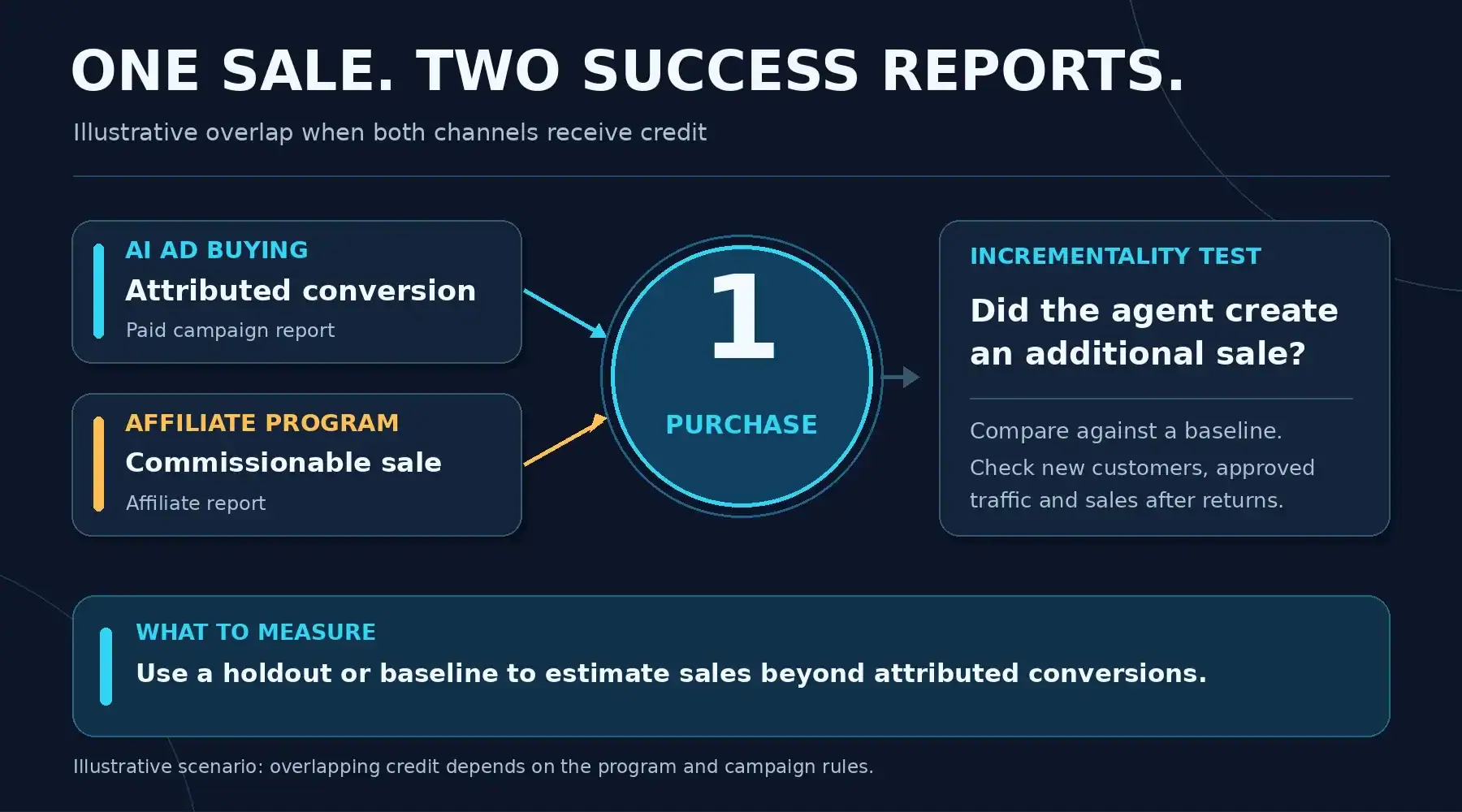
A useful test would compare agent-led campaigns against a defined baseline: new customers, approved traffic sources, conversion quality, and sales after returns or reversals. Where feasible, teams can use a holdout or another incrementality test to ask whether the agent generated additional demand. Affiverse’s webinar on measuring affiliate sales impact discusses why those tests need input from affiliate, paid media, and data teams. Teams should also retain a record of bid, budget, placement, and creative changes so that a result can be traced to the decisions that produced it.
The questions connect with Affiverse’s paid-media discussion with Andrei Blosh: faster analysis and optimization still depend on sound campaign preparation and tracking. An agent can act on the conversion signal it receives; program teams have to decide whether that signal reflects the commercial outcome they want.
What Would Make Agentic Buying Easier to Assess?
The report found demand for guidance: 31 of 50 respondents said they would benefit from AI marketing guidelines developed by an industry association. Their written responses called for clearer protocols around agentic advertising, human oversight, and evidence that helps teams compare results. IAB Europe also found that lack of expertise or training was the most frequently selected barrier to AI adoption.
For affiliate and performance teams, the immediate question is whether a particular system can operate within a program’s rules, show the decisions it made, and demonstrate that those decisions improved outcomes beyond what existing campaigns would have delivered. The survey suggests considerable interest in getting there. It also shows why buyers will need stronger evidence as they give agents more control.
Everflow
Connect
Tradedoubler
Connect
1win Partners
Connect
PIN-UP Partners
Connect
Shopnomix, a Nomix Group Company
Connect
V.Partners
Connect
Huffson Group
Connect
Kawaii Partners
Connect
Share your expertise and expand your reach and become a content contributor with us today!
Contact Us To Find Out More