AI Search Content Strategy for Affiliates: Why GEO Is Not a Shortcut
As AI Overviews, AI Mode and assistant-led search change how users discover products, offers and recommendations, generative engine optimization is becoming harder for affiliates to ignore. The question is no longer whether GEO matters, but how affiliate teams should approach it without chasing shortcuts.
A strong AI search content strategy for affiliates should build on SEO discipline: useful content, clear structure, original value, technical accessibility and trust signals. Treating GEO as a set of tricks designed to influence AI-generated answers risks repeating the same mistakes that made parts of early SEO so fragile.
Key Takeaways for Affiliate GEO Strategy
- Generative engine optimization for affiliates should support SEO, not replace it.
- GEO shortcuts such as thin FAQs, generic AI-written summaries and artificial authority signals can weaken content quality.
- AI search still depends on crawlable, structured and useful pages that give systems a reason to retrieve and trust them.
- Affiliate content needs original value, clear comparison logic and current commercial information to stand out in AI-led discovery.
- The strongest GEO strategy for affiliates is a sustainable AI search content strategy built around readers, not only rankings or citations.
What GEO Means for Affiliate Content
GEO, or generative engine optimization, is the practice of making content easier for AI search systems to understand, retrieve and reference in generated answers.
For affiliates, this matters because affiliate content often sits close to the decision-making stage. Review pages, comparison guides, tutorials, product explainers and deal content are all built to help users choose between options. As search moves from traditional results pages to AI-generated summaries, those pages may influence discovery before a user clicks.
That does not mean affiliates need to treat GEO as a separate channel from SEO. The stronger approach is to understand how SEO and GEO work together and build content that supports both.
A strong GEO strategy for affiliates should answer four simple questions:
- Does the page answer a real buyer question clearly?
- Does it add value beyond information already available elsewhere?
- Can users and search systems understand why the page should be trusted?
- Is the content structured in a way that supports both reading and retrieval?
Those are not only GEO questions. They are also the foundations of sustainable SEO.
Why GEO Shortcuts Can Weaken Affiliate Content
Every major change in search creates a rush for quick wins. In traditional SEO, that often meant keyword stuffing, thin pages, copied content, doorway pages and low-quality link building. Some of those tactics worked for a short time, but many became long-term risks. AI search is creating a similar pattern.
Common GEO Shortcuts Affiliates Should Avoid
Affiliates may be tempted to use tactics such as:
- Mass-produced FAQ sections
- Generic AI-written summaries
- Artificial authority signals
- Forced content structures
- Tools that promise AI visibility without improving the page
The risk is simple: these tactics create content for systems, not readers.
If a page exists mainly to trigger an AI citation, it may fail when a real user lands on it. The page still needs to answer the question, explain the recommendation and help the reader make a better decision.
Why GEO Shortcuts Create Long-Term SEO Risk
GEO still depends on strong SEO foundations. AI search systems need pages that are crawlable, indexable, useful and easy to understand. They also need content with original value, clear structure, and a reason to be trusted. That makes the shortcut mindset weaker than it looks. If the page is thin, GEO tactics will not fix it. They will only make the weakness easier to see.
The same pattern shows up in search quality updates. Google’s June 2026 spam update is a reminder that low-value search tactics can become liabilities when systems get better at identifying pages built mainly to manipulate visibility.
What Early SEO Shortcuts Can Teach Affiliates About GEO
The early days of SEO were full of experimentation, and that was not always a bad thing. Marketers tested how search engines worked, publishers improved site structure, and businesses started to understand how visibility could be shaped online.
The problem came when experimentation turned into shortcuts. Tactics such as keyword stuffing, thin landing pages, copied content and low-quality links often worked briefly, but became weaker as search engines improved.
GEO is now entering a similar stage. There is interest, uncertainty and pressure to move quickly. For affiliates, the risk is familiar: building content for AI systems before asking whether the page actually helps a reader make a better decision.
| Early SEO shortcut | Similar GEO risk | Better long-term approach |
|---|---|---|
| Keyword stuffing | Overloading pages with repetitive AI-facing phrases | Write clearly around real buyer questions and intent |
| Thin landing pages | Mass-producing low-value AI summaries or FAQs | Build pages with original value, context and decision support |
| Copied content | Rewriting merchant copy without adding insight | Add comparisons, testing notes, examples or updated details |
| Low-quality links and artificial signals | Chasing fake authority signals or AI visibility tricks | Build trust through useful content, structure and transparency |
| Pages built only to rank | Pages built only to be cited by AI | Create pages that help users first, then support retrieval |
The lesson from early SEO is not that affiliates should ignore new tactics. It is that they should avoid building a strategy around methods that only work while the system is still immature. If a GEO tactic depends on volume, repetition or artificial signals rather than usefulness, it is unlikely to be a strong long-term foundation.
GEO Dos and Don’ts for Affiliate Content
The clearest mistake is treating generative engine optimization for affiliates as a formatting exercise.
Adding more FAQs does not make a weak page useful. Splitting content into artificial answer blocks does not create authority. Publishing hundreds of similar AI-assisted pages does not prove expertise. Repeating product claims from a merchant page does not give an AI system or a user a reason to prefer the affiliate version.
A sustainable AI search content strategy for affiliates starts with usefulness. The goal is not to create content that looks optimized for AI search. The goal is to create content that helps readers make better decisions and gives search systems stronger reasons to retrieve, understand and trust the page.
| Don’t | Do | Why it matters |
|---|---|---|
| Mass-produce “best” lists with little original evaluation | Explain why each product, platform or offer is included | AI search and readers both need clear selection logic |
| Build FAQ sections from scraped search prompts | Answer real buyer questions that support the decision journey | Useful FAQs should clarify intent, not add filler |
| Use generic pros and cons that could apply to any product | Add specific trade-offs, limitations and use cases | Specificity makes affiliate content harder to replace with a generic AI answer |
| Repeat merchant copy without adding context | Add comparisons, examples, testing notes or updated details | Affiliate pages need value beyond the source material |
| Chase artificial authority signals or forced content structures | Build trust through accuracy, transparency and clear sourcing | Trust signals need to support the reader, not just the system |
| Optimize for AI citations while ignoring disclosures and freshness | Keep commercial relationships, terms and recommendations clear and current | Affiliate content depends on credibility and accuracy |
This is where Google’s AI search guidance for affiliates becomes useful. The practical message is not that AI search requires a completely new discipline. It is that content needs to give search systems stronger reasons to retrieve, understand and trust it.
How Affiliate Content Can Add Original Value
For affiliates, original value can come from several places:
- First-hand product testing or platform experience.
- Screenshots, examples or process walkthroughs.
- Clear comparison logic.
- Market context that helps users understand their options.
- Updated terms, limitations and eligibility details.
- A visible explanation of how recommendations are selected.
That kind of content is harder to produce at scale, but it is also harder to replace with a generic AI answer.
Why Query Fan-Out Changes the Affiliate Content Brief
AI search also changes how affiliates should think about content depth.
Traditional SEO often starts with a primary keyword and a set of supporting terms. That still matters, but AI search can break a user’s query into several related sub-queries before forming an answer. That is why query fan-out changes affiliate content planning. A shallow affiliate page may answer the surface query but miss the surrounding questions.
A user searching for the best software, finance tool, travel product or subscription service may also want to know about pricing, cancellation terms, alternatives, user types, setup time, risk, support, refunds or long-term value. AI search can look across those related needs when forming an answer.
This does not mean every page should become longer. It means the brief should become more complete.
What an AI Search Content Brief Should Include
A stronger affiliate content brief should include:
- The main user question.
- The follow-up questions a buyer is likely to ask.
- The comparison criteria that actually affect the decision.
- The proof needed to support each claim.
- The internal pages that help build topical depth.
- The commercial details that must be clear and current.
That is where GEO and SEO meet. The page is still optimized for search, but the work starts with decision support, not keyword repetition.
Why AI Search and GEO Measurement Will Be Messier
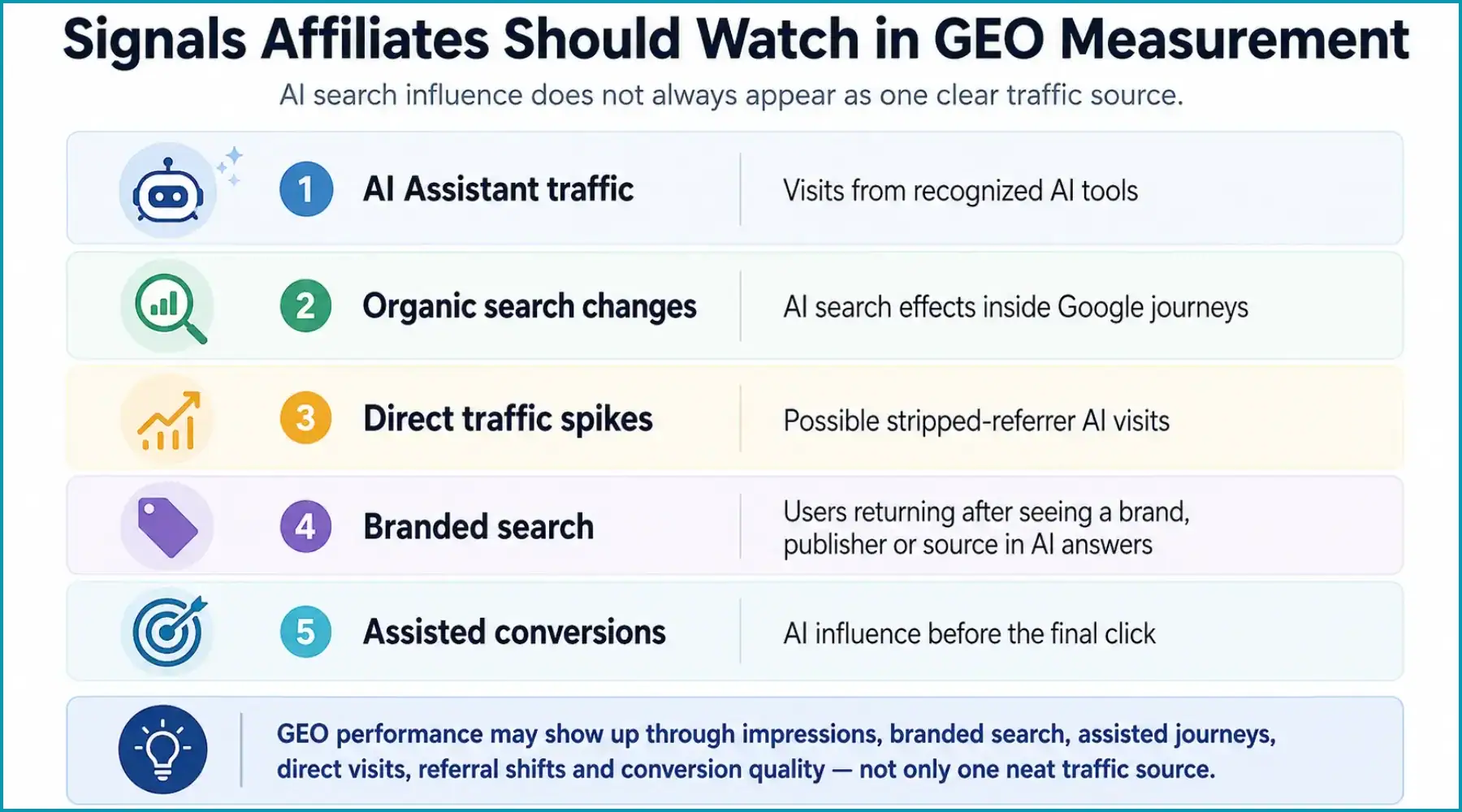
Affiliates should also avoid judging GEO only through clean referral traffic. AI search may influence a user before they click. A user might see a brand, publisher or recommendation in an AI-generated answer, then return later through organic search, direct traffic, paid search or a different device. That makes attribution harder.
AI search visibility reporting is starting to give site owners more context around how pages appear across AI-led search experiences, but reporting is still developing.
GA4 has also added a cleaner way to identify some assistant-led visits, which can help affiliates track AI assistant traffic in GA4. Even then, AI traffic can still disappear into Direct when referrer data is missing. That means affiliates need a broader measurement mindset.
How Affiliates Should Build GEO Into SEO Strategy
The strongest GEO strategy for affiliates is not a shortcut. It is a more demanding version of SEO.
That means building pages that are easy to crawl, easy to understand and genuinely useful for the reader. It means adding original value where AI summaries are likely to flatten generic information. It means keeping affiliate content current, transparent and specific. It also means resisting the urge to chase every new AI visibility tactic before asking whether it improves the page.
Understanding the difference between AEO, GEO and SEO can help teams get the language right. But the practical work is much simpler: create content that deserves to be found, summarized, cited and clicked.
Affiliates do not need to abandon SEO for GEO. They need to stop treating GEO as a loophole.
The sites most likely to benefit from AI search will be the ones that already give users and search systems a clear reason to trust them. That is not a shortcut. It is the work.
FAQs About GEO Strategy for Affiliates
What is GEO in Affiliate Marketing?
GEO, or generative engine optimization, is the process of making content easier for AI search systems to understand, retrieve and reference in generated answers. For affiliates, it affects review pages, comparison guides, product explainers and other content used during decision-making.
Is GEO Replacing SEO for Affiliates?
No. GEO should support SEO, not replace it. AI search still depends on crawlable, useful and structured pages, which means SEO fundamentals remain important for affiliate visibility.
How can Affiliates Optimize for AI Search Without Shortcuts?
Affiliates should focus on useful content, clear comparison logic, original value, current information and transparent commercial context. The goal is to help readers make better decisions, not to create pages designed only to trigger AI citations.
What GEO Tactics Should Affiliates Avoid?
Affiliates should avoid mass-produced FAQ sections, generic AI-written summaries, copied merchant content, artificial authority signals and pages built mainly to appear in AI answers. These tactics can weaken content quality and create long-term search risk.
Everflow
Connect
Tradedoubler
Connect
1win Partners
Connect
PIN-UP Partners
Connect
Shopnomix, a Nomix Group Company
Connect
V.Partners
Connect
Huffson Group
Connect
Kawaii Partners
Connect
Share your expertise and expand your reach and become a content contributor with us today!
Contact Us To Find Out More