ChatGPT Ads Guide: How to Set Up, Target, and Measure Campaigns
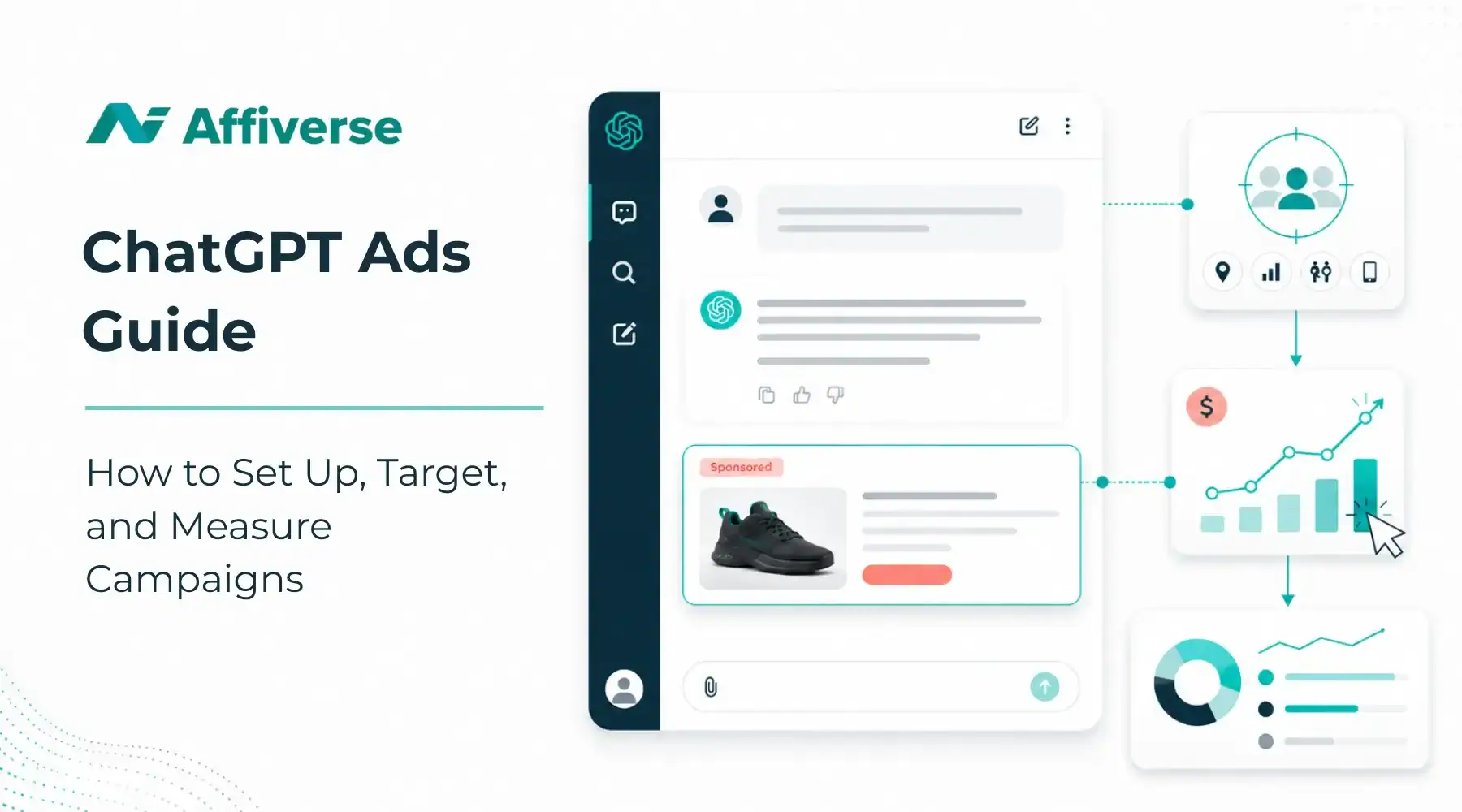
ChatGPT Ads allows businesses to place clearly labeled sponsored messages below relevant ChatGPT responses as users research products, compare options, and make decisions. The platform considers conversational context alongside campaign settings, creative, landing pages, and advertiser-provided context hints. This guide explains how performance marketers, agencies, e-commerce teams, and affiliate managers can set up, target, and measure campaigns while treating ChatGPT Ads as a beta channel for structured testing.
What Are ChatGPT Ads?
ChatGPT Ads is OpenAI’s advertising platform for displaying sponsored placements within eligible ChatGPT experiences. Campaigns are created and managed through OpenAI Ads Manager Beta, where advertisers can choose objectives based on reach, clicks, or conversions, organize ads into focused groups, and review performance data.
According to OpenAI’s ChatGPT Ads documentation, the platform differs from conventional paid search because advertisers do not simply select a list of exact keywords. OpenAI assesses multiple relevance signals, including conversational intent, ad content, landing pages, and context hints. Its campaign tools, formats, inventory, and measurement capabilities are still developing.
Where Ads Appear in ChatGPT
Sponsored units can appear below the end of a ChatGPT response. They are clearly labeled as sponsored and visually separated from the organic answer, allowing users to distinguish between information generated by ChatGPT and a paid placement.
A standard ad includes the advertiser’s name and logo, a headline, descriptive copy, an image, and a landing-page link. Context hints do not guarantee that an ad will appear in a specific conversation or against a particular prompt.
Who Can See ChatGPT Ads?
OpenAI began testing ads in the United States on February 9, 2026 and describes the rollout as deliberate and phased. Ads may appear to users on the Free and Go plans, while Plus, Pro, Business, Enterprise, and Edu accounts remain ad-free.
OpenAI does not show ads in accounts where a user says, or the platform predicts, that they are under 18. Temporary Chats also do not contain ads. For logged-out users, where OpenAI may not have age information, it says the advertising experience is designed to show ads considered appropriate for all ages.
This consumer rollout should not be confused with advertiser access to Ads Manager, which is available across a broader group of countries.
Do Ads Influence ChatGPT Answers?
OpenAI says advertising does not influence the content of ChatGPT’s answers. Paid placements operate through systems separate from the chat model, and advertisers cannot pay to shape, rank, or alter an organic response. Seeing an ad below an answer also does not mean that OpenAI endorses or recommends the advertiser.
This separation matters to brands, publishers, and affiliates assessing visibility inside conversational platforms. A publisher or another third-party source may contribute to an unpaid response while a brand purchases the sponsored position beneath it. Organic visibility may also depend on licensed information sources, as demonstrated by the decision to add Yelp data to ChatGPT’s local recommendations. Paid participation does not guarantee an organic mention, just as an unpaid mention does not necessarily indicate a commercial relationship.
Who Can Advertise Through ChatGPT Ads Manager?
Self-serve ChatGPT Ads Manager is currently available to advertisers in Australia, Canada, Japan, South Korea, New Zealand, the United Kingdom, and the United States. Businesses elsewhere can register their interest while OpenAI expands access.
Advertisers must provide business, account, and billing details, including their company name, website, industry, country, currency, and time zone. Verification is handled through Persona, while OpenAI also checks whether the advertiser’s products or services comply with its advertising policies.
How ChatGPT Selects and Ranks Ads
OpenAI selects ads based on expected relevance rather than a single keyword trigger. Signals may include:
- The context and intent of the conversation
- The advertiser’s landing page
- The ad title and copy
- Advertiser-provided context hints
- Campaign targeting settings
- Broader ChatGPT signals when ad personalization is enabled
Context hints describe the conversations, needs, or situations in which an offer may be useful. For example, a project-management platform could reference remote-team coordination, workload tracking, or replacing spreadsheets.
OpenAI recommends using descriptive phrases tied to genuine user needs and keeping each ad group focused on one product, audience, or use case. Meaningfully different offers should be separated rather than combined under one broad set of hints.
Context Hints vs Keywords
Context hints and paid-search keywords both connect advertising with user intent, but they work differently.
| Context hints | Traditional search keywords |
|---|---|
| Describe broader conversational needs and situations | Target specific terms or search queries |
| Help OpenAI understand when an offer may be relevant | Often rely on exact, phrase or broad matching rules |
| Do not guarantee delivery against a particular prompt | Can provide more direct query-level control |
| Work alongside the ad and landing-page content | Depend heavily on the chosen keyword list |
Context hints are broad relevance signals, not exact-match targeting rules. They help OpenAI recognize different ways users may describe the same need but do not guarantee delivery against a specific question or phrase. The ad, landing page, and context hints should therefore support the same commercial intent.
How the ChatGPT Ads Auction Works
ChatGPT Ads uses a relevance-weighted, second-price auction. Eligible ads are ranked using factors including expected relevance and the advertiser’s maximum bid, so a higher bid alone does not guarantee delivery.
Under a second-price model, the winning advertiser generally pays the amount required to beat the next eligible competitor rather than automatically paying its full maximum bid. A stronger bid may improve competitiveness, but it does not replace the need for relevant creative, focused context hints and an appropriate landing page.
ChatGPT Ads Objectives, Bidding and Costs
ChatGPT Ads supports three campaign objectives. The selected objective determines how delivery is optimized, which bidding model applies and how the advertiser is charged.
- Reach: Designed to generate impressions and visibility.
- Clicks: Intended to drive traffic to the advertiser’s website or product page.
- Conversions: Optimizes delivery toward clicks considered more likely to produce a selected event, such as a purchase, registration or lead.
How CPM, CPC and oCPC Campaigns Differ
Each campaign objective uses a corresponding buying model. Reach campaigns use CPM, click campaigns use CPC and conversion campaigns use oCPC.
| Objective | Buying model | Best for | How advertisers pay |
|---|---|---|---|
| Reach | CPM | Generating impressions and visibility | Per 1,000 impressions |
| Clicks | CPC | Driving website traffic and engagement | Per valid click |
| Conversions | oCPC | Prioritizing clicks more likely to produce a selected conversion event | Per valid click |
Conversion-optimized campaigns use one supported event to guide delivery. However, oCPC is not CPA buying: advertisers are still charged for valid clicks, and neither conversions nor a particular acquisition cost are guaranteed.
Campaign objectives cannot currently be changed after creation. Existing CPM or CPC campaigns cannot be converted into oCPC campaigns, and the selected conversion event cannot be replaced. A new campaign is required to use a different objective or event.
How Much Do ChatGPT Ads Cost?
OpenAI currently sets market-specific minimum daily campaign budgets:
| Advertiser market | Minimum daily budget |
|---|---|
| United States | $25 |
| Canada | C$25 |
| Australia | A$25 |
| New Zealand | NZ$25 |
| United Kingdom | £15 |
| Japan | ¥2,500 |
| South Korea | ₩25,000 |
For CPC campaigns, OpenAI recommends starting with a maximum bid of around $3–$5 per click. This is general guidance, not a guaranteed CPC, and the platform does not yet publish reliable benchmarks for CPM, CPC, CPA, conversion rates or return on ad spend.
The introduction of self-serve bidding marked ChatGPT’s move into pay-per-click advertising, but current costs still need to be assessed against each advertiser’s results. OpenAI provides no standard oCPC bid, and actual costs will depend on competition, location, inventory, relevance, audience settings and landing-page quality.
How Daily Budget Pacing Works
A daily budget is treated as an average over seven days, so actual spend may be higher or lower on individual days depending on available ad opportunities.
Daily spend can reach up to twice the selected budget, but total billed media spend is capped at seven times that amount over seven days. For example, a campaign with a $100 daily budget could spend more than $100 on one day, but should not exceed $700 across the full period.
The selected amount is therefore not a strict daily cap. Advertisers managing fixed promotional or client budgets should account for possible day-to-day fluctuations.
ChatGPT Ads Targeting Options
ChatGPT Ads combines location targeting with first-party audience controls. Advertisers can choose where campaigns are eligible to run, reach or exclude matched customer groups and adjust bids for selected audiences.
| Targeting option | How it works | Main consideration |
|---|---|---|
| Location targeting | Targets supported countries and more granular areas where available | Controls vary by market |
| Custom audiences | Uses matched first-party lists for inclusion, exclusion or bid adjustments | Requires a sufficiently large matched audience |
Location Targeting
Advertisers can target campaigns by country and, where supported, by state or region, city, designated market area or postal code. Available options differ by country, so advertisers should check the locations offered during campaign setup rather than assume the same controls apply in every market.
Custom Audiences
Custom audiences are created from first-party email addresses or phone numbers. Advertisers can use them to:
- Include selected customer or prospect groups
- Exclude existing customers or recent purchasers
- Increase or reduce ad-group bids for matched users
An audience must contain at least 25,000 matched users before it can be used, while OpenAI recommends at least 100,000. Uploaded lists may need to be larger because invalid, duplicate and unmatched records do not count.
These thresholds make custom audiences more practical for larger retailers, SaaS companies and subscription businesses than for smaller advertisers with limited first-party data.
How to Set Up a ChatGPT Ads Campaign
All standard campaign creation and management takes place through OpenAI Ads Manager Beta. The current process can be summarized in ten steps.
- Create and verify an Ads Manager account: Sign in with an OpenAI account, add the required business information and complete the verification process.
- Add billing and advertiser details: Create a billing profile, add a payment method and confirm the name and logo that should appear in sponsored placements.
- Choose the campaign objective: Select Reach, Clicks or Conversions. These use CPM, CPC and oCPC buying models respectively.
- Set the budget, schedule and locations: Choose a daily or campaign-total budget, enter the campaign dates and select the supported locations where ads should be eligible to appear.
- Create focused ad groups: Separate meaningfully different products, themes, audiences and use cases instead of placing unrelated offers together.
- Add descriptive context hints: Explain the conversations, situations and customer needs in which the product or service may be relevant.
- Create distinct ads and landing-page destinations: Add the advertiser name, title, description, image and destination URL. Ensure that each ad supports the intended use case and sends the user to an appropriate page.
- Configure conversion measurement: Install the OpenAI Pixel, connect the Conversions API or configure an eligible measurement partner before launching conversion-focused campaigns.
- Submit the campaign for review: Check that the ad, image, claims and landing page comply with OpenAI’s requirements and can be accessed by its advertising crawler.
- Check delivery and reporting after launch: Monitor the serving status and review impressions, clicks, spend, CTR, average CPC, average CPM and conversions where tracking has been configured. Compare these results with the advertiser’s own analytics and commercial data.
Guided Setup vs Bulk Upload
Ads Manager supports two main campaign-creation workflows.
| Feature | Guided setup | Bulk upload |
|---|---|---|
| Best for | First-time advertisers and smaller campaigns | Agencies and advertisers managing larger accounts |
| How it works | Creates campaigns step by step inside Ads Manager | Uploads campaigns, ad groups and ads through a structured template |
| Level of control | Easier to review each setting manually | Faster for managing many products, locations or creative variations |
| Main limitation | Less efficient at scale | Requires correctly formatted campaign data |
OpenAI also provides an Advertiser API for programmatic campaign management, while its Bulk API is currently available in limited preview for enabled accounts.
Campaign, Ad Group and Ad Structure
Every standard ChatGPT Ads campaign follows a three-level hierarchy. Keeping each level focused helps advertisers organize activity clearly and understand which settings are influencing delivery and performance.
- Campaign: Defines the overall commercial objective, budget, schedule, and target locations. Meaningfully different objectives, product categories, or regions should generally be placed in separate campaigns.
- Ad group: Organizes ads around a specific theme, audience, intent, or use case. This is where advertisers add context hints, set bids and apply eligible audience controls.
- Ad: Contains the sponsored message shown to users, including the advertiser name, title, description, image and landing-page destination.
A clear structure makes campaigns easier to manage and measure. Combining unrelated products, audiences or intentions can make it harder to identify which context hints, creative and landing pages are contributing to results.
ChatGPT Ad Creative and Landing-Page Dos and Don’ts
ChatGPT ads should clearly explain what the product offers, who it is for and why it may be relevant to the user’s conversation.
| Do | Don’t |
|---|---|
| Make the main benefit clear in the title | Use vague or exaggerated promotional claims |
| Add useful detail in the description | Repeat the title without adding information |
| Keep product, pricing and service claims accurate | Create expectations the landing page cannot support |
| Test different benefits, audiences and use cases | Limit testing to minor headline changes |
| Use a simple, relevant image | Add visuals that distract from the offer |
| Link to the most relevant product or service page | Send every visitor to a generic homepage |
| Align the context hints, ad and landing page | Combine unrelated messages or customer needs |
| Provide a clear next action | Leave users unsure what to do next |
| Add static UTM parameters to destination URLs | Rely only on Ads Manager for measurement |
The strongest tests compare genuinely different commercial propositions rather than small wording changes. Consistency between the context hints, creative and landing page also helps create a clearer journey from the conversation to the advertiser’s offer.
OpenAI Crawler Requirements
OAI-AdsBot must be able to access an ad’s landing page so OpenAI can validate its safety and compliance. OpenAI may also use the page’s content to understand when the ad is relevant. OAI-SearchBot is recommended, but OAI-AdsBot is the crawler advertisers must prioritize for ad review.
Advertisers should check that OAI-AdsBot is not blocked by robots.txt rules, firewalls, CDN protections, bot-mitigation tools, CAPTCHAs, authentication barriers, geographic restrictions, redirects or rate limits. OpenAI advises fixing the source of the access problem rather than relying on a manual review bypass. A landing page may need to be resubmitted after crawler access is restored.
How ChatGPT Ads Conversion Tracking Works
ChatGPT Ads supports browser-side, server-side and partner-led measurement for actions such as purchases, registrations and lead submissions. A conversion must occur within the applicable attribution window and be connected with an eligible ad click before it can be attributed to the campaign.
OpenAI Pixel and Conversions API
The OpenAI Pixel records browser-side conversion events, while the Conversions API sends events directly from the advertiser’s server. Advertisers can use either method or combine both to improve measurement coverage when browser signals are incomplete. When the same conversion is sent through both systems, OpenAI recommends using a consistent event ID so duplicate records can be removed. Server-side tracking does not replace privacy obligations: advertisers must still provide appropriate information, obtain any required consent and only share permitted conversion data.
How oppref Supports Attribution
After an eligible ad click, OpenAI can append an oppref reference to the landing-page URL. The Pixel may store this value in a first-party cookie, while advertisers can also include it in eligible Conversions API events. The reference should be preserved through redirects and navigation so a later conversion can be connected with the original click. However, oppref only supports ChatGPT Ads attribution. It does not reveal earlier influences such as affiliate comparisons, reviews, creator content, or interactions with other advertising channels.
Attribution, Modeling, and Reporting Differences
OpenAI may attribute conversions using oppref, browser and server-side events, permitted advanced-matching information and modeled measurement where available. Ads Manager may report different totals from analytics platforms or CRM systems because they can use different attribution windows, event definitions, time zones, consent signals, modeling methods, and deduplication rules. Advertisers should compare equivalent events and reporting periods before drawing conclusions. Attributed conversions may also take 24–48 hours to appear, so platform reporting should be treated as one measurement view rather than the complete customer journey.
Measurement Partner Integrations
ChatGPT’s early measurement limitations made it difficult to assess performance beyond basic delivery metrics. OpenAI has since added integrations with AppsFlyer and Adjust for mobile attribution, Hightouch for customer and event data, LiveRamp for online and offline conversions, and Triple Whale for ecommerce reporting through campaign UTMs. These tools improve measurement across web, app and offline activity, although advertisers should still compare platform-reported results with independent analytics, CRM data and internal revenue figures.
How Product Feed Campaigns Work
Product-feed campaigns allow retail advertisers to upload structured catalog information and create ads across a larger or frequently changing inventory. The feed can maintain product details, availability, and ad metadata while reducing the need to build every product ad manually.
OpenAI says ads created from product feeds have been among the strongest performers in its advertising program to date. It has not published the supporting comparative results, so this should be treated as OpenAI’s own assessment rather than independent evidence that feeds will outperform standard campaigns for every retailer.
When Product Feeds Make Sense
Product feeds are best suited to retailers with:
- Large product catalogs
- Frequently changing prices or availability
- Multiple categories or product lines
- A need to group products through structured filters
- Too many products to manage efficiently through individual ads
A smaller advertiser with only a few stable products may find manually created campaigns easier to control. Each advertising account is currently limited to one product-feed connection, which should be considered when a retailer operates several catalogs, regional stores, or product systems.
How Feed-Based Ads Are Created
The current process can be summarized as follows:
- Create the feed and configure its SFTP connection.
- Upload the catalog and allow Ads Manager to validate it.
- Correct any formatting or eligibility errors.
- Create a product-feed campaign and filter products into ad groups.
- Create the ad template and review product previews.
- Submit the campaign for review and launch.
Product titles and descriptions are drawn directly from the feed, while the ad template currently controls the image selection. Advertisers should inspect sample product previews before submission to ensure that the structured data produces clear and accurate ads.
Paid Product Ads vs Organic Recommendations
Products uploaded through an advertising feed are currently eligible for paid campaigns only. OpenAI states that inclusion in the feed does not make the products eligible to appear in organic ChatGPT conversations, although it may introduce that capability in the future.
Retailers should therefore treat paid advertising and organic product discovery as separate systems. Paying to submit a product feed does not improve organic visibility or guarantee that ChatGPT will recommend the product within an unpaid response.
ChatGPT Ads Advantages and Limitations
| Advantages | Limitations |
|---|---|
| Reaches users during conversational research | Remains a beta platform with changing features and inventory |
| Supports CPM, CPC and conversion-optimized campaigns | Lacks reliable cross-industry performance benchmarks |
| Uses conversational context and intent signals | Does not provide exact-match keyword targeting |
| Supports first-party audience inclusion and exclusion | Custom audiences require at least 25,000 matched users |
| Provides browser-side, server-side and partner-led measurement | Reporting differences and attribution delays may still occur |
| Supports product feeds, bulk uploads and API workflows | Some objectives and campaign settings cannot be changed after creation |
The value of these capabilities will depend on the advertiser’s scale, audience, and measurement setup. Larger retailers may benefit most from product feeds, custom audiences, and bulk workflows, while smaller advertisers may find the audience thresholds and limited benchmarks more restrictive.
What ChatGPT Ads Means for Affiliate Marketing
ChatGPT Ads adds a measurable paid touchpoint to journeys affiliates may already influence. A user might read a comparison, watch a creator review, or visit a specialist publisher before asking ChatGPT for advice and clicking a sponsored placement. The platform may record the final click without showing which sources helped create demand or shape the shortlist.
This challenge became more visible when Criteo joined ChatGPT’s advertising pilot. Paid placements, organic answers, and affiliate content can now contribute at different stages of the same journey.
Brands should therefore compare paid AI and affiliate traffic using new-customer acquisition, incremental revenue, lifetime value, assisted conversions, and channel duplication. The wider zero-click attribution challenge remains: a measurable final click should not erase publisher influence that occurred earlier.
How Performance Marketers Should Test ChatGPT Ads
A useful ChatGPT Ads test should be designed around commercial outcomes rather than curiosity about a new advertising platform.
- Select one meaningful commercial outcome.
Decide whether the campaign should generate purchases, qualified leads, registrations, or another clearly defined action. - Establish independent analytics before launch.
Configure UTMs, CRM fields, conversion events, and revenue reporting before paid traffic begins. - Separate prospecting from existing-customer audiences.
Use custom-audience exclusions where the matched audience is large enough so acquisition performance is not inflated by existing customers. - Test substantially different context hints and creative propositions.
Compare distinct customer needs, use cases, and benefits rather than minor wording changes. - Compare conversions with CRM and revenue data.
Confirm that reported leads and purchases are genuine, correctly categorized and commercially valuable. - Review customer quality rather than CPC alone.
Consider order value, lead quality, retention, repeat purchasing, and customer lifetime value. - Check for overlap with affiliate, search, and social channels.
Look for recent partner referrals or other paid interactions before assigning full credit to ChatGPT Ads. - Scale only after there is evidence of incremental value.
Increase spending when the channel demonstrates sustainable commercial contribution, not simply because the platform reports conversions.
Is ChatGPT Ads Worth Testing?
ChatGPT Ads now offers enough targeting, bidding, and measurement tools to support controlled performance tests. However, the platform remains in beta, with limited public benchmarks and features that may continue to change.
Advertisers should compare platform-reported results with internal analytics, customer quality and incremental revenue before increasing spend. A recorded conversion does not necessarily prove that ChatGPT Ads created the customer. The channel appears ready for structured experimentation, but there is not yet enough evidence to assume it will outperform established search, social, or affiliate channels.
ChatGPT Ads FAQs
How Do ChatGPT Ads Work?
ChatGPT Ads displays clearly labeled sponsored units below eligible responses. OpenAI considers signals including conversational context, user intent, the landing page, ad content, context hints, and campaign targeting. Eligible ads then compete through a relevance-weighted auction.
Can You Target Keywords on ChatGPT?
ChatGPT Ads does not currently use conventional exact-match keyword targeting. Advertisers provide context hints describing relevant conversations, needs, and topics. These hints guide matching but do not guarantee that an ad will appear for a particular prompt or phrase.
How Much Do ChatGPT Ads Cost?
Minimum daily campaign budgets vary by advertiser market, beginning at $25 in the United States. OpenAI recommends a starting maximum CPC bid of approximately $3–$5 for click campaigns but does not provide universal performance benchmarks or a standard recommended oCPC bid.
Can ChatGPT Ads Track Conversions?
Yes. Advertisers can use the OpenAI Pixel, Conversions API, or both, as well as supported measurement-partner integrations. The oppref click reference helps associate an eligible ad click with a later event. Attributed conversions may take 24–48 hours to appear in Ads Manager.
Do ChatGPT Ads Affect Organic Answers?
No. OpenAI says sponsored placements operate separately from its chat model and do not influence the content or ranking of ChatGPT’s organic answers. Product-feed inclusion also currently applies only to paid advertising eligibility, not organic product recommendations.
Everflow
Connect
Tradedoubler
Connect
1win Partners
Connect
PIN-UP Partners
Connect
Shopnomix, a Nomix Group Company
Connect
V.Partners
Connect
Huffson Group
Connect
Kawaii Partners
Connect
Share your expertise and expand your reach and become a content contributor with us today!
Contact Us To Find Out More