The AI Production Paradox: Why Customer Agents Are Becoming a Brand Risk for Marketers
A new report from Sinch gives marketers a useful warning about customer-facing AI: getting AI agents live doesn’t mean the hard part has ended. According to Sinch’s AI Production Paradox report, 74% of enterprises have rolled back or shut down an AI customer communications agent after deployment due to a governance failure. Among organizations with fully mature guardrails, that figure rises to 81%. The research surveyed 2,527 enterprise decision-makers across 10 countries and six industries.
For performance marketers, that matters. AI customer agents now sit inside the same journey that paid media, affiliates, creators, influencers, and partner campaigns feed into. A user clicks, they land, they ask a question. Then an AI agent may decide what happens next. That makes customer-facing AI part of the conversion path.
Key Takeaways: AI Customer Agents Are Now Part of the Conversion Journey
- Sinch’s research shows that AI customer agents have already moved into production across many enterprises.
- The bigger issue now starts after launch, where reliability, governance, infrastructure, and customer trust come under pressure.
- For marketers, a poor AI-agent experience can damage conversion rates, campaign ROI, retention, and affiliate partner confidence.
- Brands should review AI customer agents as part of the wider customer acquisition journey, not as a support tool that sits away from marketing.
AI Customer Agents Have Moved Beyond Testing
Enterprise AI customer agents are no longer just sitting in test environments.
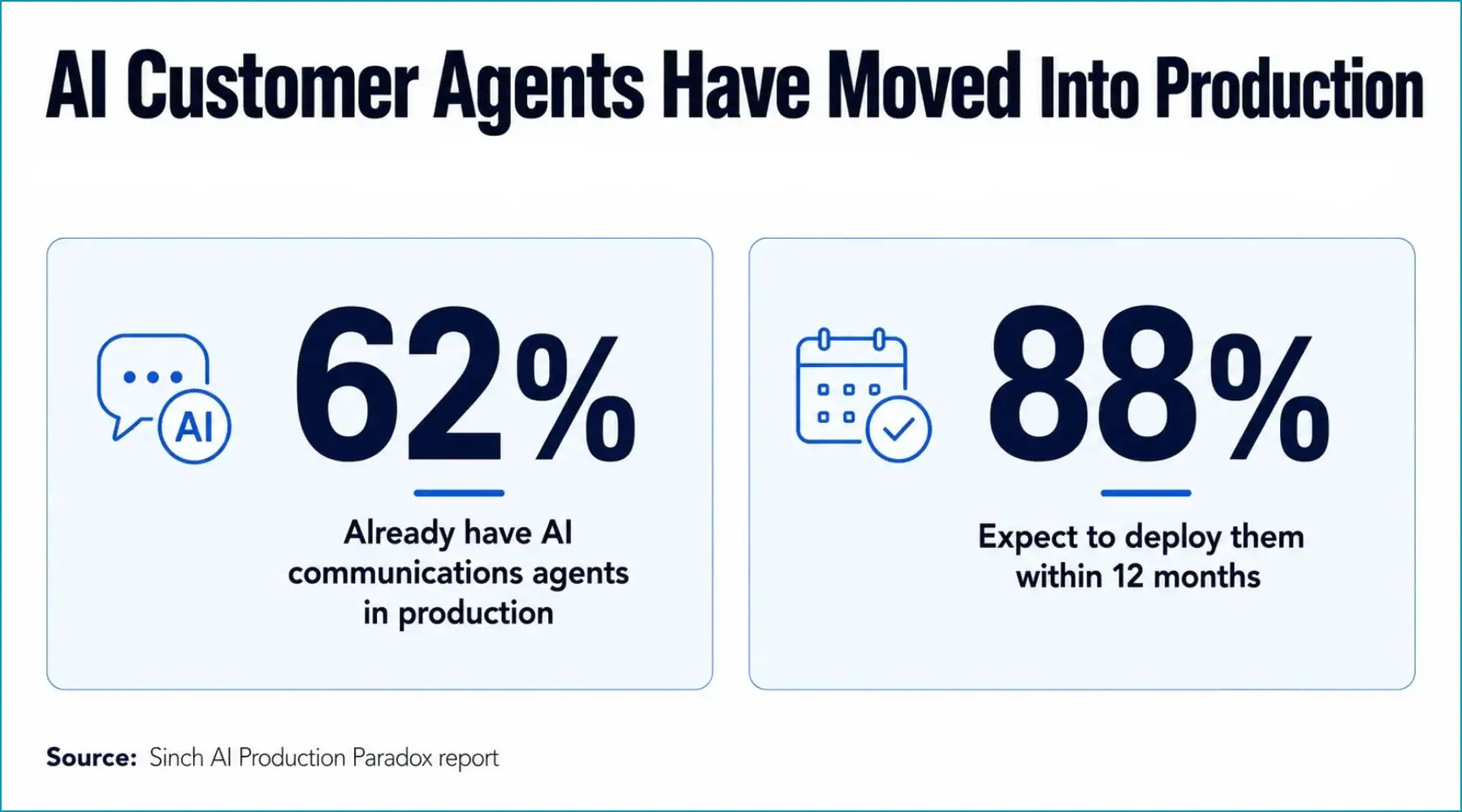
According to Sinch, 62% of enterprises already have AI communications agents in production, while 88% expect to deploy them within 12 months. That means customer-facing AI is already handling real conversations, not just internal experiments.
These agents now appear across:
- web chat
- social platforms
- messaging apps
- voice channels
- post-click customer journeys
They answer product questions, explain offers, handle account queries, respond to refund requests, and guide users after a paid click or affiliate referral. That last point matters most for Affiverse readers.
Performance teams can do everything right at the acquisition stage. They can buy strong traffic, build clean landing pages, sharpen creative, and test better offers. But if the user then reaches an AI agent that gives a poor answer, the campaign can still lose the conversion.
Worse, the issue may not appear in reporting as an “AI problem.” It may look like weak traffic, poor intent, low-quality leads, or bad funnel performance. In reality, the customer experience may have broken one step after the click.
The Rollback Rate Shows the Risk Starts After Launch
Getting an AI agent live doesn’t mean the work is done. In many cases, the harder part begins once real customers start using it. Sinch says 74% of enterprises have rolled back or shut down a deployed AI customer communications agent because of governance failure. Among organizations with fully mature guardrails, that figure rises to 81%.
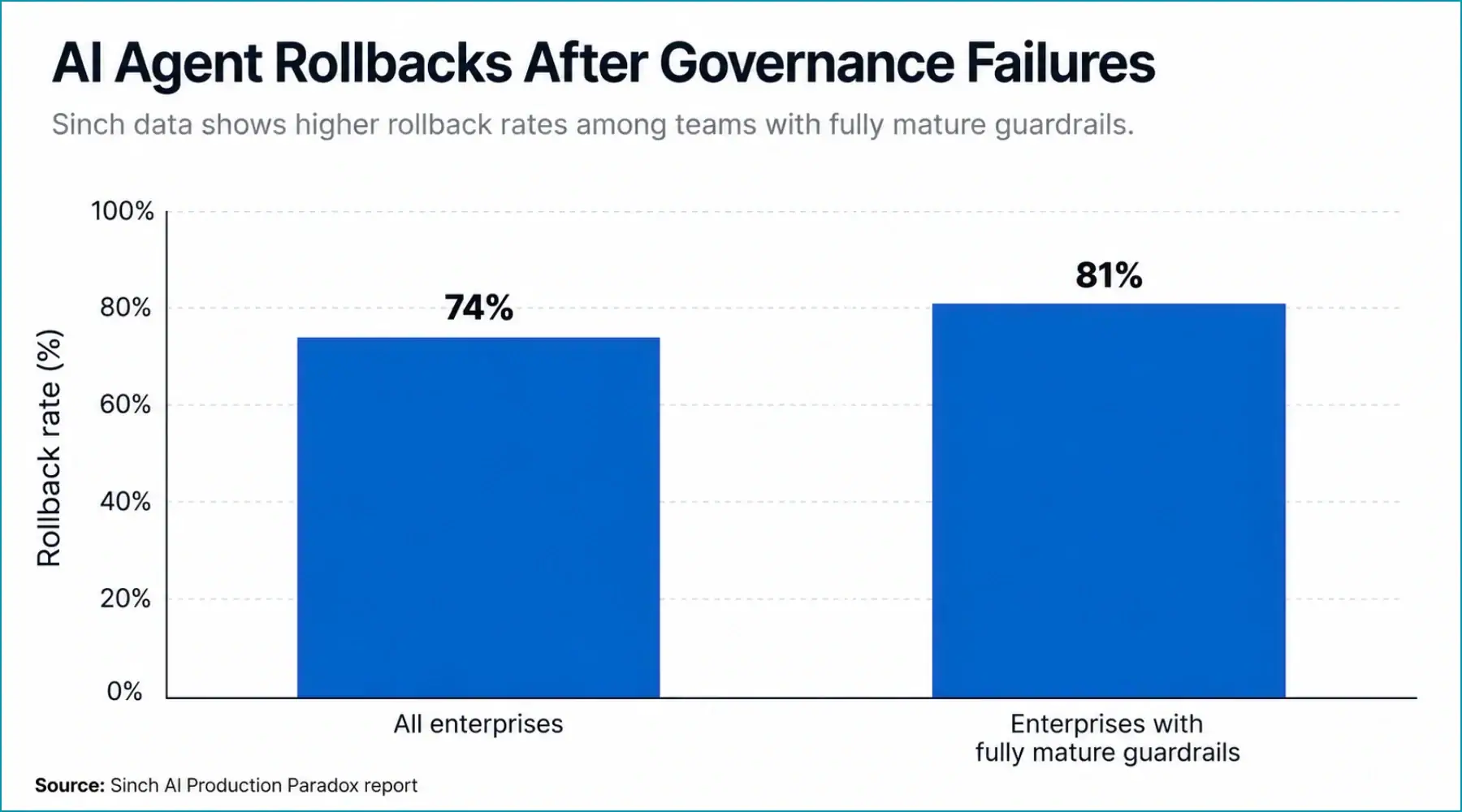
At first glance, that higher number looks strange. Mature teams should, in theory, run safer systems. But there’s another way to read it: better-governed teams may spot failures faster. They have the monitoring, controls, and internal pressure needed to pull an agent back before the issue spreads. That doesn’t mean lighter-governed teams have fewer problems. Some may simply miss them.
For marketers, this creates a reporting blind spot. If an AI agent gives confusing answers about pricing, terms, delivery, account access, or a promotion, the performance team may blame the wrong part of the funnel.
The result?
- The affiliate source gets questioned.
- The creative gets changed.
- The landing page gets rewritten.
- The offer gets adjusted.
Meanwhile, the real customer experience problem sits one step later.
Why This Matters for Performance Marketers
Performance teams usually focus on the parts of the journey they can measure cleanly: traffic quality, cost per click, cost per acquisition, landing page behavior, conversion rate optimization, average order value, and retention. AI customer agents can disrupt that picture.
A user may arrive from a strong affiliate placement, paid search ad, creator campaign, or email promotion. The landing page may do its job. The offer may be clear. The user may show real intent. Then they ask the AI agent a question.
That single exchange can affect the conversion.
| AI Agent Issue | What It Can Look Like in Performance Data |
|---|---|
| Wrong answer about pricing, offers, or terms | Lower conversion rate, more abandoned journeys, more complaints |
| Poor escalation to human support | High-intent users drop off before completing the action |
| Confusing refund, account, or product information | More support tickets, refund requests, or negative feedback |
| Weak handling after an affiliate referral | Publisher traffic looks poor, even when the source has strong intent |
| Repeated bad answers or public AI mistakes | Lower brand trust and reduced partner confidence |
That’s why this report matters for affiliate and partner teams. An affiliate manager might see strong publisher traffic fail to convert. A SaaS marketer might see demo requests fall after users ask product questions. An e-commerce team might see users abandon carts after asking about delivery, refunds, or discounts. In each case, the traffic source may not deserve the blame.
Customer communications now act like performance infrastructure. If AI agents sit inside that layer, marketers need visibility into how those agents affect conversion, drop-off, complaint volume, and customer trust.
The “Guardrail Tax” Is Now Part of AI Adoption
Sinch also points to a cost problem. The report says 84% of AI engineering teams spend at least half their time rebuilding safety infrastructure from scratch. That should cool some of the easy cost-saving claims around AI support.
AI agents may reduce pressure on human support teams, but brands still need to pay for the systems around them: monitoring, escalation rules, knowledge base accuracy, compliance checks, channel context, data controls and of course, human review.
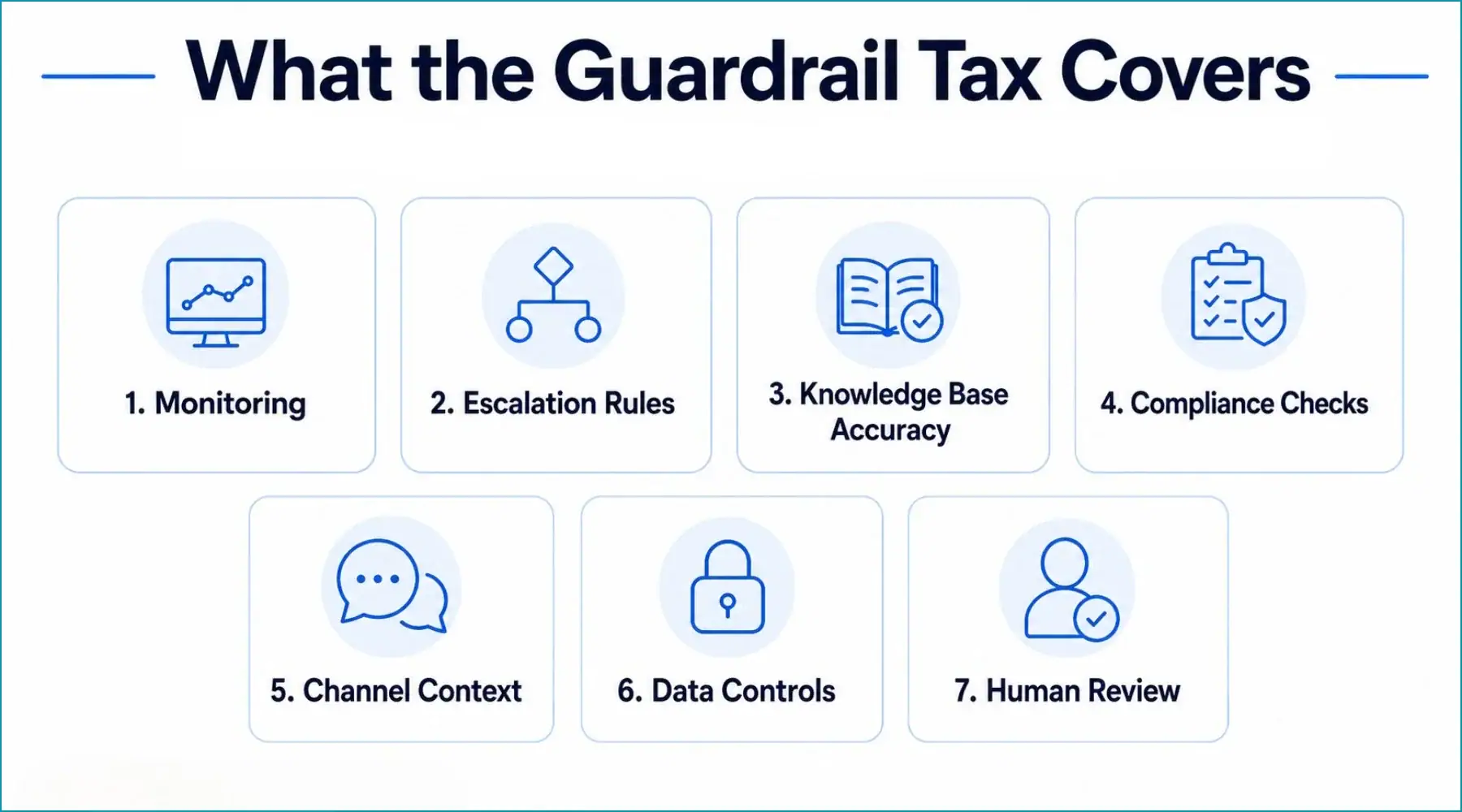
Sinch frames this as the “guardrail tax.” The phrase works because it captures the hidden work behind a live AI agent. The tool may answer at scale, but someone still needs to make sure it answers safely. For brands that depend on affiliate or paid acquisition, that safety work carries commercial value. The agent protects the support team, and it protects the value of tracking beyond the initial conversion.
What Brands Should Check Before Scaling AI Customer Agents
Before brands push AI agents deeper into customer journeys, marketing teams should ask sharper questions.
| Area to Review | Question to Ask |
|---|---|
| Offers and pricing | Can the AI agent explain promotions, pricing, and terms accurately? |
| Escalation | Does it hand off to a human before the customer gets stuck? |
| Reporting | Can teams see whether AI conversations affect conversion or drop-off? |
| Partner traffic | Do affiliate teams know when AI agents change across key funnels? |
| Risk control | Is there a rollback process if the agent starts creating problems? |
Affiliate teams should also know when AI agents change across key landing pages, product flows, or post-click journeys. If partners send high-intent users into a funnel, they need confidence that the brand can handle those users properly. That doesn’t mean every AI change needs a partner memo. But major changes to customer communication flows should no longer sit outside the performance conversation.
Affiverse Take: AI Agents Need Marketing Oversight, Too
Sinch’s report doesn’t make the case against AI customer agents. It makes the case against treating deployment as the finish line. For marketers, the sharper lesson sits in the handoff between acquisition and experience, where paid campaigns, affiliate traffic, influencer promotions, and partner-led growth all depend on trust after the click.
If an AI agent damages that trust, performance suffers. Brands can still use AI agents to improve customer journeys, but once those agents speak to customers, they need human oversight as well as technical oversight.
Launching the agent is only one part of the job. The real test comes after the click: when that agent speaks to a customer, does it protect the conversion the marketing team paid for?
Everflow
Connect
Tradedoubler
Connect
1win Partners
Connect
Shopnomix, a Nomix Group Company
Connect
Huffson Group
Connect
Kawaii Partners
Connect
Trackdesk
Connect
Share your expertise and expand your reach and become a content contributor with us today!
Contact Us To Find Out More