ChatGPT Adds Yelp Data: What It Means for Affiliate Visibility in AI Search
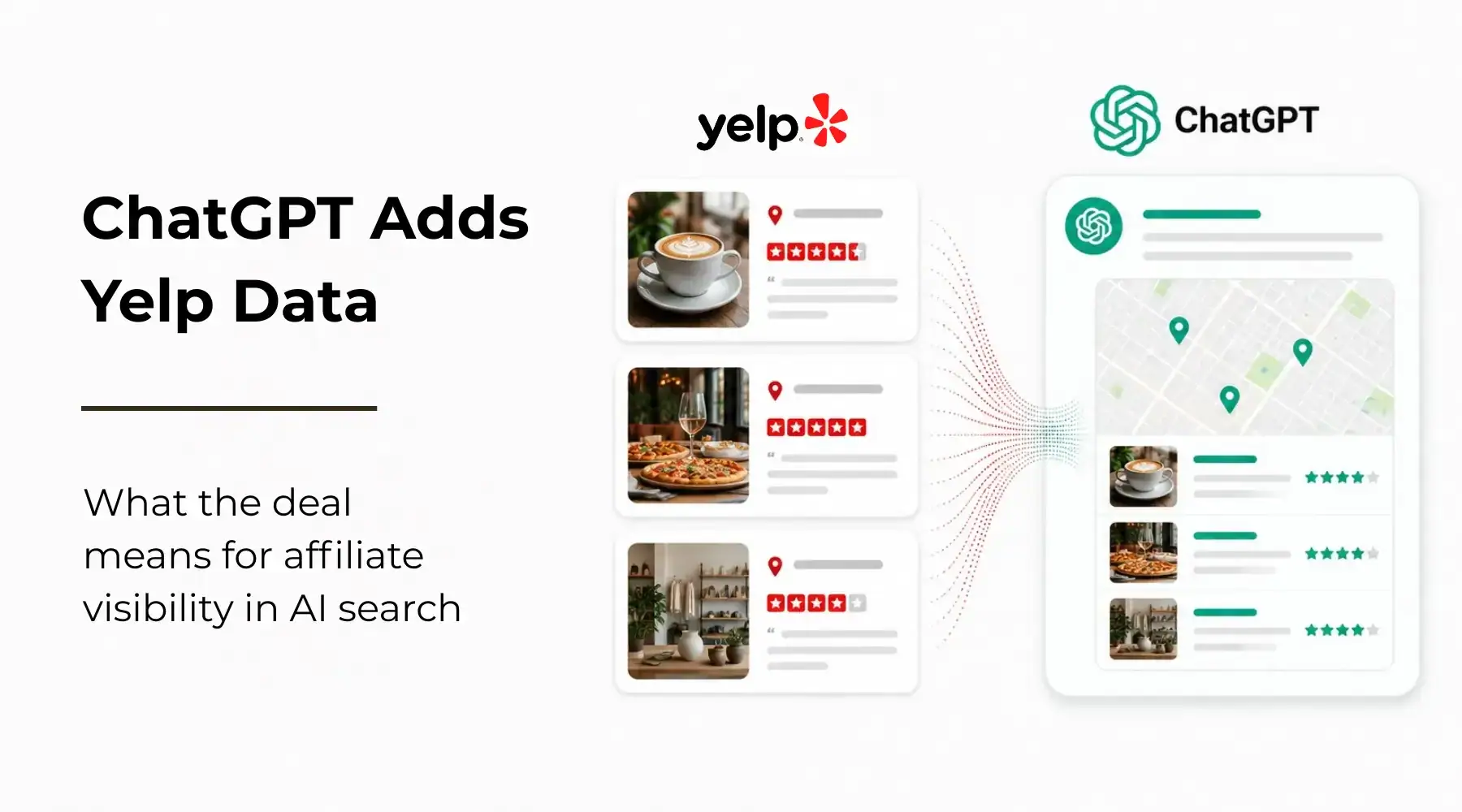
OpenAI has licensed Yelp’s reviews, ratings, photos, and business information, giving ChatGPT a new source of data for answering local questions and recommending nearby businesses and services. For affiliate publishers, the agreement is not evidence of a new way to “rank in ChatGPT.” It does, however, highlight what AI platforms may increasingly value: trusted entities, structured information, original data, and content that is difficult to reproduce.
Key Takeaways: What the Yelp x OpenAI Deal Means for Affiliates
- ChatGPT will be able to surface Yelp reviews, ratings, photos and business details when answering relevant local questions.
- Yelp branding and links will appear when its information is used, although OpenAI controls how the experience is presented.
- This is a direct licensing agreement rather than a public ChatGPT ranking method affiliates can reproduce.
- Original research, maintained directories, transparent testing and structured comparisons may become more valuable as AI-led discovery expands.
- Visibility inside AI answers still creates attribution problems when publisher influence does not lead to a trackable click.
What the OpenAI and Yelp Agreement Includes
Yelp announced in February that it had signed an agreement with OpenAI as part of its effort to extend the reach of its content across the AI ecosystem. The company did not initially provide a detailed breakdown of how that information would be used inside ChatGPT. Those details emerged in Axios’ July 23 report. ChatGPT will be able to surface Yelp reviews, star ratings, photos and other business information when responding to relevant user questions. Yelp branding and links will appear when OpenAI uses its content, helping users identify where the information came from.
OpenAI will control the design and presentation of the experience. The companies have not explained how individual businesses, reviews, or ratings will be selected for each response. Yelp’s Request a Quote feature is also expected to be added. This could allow a user to move from asking ChatGPT for a local recommendation to contacting a service provider for a quote without beginning a separate search.
It was reported that the agreement is non-exclusive, meaning Yelp can form similar arrangements with other AI companies. The financial terms were not disclosed. The scale of Yelp’s content helps explain its value to OpenAI. Yelp reported that users added 22 million reviews during 2025, taking its cumulative total to approximately 330 million by the end of the year.
Why Yelp’s Data Matters to AI Search
Yelp’s value goes beyond the number of pages it has published. The platform owns a large collection of reviews, ratings, photographs, and local service information connected to identifiable businesses.
Reviews can be associated with specific companies, locations, categories, and customer experiences. An AI system can use those relationships to answer detailed local questions rather than relying entirely on broad articles about a destination or service. The information is also regularly updated by businesses and users. That makes it harder to reproduce than content that simply summarizes details available from other websites.
Affiliate publishers are unlikely to match Yelp’s scale, but the same principle can apply within a smaller vertical. A specialist publisher may own product-testing results, historical pricing data, verified directory information, market-specific comparisons, industry surveys, or expert analysis that cannot be found on a manufacturer’s website.
What the Yelp x OpenAI Deal Means for Affiliate Publishers
Affiliate visibility in AI search may depend on more than publishing well-optimized articles. Publishers need to create information that adds something new, whether through product testing, pricing histories, original photography, verified directories, expert interviews, or market-specific comparisons.
These assets do not guarantee a citation in ChatGPT or another AI platform, but they give retrieval systems a stronger reason to select one source over competing pages. Clear entity signals also help: product and company names, author details, specifications, update dates, testing methods, and inclusion criteria should remain accurate and consistent.
The same principles appear in Google’s AI Search guidelines for affiliates, which reinforce the importance of accessible, well-structured, evidence-led content. Publishers should also treat GEO as an extension of SEO rather than a replacement for it. As search experiences become more compressed, the goal is not only to rank but to become a source that AI systems can understand, trust, and reference.
This Is Not a ChatGPT Ranking Formula
Yelp’s agreement does not show that reviews, local pages or structured data will automatically improve visibility inside ChatGPT. The company has a direct licensing relationship with OpenAI and is providing access to a large proprietary dataset.
OpenAI has not published a universal set of ranking signals for ChatGPT. Responses may draw on licensed data, web search, connected tools or other retrieval systems depending on the query.
For publishers, the more useful question is:
What information do we own that readers and AI systems cannot easily find elsewhere?
That could include first-hand testing, proprietary research, expert interviews, maintained datasets or specialist knowledge. Generic content based largely on merchant or brand pages is easier for competitors and AI systems to reproduce.
AI Visibility Still Has an Attribution Problem
Yelp’s branding and links matter because users may get enough information inside ChatGPT without visiting the original source.
Yelp may still benefit through licensing revenue, brand exposure, referral traffic, and future quote requests. Most affiliate publishers have fewer monetization options. Their content could influence an AI-generated recommendation without producing a trackable click, leaving that contribution invisible to last-click reporting.
AI visibility and affiliate monetization should therefore be treated separately. A citation can support authority and discovery, but the industry still needs better ways to measure publisher influence before the final tracked interaction.
The APMA highlighted this gap in its AI search roadmap for affiliate marketing, noting that publisher influence can become disconnected from the clicks and conversions recorded by conventional tracking.
Affiverse Take: Original Data Could Become a Stronger AI Search Advantage
The OpenAI and Yelp agreement should not be treated as a shortcut for ranking affiliate content inside ChatGPT. It instead shows why AI platforms value trusted sources with structured, current and difficult-to-reproduce information.
For affiliate publishers, three priorities stand out:
- Create information rather than repeat it. Original research, first-hand testing, maintained directories, and structured comparisons give readers and retrieval systems a clearer reason to reference a particular source.
- Keep foundational SEO in place. Content must still be discoverable, accessible, and easy to understand. Original data can strengthen a page, but it does not guarantee inclusion in an AI-generated answer.
- Build a defensible source of expertise. Recognizable authors, transparent methodologies, and consistent specialist coverage are harder for competitors and AI systems to reproduce than generic summaries.
Publishers with useful proprietary information may therefore be better positioned for citations, brand visibility, and future distribution opportunities. The immediate priority, however, should be creating information that genuinely helps the audience rather than trying to imitate Yelp’s commercial relationship with OpenAI.
Everflow
Connect
Tradedoubler
Connect
1win Partners
Connect
PIN-UP Partners
Connect
Shopnomix, a Nomix Group Company
Connect
V.Partners
Connect
Huffson Group
Connect
Kawaii Partners
Connect
Share your expertise and expand your reach and become a content contributor with us today!
Contact Us To Find Out More