AI Affiliate Marketing Guide: How to Build Trust Into Content, Traffic and Attribution
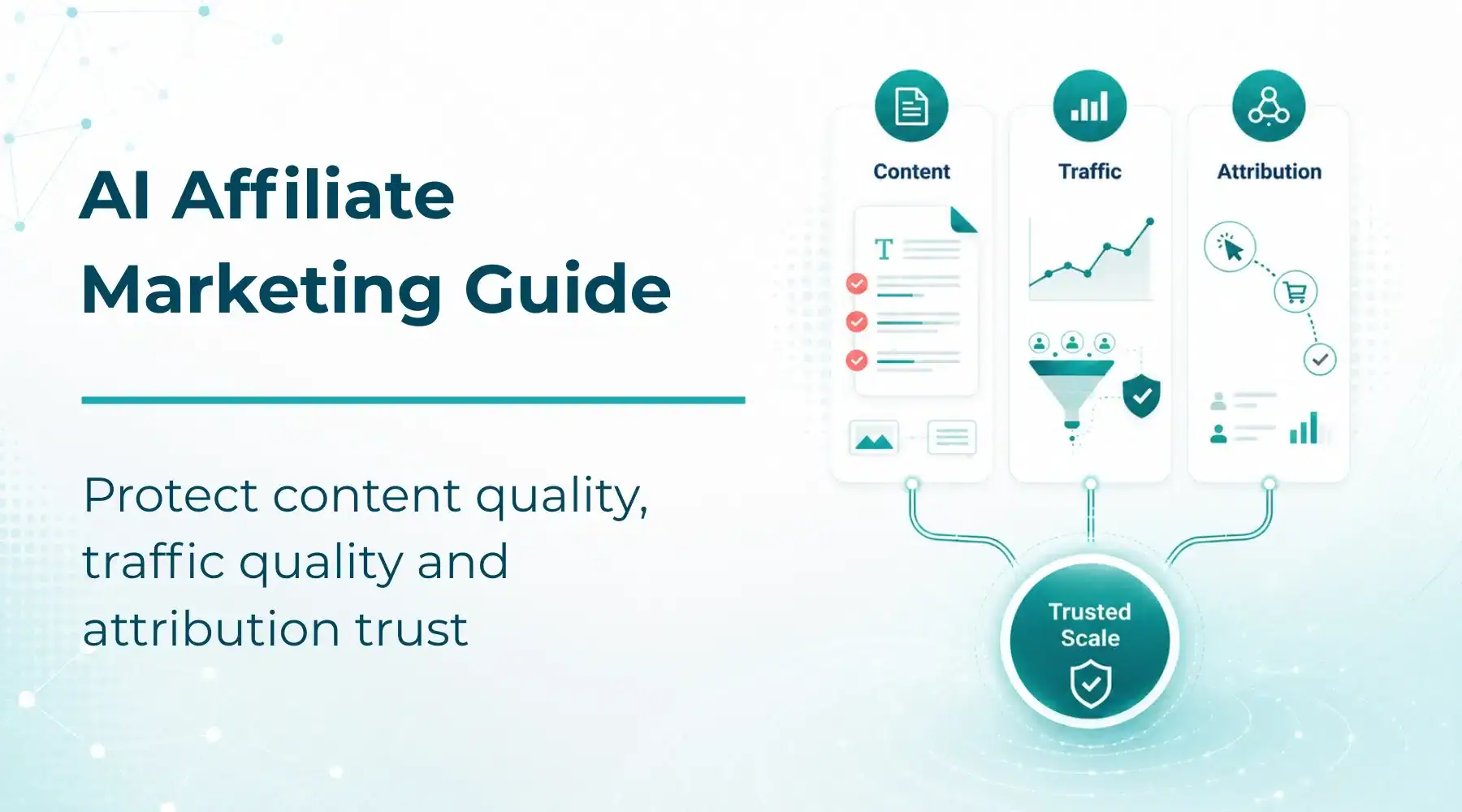
AI affiliate marketing is moving quickly, but the pressure is no longer just about speed. Affiliate publishers can use AI to draft content, refresh pages, structure briefs, summarize research and prepare campaign assets faster than before. Advertisers and affiliate managers are also working in a market where more campaign signals are shaped by automation, from traffic sources and attribution paths to lead quality and conversion reporting. That creates a bigger question for the next phase of affiliate marketing: can teams still prove what is real?
- Why AI Affiliate Marketing Needs a Trust Framework
- What the Data Shows About AI Affiliate Marketing Trust
- How Affiliate Teams Can Build Trust Into AI Workflows
- Step 1: Review AI Content Before Publishing
- Step 2: Check Traffic Quality, Not Just Volume
- Step 3: Protect Affiliate Attribution
- Step 4: Build a Trusted Scale Checklist
- AI Affiliate Marketing Dos and Don’ts for Trusted Scale
- Why Trusted Scale Matters in AI Affiliate Marketing
Why AI Affiliate Marketing Needs a Trust Framework
AI can help affiliate teams move faster across content, reporting and campaign management. But faster workflows also create more places where mistakes can enter the system.
A publisher may use AI to create comparison content, but the claims, pricing, product details and offer terms still need to be checked. An advertiser may see more leads coming from an affiliate partner, but still needs to know whether those leads are genuine. A program manager may see stronger conversion volume, but still needs to understand whether the traffic behind it reflects real customer intent. That is why AI affiliate marketing needs a trust framework.
The framework should answer three practical questions:
- Is the content accurate enough to publish?
- Is the traffic genuine enough to reward?
- Is the attribution data reliable enough to guide budget decisions?
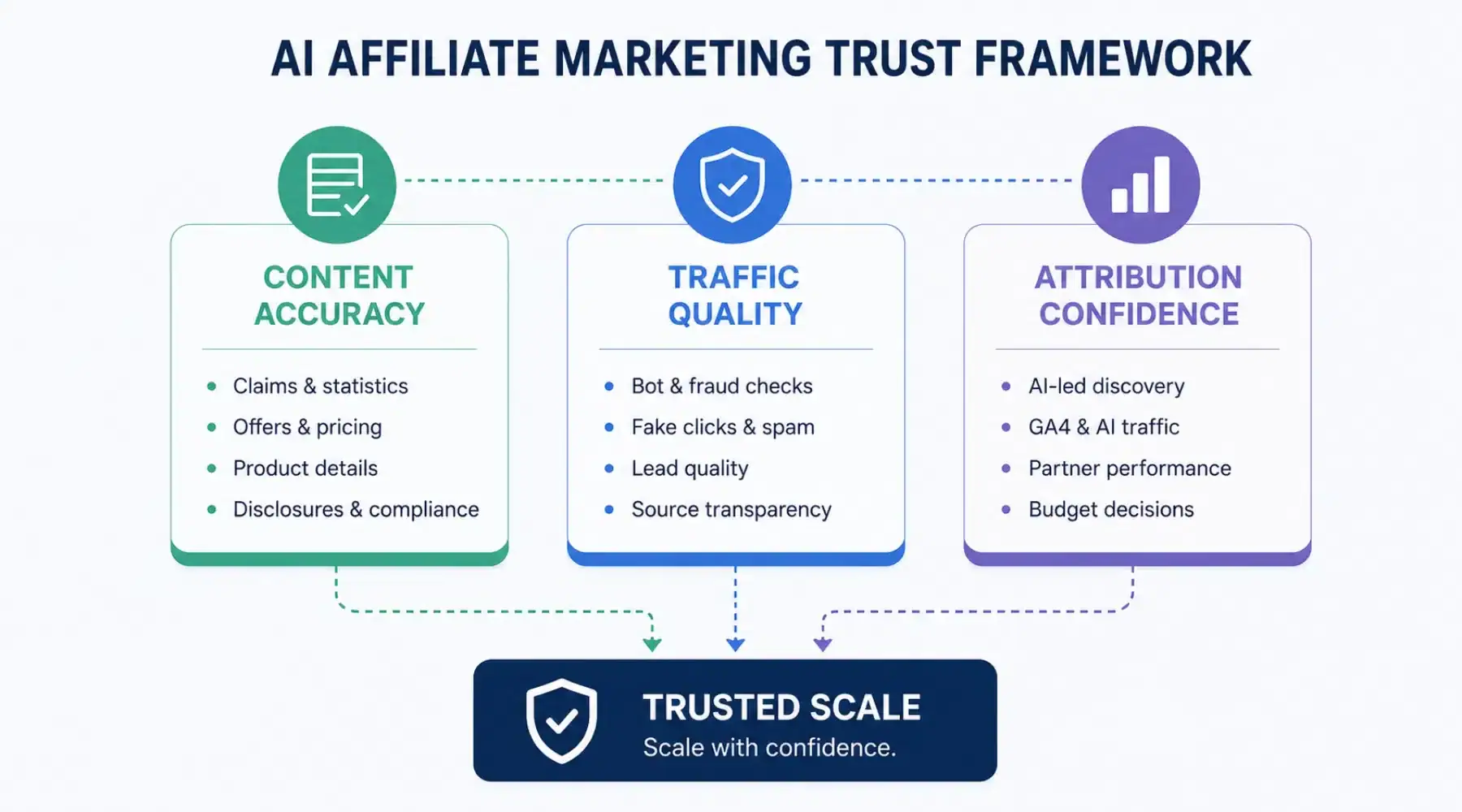
These questions matter because affiliate marketing depends on trust across the full journey. Content needs to be accurate before a user clicks, and traffic needs to be genuine before a partner is rewarded.
For publishers, that means clear comparisons, accurate claims and transparent disclosures. For advertisers and affiliate managers, it means looking beyond reported numbers and checking traffic quality, conversion quality, lead approval rates and partner behavior.
This is also where media buying, AI and tracking become part of the trust discussion. As affiliate programs test more traffic sources, they need clear tracking and attribution before scaling. This is where the shift from scale to trusted scale begins.
What the Data Shows About AI Affiliate Marketing Trust
Recent industry data points to two sides of the same issue: AI is helping teams move faster, but it is also increasing the need for stronger verification.
- On the content side, Optimizely’s June 2026 global study found that 76% of marketers spend at least three hours each week editing, fact-checking or correcting AI-generated output. The same study found that 48% said fact-checking and hallucination review created more additional work than any other factor.
- On the traffic side, Anura’s executive brief on AI-powered ad fraud reports that invalid traffic rates climbed from 26% in January 2026 to 40% by June 2026. Anura frames this as a campaign data problem, with AI-assisted fraud making performance signals harder to trust.
| Trust area | What needs checking | Why it matters for affiliate teams |
|---|---|---|
| AI content quality | Claims, offers, prices, product details, disclosures and brand tone | Inaccurate affiliate content can damage user trust before the click. |
| Traffic quality | Bots, fake clicks, low-quality leads, unusual spikes and source transparency | Poor-quality traffic can distort campaign results and payout decisions. |
| Attribution confidence | Click paths, AI-led discovery, last-click reporting and partner value | Programs need to know whether affiliates are driving genuine customer intent. |
| Search visibility | Helpful content, original value, clear structure and trusted signals | AI-assisted pages still need to meet search quality expectations. |
Google’s own guidance on helpful, reliable, people-first content also reinforces the point. AI-assisted content is not automatically a problem, but automation does not remove the need for editorial judgment, original value and clear quality control.
How Affiliate Teams Can Build Trust Into AI Workflows
AI does not need to be removed from affiliate workflows. It needs to be managed with clearer checks. The aim is not to slow every process down. The aim is to stop teams from treating AI output, traffic volume or attribution reports as trustworthy by default. A useful AI affiliate marketing workflow should separate speed from accuracy, traffic from value, and reported conversions from genuine customer behavior.
Step 1: Review AI Content Before Publishing
AI can help affiliate publishers create drafts, outlines, product summaries, comparison tables and content refreshes, but AI-assisted content should still be treated as a first draft. Before publishing, teams need to check the details that affect trust and commercial accuracy, including claims, prices, product information, offer terms, disclosures and compliance language. The page should also add something useful beyond a merchant page or generic AI summary. This connects to AI search content strategy for affiliates, where useful structure, original value and trusted signals matter more than shortcuts. AI can help produce a page, but editors still need to decide whether it is accurate, helpful and worth publishing.
Step 2: Check Traffic Quality, Not Just Volume
Traffic volume can be misleading when automation and invalid traffic enter the funnel. A sudden rise in clicks or leads may reflect strong promotion, but it may also point to bot activity, low-quality placements or suspicious traffic sources. Affiliate teams should look beyond reported numbers and compare traffic with lead quality, conversion behavior, refunds, chargebacks, geo and device patterns, and partner transparency. The debate around bot traffic and affiliate attribution is becoming more complex because not every automated visit means the same thing. The key question is not only whether traffic is automated, but whether it reflects real user intent.
Step 3: Protect Affiliate Attribution
AI-led discovery is making affiliate attribution harder to read. A user may discover a brand, product or publisher inside an AI-generated answer, then return later through search, direct traffic, a review site, a newsletter or a paid ad. That makes last-click reporting less complete, because the source that influenced the decision may not be the same source that receives the final click. This is why AI attribution in affiliate marketing is becoming a wider commercial issue. Tracking AI traffic in GA4 can help teams identify some assistant-led visits, but the goal is attribution confidence, not perfect attribution.
Step 4: Build a Trusted Scale Checklist
“Trusted scale” means using AI without removing accountability. For publishers, AI-assisted pages still need human review before publishing. For advertisers, traffic sources should be judged by customer value, not only by volume. For affiliate managers, attribution should be reviewed alongside traffic quality and post-conversion behavior. A simple trusted scale process should help teams ask whether the content is accurate, whether the traffic looks genuine, whether conversions are supported by real customer behavior, and whether partners are transparent about sources and placements. This is also where Google’s AI search guidelines for affiliates are relevant, because AI search still depends on crawlable pages, useful structure and trusted signals.
AI Affiliate Marketing Dos and Don’ts for Trusted Scale
AI can support affiliate teams, but it should not replace the checks that make content, traffic and attribution reliable. The strongest teams will use AI to speed up work while keeping human review, source checks and partner quality controls in place.
| Do | Don’t |
|---|---|
| Use AI to support drafts, briefs, summaries and content refreshes. | Treat AI-generated content as ready to publish without review. |
| Check claims, prices, offers, disclosures and product details before publishing. | Assume AI has understood current merchant terms or market restrictions. |
| Review traffic quality alongside clicks, leads and conversions. | Reward partners based only on volume. |
| Track AI-led visits where possible and compare them with other channels. | Expect analytics tools to capture every AI-assisted journey perfectly. |
| Judge partners by customer value, transparency and post-conversion behavior. | Rely only on last-click data when making budget decisions. |
Why Trusted Scale Matters in AI Affiliate Marketing
AI affiliate marketing should not be judged only by how much faster teams can move. Speed matters, but trust is what gives affiliate marketing its commercial value. Readers need to trust the content before they click. Advertisers need to trust the traffic before they pay. Affiliate managers need to trust the attribution data before they move budget. That makes the trusted scale the real standard.
The strongest affiliate teams will not simply be the ones that publish the most AI-assisted content or automate the most campaign decisions. They will be the teams that build verification into the process: content checks before publishing, traffic checks before rewarding partners, and attribution checks before making commercial decisions. AI can help affiliate teams scale. But the teams that benefit most will be the ones that can still prove that their content, traffic and performance data are real enough to trust.
Everflow
Connect
Tradedoubler
Connect
1win Partners
Connect
PIN-UP Partners
Connect
Shopnomix, a Nomix Group Company
Connect
V.Partners
Connect
Huffson Group
Connect
Kawaii Partners
Connect
Share your expertise and expand your reach and become a content contributor with us today!
Contact Us To Find Out More