Cloudflare Bot Data Raises New Questions for Affiliate Attribution
Cloudflare Radar data shows that automated traffic now accounts for a major share of web page requests, adding pressure to how marketers read traffic quality, attribution, and conversion data. The data comes from Cloudflare’s Bot vs. Human traffic chart, which tracks the percentage of HTTP requests classified as bot or human. Cloudflare describes the chart as “Bot (automated) vs. human HTTP requests distribution to HTML content” and says the data is filtered to HTML responses, representing web page traffic.
The data does not mean every part of the internet now receives more bot activity than human activity. It focuses on HTTP requests to HTML content. Still, for affiliate marketers, publishers, brands, and networks, the direction of travel matters because web page traffic feeds the numbers many teams use to judge performance.
Clicks, sessions, landing page visits, form fills, conversion rates, and attribution windows—all of them become harder to read when automated systems account for a larger share of web activity.
Key Takeaways: Bot Traffic and Affiliate Attribution
- Cloudflare Radar tracks bot vs. human HTTP requests to HTML web page content.
- The data shows automated traffic now makes up a major share of web page requests.
- Affiliate marketers may need closer checks around traffic quality, attribution, lead quality, and campaign reporting.
- AI agents add a new layer because some automated traffic may represent real user intent, rather than fraud.
- Networks, brands, and publishers may need clearer rules around how machine-led traffic gets measured and valued.
What Cloudflare’s Bot vs Human Data Shows
Cloudflare Radar’s traffic dashboard gives a live view of web traffic patterns across its network. Its Bot vs. Human chart breaks down the percentage of HTTP requests classified as human or bot, with the view filtered to HTML responses. In simple terms, Cloudflare is looking at web page traffic.
On Cloudflare Radar, viewed on June 17, 2026, the Bot vs. Human chart for North America showed bots accounting for 66.6% of HTTP requests to HTML content over the past seven days, compared with 33.4% for human traffic. Cloudflare defines the chart as “Bot (automated) vs. human HTTP requests distribution to HTML content,” with the data filtered to HTML responses that represent web page traffic.
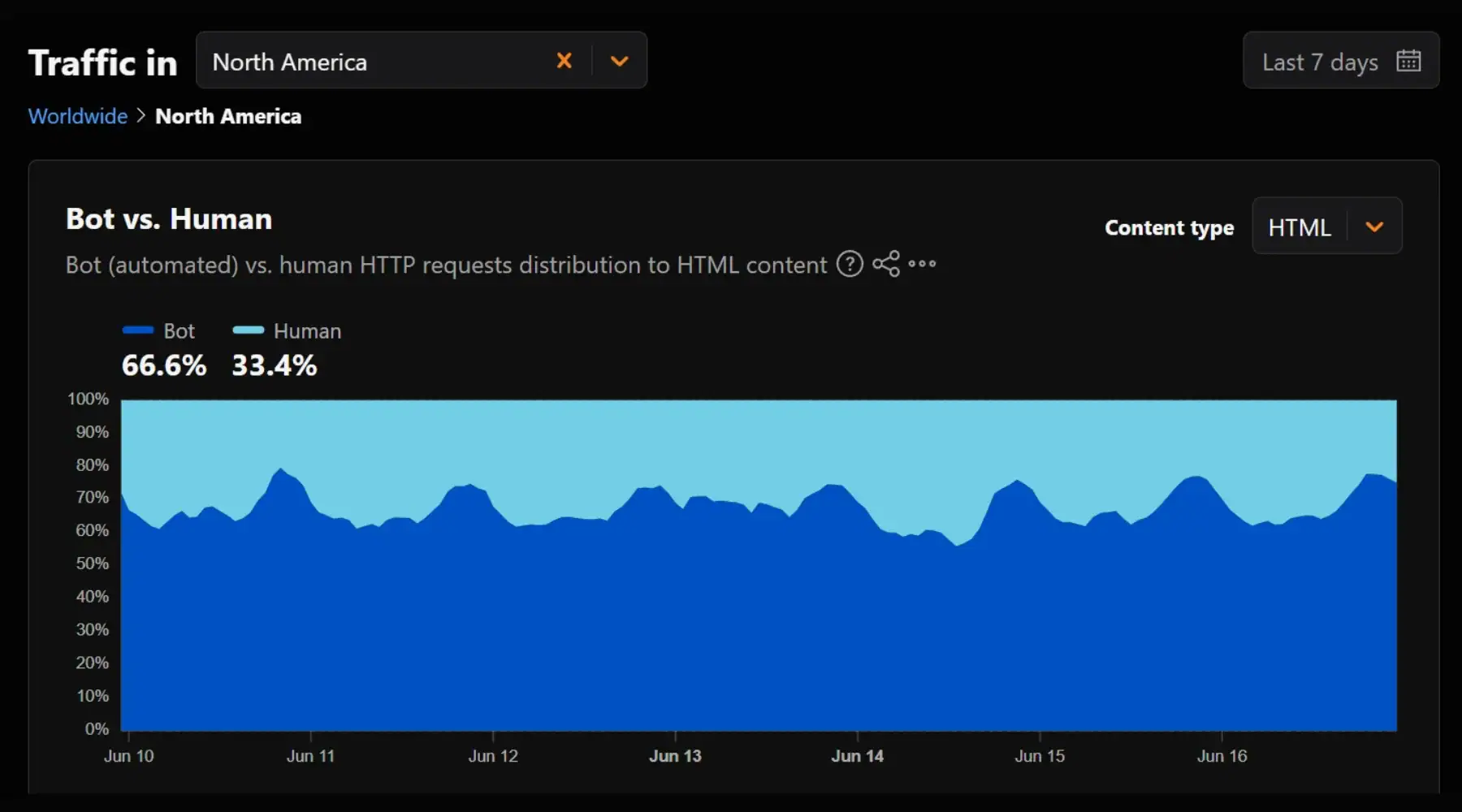
Source: Cloudflare Radar
For marketers, the exact definition matters more than the headline number. HTML page requests sit close to the areas performance teams monitor every day. When bot activity grows there, it can affect the signals used to judge whether campaigns are working.
That does not mean every automated visit is harmful. Search crawlers, monitoring tools, AI crawlers, scrapers, fraud bots, and shopping assistants can all fall under the wider automation bucket. Some help discovery. Some extract value. Some create waste. Some attack systems directly. Affiliate teams need to know which is which.
Why Affiliate Marketers Should Care
Affiliate marketing depends on measurable traffic. A publisher sends a user to a brand. A network records the click. The brand tracks the session, conversion, and sale. Then the program pays against an agreed model. That system works best when traffic signals point to real commercial intent.
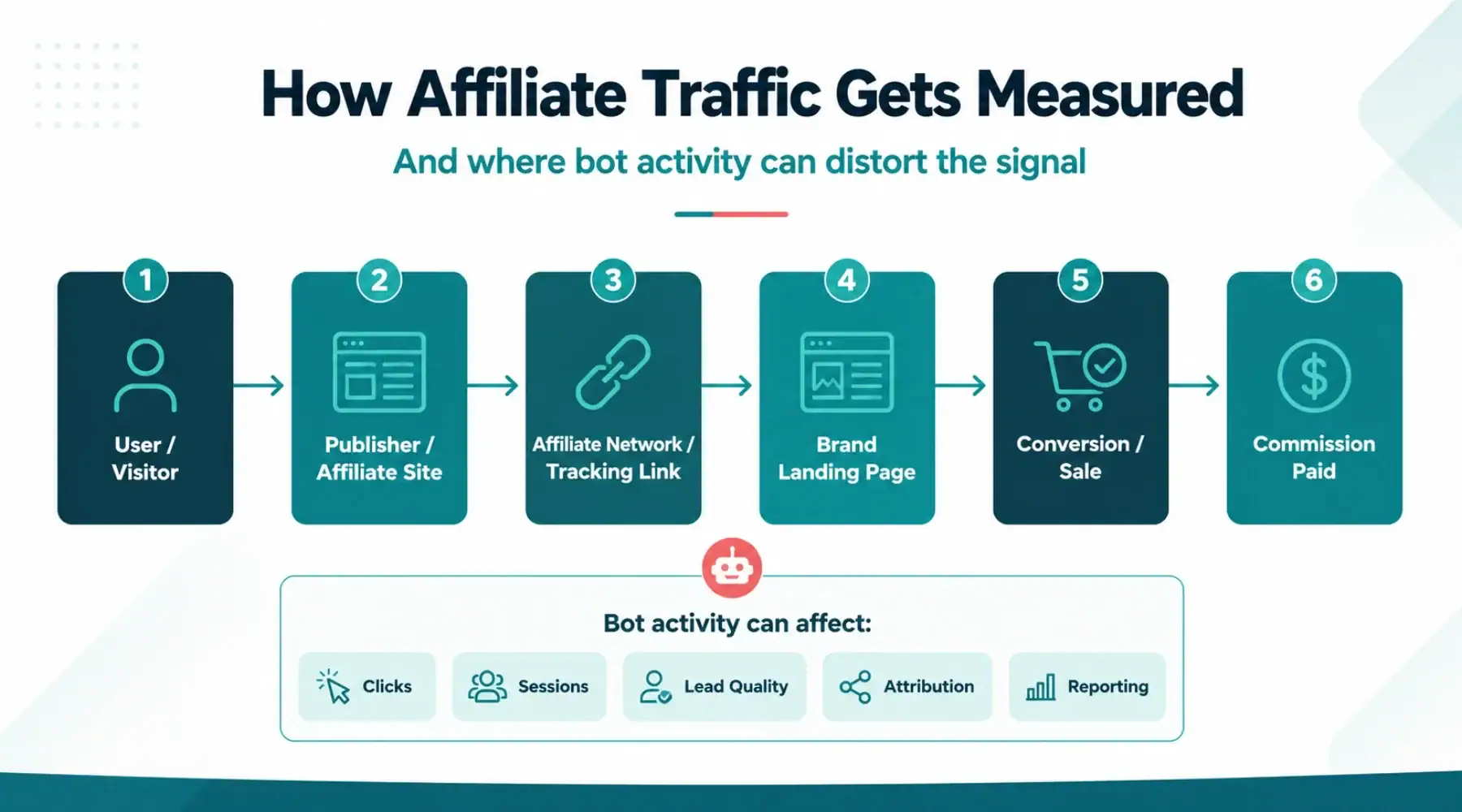
Rising bot traffic complicates that. Automated requests can inflate visits, trigger clicks, distort bounce rates, scrape offers, test checkout flows, or submit poor-quality leads. Even when bots do not trigger a commission, they can still muddy reporting.
The issue links closely to the wider attribution debate. Affiverse has already covered how AI is reshaping influence and attribution in affiliate marketing, especially as discovery moves across search, social, content, creator channels, and AI tools. Bot traffic adds another measurement layer.
A campaign might show traffic growth. But that alone does not answer the questions affiliate managers need to ask:
- Where did the traffic come from?
- Did humans arrive with intent?
- Did AI tools scrape the page?
- Did monitoring systems trigger repeated visits?
- Did low-quality traffic push up clicks without matching conversions?
These are not abstract questions. They affect commission decisions, partner trust, traffic source reviews, and budget allocation.
The Attribution Problem Gets Messier
Last-click attribution already struggles to explain how people shop. A user might discover a product through a creator, compare prices in search, read a review, visit a voucher site, and buy days later. Affiverse has covered how AI is reshaping influence and attribution in affiliate marketing, and AI agents can add more steps.
An automated assistant may search for products, compare offers, open affiliate pages, summarise content, or visit a merchant site on behalf of a user. The user may never interact with every page directly, but the machine activity still connects to a real purchase journey. This creates a difficult middle ground. Traditional fraud systems often look for automated behavior: fast browsing, repeated requests, unusual form activity, or non-human patterns. But AI agents may show some of those same behaviors while carrying genuine user intent.
For affiliate programs, that shift matters. If a machine visits a comparison page on behalf of a user, should that visit count? If an AI assistant uses affiliate content to make a recommendation without generating a tracked click, how should the publisher receive credit? If an agent triggers a click but the user completes the purchase elsewhere, who gets attributed? There are no clean answers yet.
AI Agents Bring Automation Closer to Commerce
The bot traffic discussion now overlaps with AI agents and automated commerce journeys. That does not mean every bot is a shopping assistant, but the category has become harder to read. HUMAN Security, a bot detection and cyberfraud prevention company, separates AI-driven traffic into categories such as training crawlers, AI scrapers, and agentic AI in its 2026 benchmark report. The company bases the report on aggregated interactions observed across its customer base, so the findings should be treated as vendor research rather than a full view of global internet traffic. Still, the split is useful for affiliate marketing because “bot traffic” no longer describes one single behavior.
Some automation supports search visibility. Some feeds AI answers. Some scrapes content without permission. Some tests forms or checkout flows. Some may act on behalf of users as AI shopping tools become more common. Mastercard’s Agent Pay Acceptance Framework adds another signal here, as it aims to help merchants identify trusted AI agents and support tokenized transactions. For affiliate teams, the question is practical: when automated systems interact with commercial content, how should that activity be measured? A crawler reading a review page has a different value from a bot generating fake clicks, while an agent visiting a merchant page on behalf of a user creates a different attribution question again.
From Bad Bots to Machine-Led Buyers
Affiliate teams have usually treated bot traffic as a quality and fraud issue. That still applies. Click fraud, fake leads, attribution hijacking, cookie stuffing, and low-quality traffic remain real concerns. Affiverse has covered those risks in guides on how ad fraud affects affiliate program profit and how affiliate teams can get ahead of click fraud and arbitration.
But automation now needs a more detailed read. A bad bot might generate fake clicks. A scraper might copy offer data. A search crawler might help a publisher get discovered. An AI customer agent might summarize affiliate content for a user. A shopping agent might compare products and complete a purchase inside a permitted payment flow.
Each case carries a different commercial value. The problem for affiliate tracking is that many systems still group traffic into simpler buckets: human, bot, valid, invalid, converted, did not convert. That may not capture what happens when automated systems start influencing real buying journeys without behaving like human users.
What Affiliates, Brands and Networks Should Watch
Affiliate teams do not need to rebuild every process because of one Cloudflare chart. They should, however, look more closely at traffic patterns that already affect program quality.
Warning signs can include:
- Sudden traffic spikes without matching conversions
- High click volume from weak or unclear sources
- Poor lead quality
- Repeated form activity
- Click-to-conversion ratios that move away from normal partner benchmarks
- Unusual session patterns from specific sources or regions
Networks and advertisers may also need clearer reporting around bot filtering. If traffic gets filtered before it reaches a dashboard, affiliates should understand what has been removed. If suspicious traffic remains visible, brands need a way to separate noise from useful activity.
Server-side tracking, stronger lead validation, clearer traffic source rules, and closer communication between affiliates and advertisers can all help. So can better internal definitions. “Bot traffic” no longer describes one behavior.
For publishers, the issue also connects to content strategy. AI tools may access product pages, guides, comparison tables, and reviews without sending traditional referral traffic. That raises similar questions to zero-click search, where platforms may use content to answer user questions while reducing the click back to the source.
Affiverse Take: Traffic Quality Now Needs a Sharper Definition
Cloudflare’s bot traffic data gives affiliate marketers a practical reason to look more closely at how they read web traffic. The headline number may draw attention, but the real issue sits in the reporting. Can a program tell the difference between human visitors, useful automation, AI crawlers, scrapers, bad bots, and agent-led commercial activity?
That question now reaches beyond fraud teams. It affects publishers, networks, advertisers, and anyone using web sessions or clicks to judge partner performance. Traffic volume still matters. But clean traffic, clear attribution, and trusted measurement now carry more weight than a larger number in an analytics dashboard.
Everflow
Connect
Tradedoubler
Connect
1win Partners
Connect
PIN-UP Partners
Connect
Shopnomix, a Nomix Group Company
Connect
V.Partners
Connect
Huffson Group
Connect
Kawaii Partners
Connect
Share your expertise and expand your reach and become a content contributor with us today!
Contact Us To Find Out More