Perplexity Just Told The Ad Industry Something Worth Paying Attention To
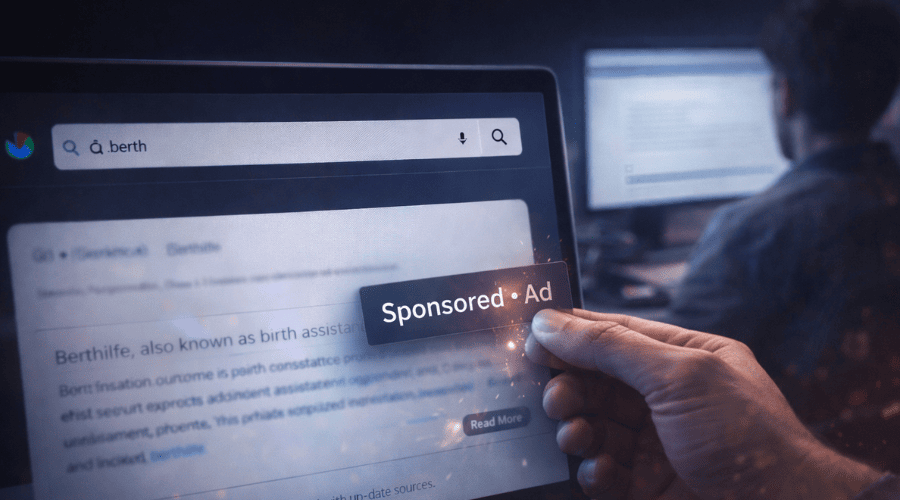
Perplexity has pulled advertising from its platform. Not quietly, not provisionally, and not with a “we may revisit this later” caveat. Its executives confirmed this week that there are no plans to use advertising as a revenue stream, and the company’s top advertising lead, Taz Patel, has already departed. The subscription model is the business model, full stop.
The San Francisco-based company began testing sponsored placements beneath its chatbot responses in late 2024, making it one of the first AI search firms to bring ads into the format at all. The experiment lasted less than a year. According to reporting from the Financial Times, the wind-down has been gradual since late 2024, and this week’s confirmation puts a formal end to any speculation about a reversal.
The reasoning Perplexity gave deserves more than a passing read. “A user needs to believe this is the best possible answer to keep using the product and be willing to pay for it,” the company said. On advertising specifically: “a user would just start doubting everything, which is why we don’t see it as a fruitful thing to focus on right now.”
That is not a company talking about ad formats or targeting strategies. It is a company saying that the presence of commercial incentives inside an answer engine corrodes the one thing the product depends on: the user’s belief that the answer is uncompromised.
The context matters here. Perplexity now handles 780 million monthly queries and reached $200 million in annualised revenue by late 2025, representing nearly fivefold year-over-year growth on subscriptions alone. The company is valued at $18 billion. This is not a startup abandoning ads because it could not sell them. It is a platform at scale making a deliberate choice about what kind of product it wants to be.
What this means for the wider AI search market
Perplexity’s decision lands at a moment when its two most prominent competitors are moving in the opposite direction. OpenAI began testing advertisements inside ChatGPT in February 2026, placing clearly labelled sponsored results below organic answers for users on free and lower-cost tiers. Google, meanwhile, continues integrating advertising into its AI-powered search features.
So the three dominant forces in AI search are now operating on three different commercial models. One has committed to subscriptions and walked away from ads entirely. One has never run ads but is testing them on free-tier users. One is deepening its existing ad infrastructure into AI answers. For affiliate managers trying to build a paid media strategy around AI search channels, that divergence is not a minor inconvenience. It is the strategic question.
We examined that fragmentation in detail when Perplexity first confirmed the ad wind-down, and the core tension has not changed: the platforms consuming publisher content to generate answers are not necessarily creating trackable referral traffic in return. Perplexity’s decision to close the paid placement channel means the only route to visibility on the platform is now through organic citation. Your content either gets referenced because the platform’s systems judge it authoritative, or it does not get referenced at all.
This is, in one sense, clarifying. The ambiguity about whether Perplexity would become a paid channel for affiliate programs is gone. The question now is whether your content qualifies for organic citation, and that is a question about credibility, not budget.
The trust signal is the product
What makes Perplexity’s reasoning significant for affiliate marketers is that the company’s entire argument against ads is also an argument about how AI search will work for brands that get cited. If users are using Perplexity because they believe the answers are uninfluenced, then being cited within those answers carries a different weight than a paid placement would. The citation is, by the platform’s own design, a trust signal.
This connects to something we have been tracking across multiple angles here at Affiverse. As we explored in our analysis of how AI is reshaping influence and attribution, the platforms generating AI answers are becoming influence points in the customer journey, but the measurement infrastructure to capture that influence is still catching up. When 77% of active AI users report trusting AI-generated content, appearing inside those answers matters. The mechanism for monetising that appearance is just not as straightforward as a click.
The broader zero-click reality is well-documented at this point. Approximately 60% of searches now end without users clicking through to any external site, and the affiliate attribution models built around last-click tracking were not designed for this environment. We went deep on what that means structurally in our piece on zero-click search and the attribution challenge reshaping affiliate strategy. Perplexity’s pivot does not change that challenge. It concentrates it.
For publishers who had been exploring Perplexity as an emerging paid placement channel, that conversation needs to change. The only viable path on this platform is content that gets cited because it is considered genuinely authoritative. That is a harder thing to engineer than a media buy, but it is also a more defensible position once you have it.
What the Receptional study tells us
The source material here mentions a recent study by Receptional examining why certain brands rank higher on AI chatbots than others. The implication of that research sits directly alongside Perplexity’s decision. If the ranking factors inside AI answer engines favour credibility, specificity, and content authority over commercial signals, then Perplexity removing ads is consistent with the platform doubling down on exactly those qualities.
The brands that show up well in AI search are not necessarily the brands with the largest ad budgets. They are the brands with the most trusted, clearly structured, expert-authored content. That is a different competitive advantage, and it changes how affiliate programs should be evaluating their publisher mix.
We have covered the practical consequences of this shift from multiple angles. Our piece on why affiliates need alternative traffic channels makes the case for diversification that does not depend on any single platform’s commercial decisions. Our SEO predictions for 2026 set out what “ranking” actually means in an AI-search-dominant environment, where visibility inside an answer matters more than a position on a results page. And if you want a cautionary example of what happens when affiliate content is built on low-trust signals with no original authority behind it, the experiment where someone actually built AI affiliate sites and watched them fail inside two months is instructive.
The gap Perplexity is creating
The strategic reality for affiliate marketers in 2026 is that AI search platforms are not a single channel. They are a collection of platforms with diverging commercial models, different citation criteria, and no unified attribution infrastructure. Perplexity will cite content it trusts, without any commercial mechanism for influencing that citation. OpenAI is testing whether sponsored placements can coexist with user trust in the ChatGPT format. Google is integrating ads into AI answers while simultaneously running the world’s largest existing ad business.
That is three different bets on where user tolerance for commercial influence in AI answers actually sits. Perplexity’s bet is that it sits at zero, and that users will pay a subscription premium precisely because the answers are not shaped by advertising relationships.
For affiliate program managers, the practical implication is specific. Publishers in your program whose content authority is strong enough to be cited organically on Perplexity are delivering value that your attribution model cannot measure. Publishers whose strategy was built around eventual paid placement on the platform no longer have that route available.
The platforms that decide trust is the product are going to reward content built for trust. That has been true across every search environment affiliate marketers have operated in, and AI search is not changing the principle. It is making it harder to fake.
Everflow
Connect
Tradedoubler
Connect
1win Partners
Connect
PIN-UP Partners
Connect
Shopnomix, a Nomix Group Company
Connect
V.Partners
Connect
Huffson Group
Connect
Kawaii Partners
Connect
Share your expertise and expand your reach and become a content contributor with us today!
Contact Us To Find Out More