Performance Marketing’s Reality Check: Industry Leaders Reveal What’s Really Driving Success in 2025
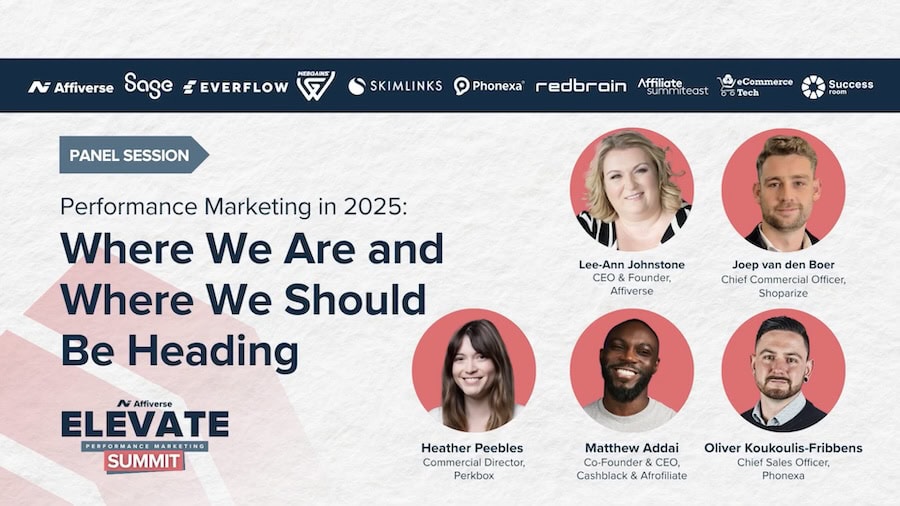
This summer, the Affiverse ELEVATE Summit transformed London into the epicentre of performance marketing innovation, and now we’re bringing a sneak peek of some of those game-changing insights directly to you through our exciting new ELEVATE Education blog series. As we’re all gearing up for back-to-school season, what better time to return to the performance marketing masterclass that was the ELEVATE stage? We’re kicking off with our first panel from Day 1: Performance Marketing in 2025: Where We Are and Where We Should Be Heading.
In this opening panel discussion, Affiverse Founder Lee-Ann Johnstone was in conversation with Joep van den Boer (Chief Commercial Officer, Shoparize), Heather Peebles (Commercial Director, Perkbox), Matthew Addai (Co-Founder and CEO, Cashblack and Afrofiliate), and Oliver Koukoulis-Fribbens (Chief Sales Officer, Phonexa).
This panel of industry veterans delivered sobering insights into an ecosystem grappling with AI disruption, attribution complexity, and the growing demand for authentic human connection, revealing both unprecedented opportunities and significant challenges that could determine which businesses thrive in the affiliate economy.
If you were not able to join us in London, then take some time out to watch this panel discussion now…
The Transparency Revolution: Beyond Traditional CPA Models
Perhaps the most significant evolution identified by panellists was the fundamental shift in advertiser-publisher relationships. Joep van den Boer from Shoparize observed a fundamental shift in brand conversations: “A couple of years ago, the number one question you got is how many sales can you deliver me? Well, right now, when you have the same conversations, it’s all about incrementality.”
This focus on incrementality presents both opportunity and challenge. While it demonstrates industry sophistication, it also raises the bar significantly for publishers who must now prove additive value rather than simply driving volume through existing customer bases.
The AI Paradox: Enhancement Versus Authenticity Backlash
The panel revealed a complex relationship with artificial intelligence that defies the typical industry narrative of wholesale AI adoption. While panellists acknowledged AI’s operational benefits—from fraud detection to content creation—they identified an unexpected consumer resistance that could reshape marketing strategies.
Matthew Addai provided a revealing insight from his industry perspective: “What we find now is that there’s so much AI about, and people are almost put off it in the sense that, oh, this isn’t real. I’m not speaking to a real person. I need an actual human connection to get a recommendation.”
This authenticity backlash presents a strategic inflection point for performance marketers. While AI tools can enhance operational efficiency—as Oliver noted with AI agents for lead pre-qualification—brands that over-rely on AI for customer-facing interactions may find themselves at a competitive disadvantage. It would appear that humans… still want humans.
The challenge lies in finding the optimal balance. As Heather explained, successful implementation focuses on AI as “an assistive tool” rather than replacement for human judgment, particularly in trust-based industries like employee benefits where “the whole industry is built on the human.”
Attribution Complexity: The Make-or-Break Factor for SMEs
The panel identified proper attribution and tracking as perhaps the most critical success factor for emerging affiliate programs, yet also the area where small and medium enterprises most frequently stumble. The consequences of inadequate tracking extend far beyond poor optimisation—they can result in complete program failure.
Oliver was unequivocal about the importance of early implementation: “If you’re launching something and you’re not tracking and attributing correctly, then you’re flying blind. You can’t optimise it efficiently. You can’t see what is working and what isn’t working.”
Heather’s perspective from Perkbox revealed the broader business implications: “Poor tracking really does result in those user complaints, which then is a loss of trust, a drop in usage and like I say, the worst thing that can happen then is that we churn that client.”
This creates a particularly acute challenge for SMEs who may lack the technical expertise or resources to implement sophisticated tracking solutions from launch. The panel suggested that businesses prioritise server-to-server tracking and establish clear attribution rules before scaling their programs, even if this means starting smaller than initially planned.
Five Pillars for Performance Marketing Success
1. Always be testing – The ecosystem is evolving rapidly, making trial and error essential for discovering new opportunities. As Joep recommended, set a goal to test something new every month or two, whether it’s a different publisher type or emerging technology.
2. Stay authentic – Despite AI’s operational benefits, there’s a growing consumer backlash against artificial interactions. Matthew’s experience highlighted how consumers increasingly crave genuine human connections and recommendations over automated responses.
3. Be performance led – Move beyond volume-focused metrics to prioritise true incrementality and value creation. The industry’s maturation means brands are asking tougher questions about additive value rather than simply accepting traffic volume.
4. Value versus volume – The most successful affiliate programs often work with fewer partners but develop deeper, more strategic relationships. Rather than recruiting thousands of affiliates, focus on cultivating high-value partnerships that drive genuine business outcomes.
5. Data is king – As Lee-Ann noted, “We’ve always said content is king, but I think I’m going to change it now… data is king.” Understanding and owning your traffic sources, customer data, and attribution flows has become the fundamental differentiator for sustainable success.
Strategic Predictions: Data Ownership and Partnership Evolution
Looking towards 2026, the panellists identified several trends that could fundamentally reshape the performance marketing ecosystem. Oliver’s prediction about offer ownership represents perhaps the most significant structural shift: “We are seeing more and more affiliates and networks that are actually owning the offer or creating their own offer and then using that to capture consumer data and distribute that to various advertisers.”
This evolution towards data ownership could create new power dynamics within the affiliate ecosystem, potentially challenging traditional advertiser-publisher relationships. Networks and affiliates who successfully implement this model may find themselves with significantly enhanced negotiating positions and revenue diversification opportunities.
Heather’s prediction of industry movement towards “fewer high-value affiliates who are long-term growth collaborators” suggests consolidation within publisher relationships, favouring depth over breadth. This trend could create barriers for newer publishers while offering enhanced opportunities for established, high-performing partners.
The performance marketing industry stands at a critical juncture where technological advancement must be balanced with human authenticity, where transparency demands are reshaping traditional relationships, and where data ownership could determine future competitive advantage. Success will require continuous education and having conversations and debates like the one above. We will all have our own opinions and experiences, but isn’t it great when our industry comes together to share them?
If you want to learn from the people who are actually changing how performance marketing works, get your tickets now for ELEVATE 2026 and hear directly from the industry’s most innovative minds.
Everflow
Connect
Tradedoubler
Connect
1win Partners
Connect
Shopnomix, a Nomix Group Company
Connect
Huffson Group
Connect
Kawaii Partners
Connect
Trackdesk
Connect
Share your expertise and expand your reach and become a content contributor with us today!
Contact Us To Find Out More