TikTok’s Oracle-Led Ownership Deal Closes This Month: Algorithm Changes Are Coming, But Will US Politics Shape Your For You Page?
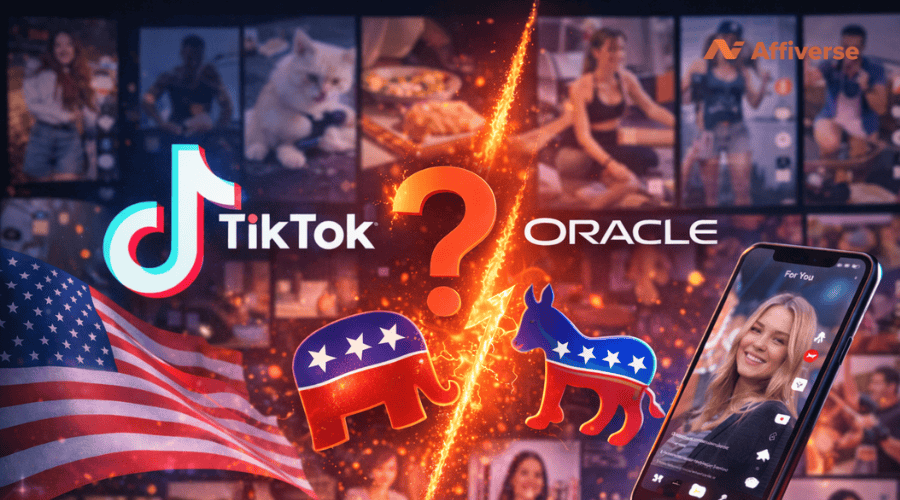
The landmark transfer of TikTok’s US operations to American investors is set to complete on January 22, 2026—and algorithm retraining is guaranteed under the deal’s terms. For affiliate marketers, the question isn’t whether changes will happen, but how deep they’ll cut.
The long-running saga of TikTok’s US future reaches its conclusion this month when a consortium led by Oracle, Silver Lake, and Abu Dhabi-based MGX formally takes control of the platform’s American operations. TikTok CEO Shou Chew confirmed in an internal memo that binding agreements have been signed, with the deal expected to close on January 22, 2026.
The ownership structure gives American investors approximately 80% control of the newly formed “TikTok USDS Joint Venture LLC,” with ByteDance retaining a minority 19.9% stake. Oracle, Silver Lake, and MGX will each hold 15% of the company, with the remaining shares distributed among existing ByteDance investors and new participants.
But the real story for affiliate marketers isn’t the ownership percentages—it’s what happens next to the algorithm that has made TikTok one of the most valuable platforms for performance marketing.
Algorithm Retraining: Not a Question of If, But How
The deal framework makes algorithm changes unavoidable. According to White House officials, Oracle will receive a licensed copy of TikTok’s recommendation algorithm from ByteDance and retrain it “from the ground up” using exclusively US user data.
This isn’t optional fine-tuning. The 2024 ban-or-sale legislation explicitly prohibits “any cooperation with respect to the operation of a content recommendation algorithm” between ByteDance and the new American owners. The algorithm that has driven TikTok’s remarkable affiliate engagement rates—5.2% on affiliate links compared to Instagram’s 2.0%—will be fundamentally rebuilt.
TikTok’s memo to employees confirmed the scope: the new entity will handle “retraining the content recommendation algorithm on U.S. user data to ensure the content feed is free from outside manipulation.” Oracle will continuously monitor algorithm operations, and the new investor-controlled board will have “ultimate decision-making authority for reviewing and approving all content moderation and related policies within the United States.”
For affiliates who have built strategies around TikTok’s current algorithmic dynamics, this represents genuine uncertainty. The platform’s ability to surface content to interested users—the core engine behind TikTok Shop’s explosive growth—will operate under entirely new management.
The Political Dimension: Ellison, Trump, and Content Control
The involvement of Oracle founder Larry Ellison has drawn particular attention from industry observers and lawmakers alike. Ellison, whose estimated fortune exceeds $390 billion, has maintained a close relationship with President Trump throughout 2025, regularly visiting the White House and hosting fundraisers at his California estate.
Senator Elizabeth Warren has called for scrutiny of the deal’s structure, noting that Trump administration approval of both the TikTok agreement and the Paramount-Skydance merger (engineered by Ellison’s son David) raises questions about political influence over media properties.
The Ellison family’s media holdings have expanded dramatically in recent months. David Ellison now controls CBS News through the Paramount Skydance merger, and the family has been pursuing a hostile acquisition of Warner Bros. Discovery. TikTok US now joins a portfolio that gives the Ellisons significant influence over what Americans watch and how they discover content.
Digital rights organisations have expressed concern about what this means for content moderation. NPR reported that the new ownership structure gives Ellison and the investor group control over “what’s allowed, what’s not, what you and I can post” on the platform. Free speech advocates worry less about overt censorship and more about subtle algorithmic adjustments that could influence which content reaches audiences.
Former Oracle CEO Safra Catz, who stepped down in September (potentially to take a leadership role in the new joint venture), has been explicit about the company’s ideological positioning. Both Ellison and Catz have been major donors to Israeli causes and Republican political committees, leading some observers to question whether content moderation policies might shift in ways that affect certain topics or communities.
What X’s Trajectory Reveals—And Where TikTok Differs
Industry observers are drawing parallels to Elon Musk’s chaotic 2022 takeover of Twitter (now X), which saw advertisers flee amid brand safety concerns, policy reversals, and algorithmic changes that altered platform dynamics.
The comparison has limits. TikTok’s new ownership structure involves experienced technology and private equity operators rather than a single individual with public vendettas. Oracle’s business depends on corporate relationships and government contracts that reward stability over controversy. Silver Lake has extensive experience managing media and entertainment properties through its control of WME and TKO Group Holdings.
More importantly, TikTok’s advertising business dwarfs X’s. The platform is projected to generate over $17 billion in US ad revenue in 2026, compared to X’s estimated $2.46 billion globally. Almost $1 of every $7 spent on social network advertising now flows to TikTok—a position that creates strong incentives to maintain advertiser confidence.
As one agency executive noted to Digiday, TikTok “seems to care more about advertisers than X did at the height of Musk’s takeover.” The platform hasn’t told advertisers to go away; it’s been actively expanding commerce features and creator monetisation programs.
Yet the executive departures throughout 2025 mirror what happened at Twitter. TikTok lost Sameer Singh (general manager for global business solutions in North America), Jack Bamberger (general manager of agency business), and Blake Chandlee (global head of advertising sales). That institutional knowledge loss creates uncertainty about how the new ownership will navigate advertiser relationships.
Affiliate Marketing Implications: Planning for Uncertainty
The ownership transition arrives at a critical moment for affiliate marketers. TikTok has emerged as a dominant force in performance marketing, with engagement rates that significantly outperform competitors. The platform’s integration with affiliate networks through partnerships like CJ Affiliate’s TikTok Shop connection has created sophisticated tracking infrastructure that many affiliates now depend upon.
Historical precedents from platform acquisitions suggest affiliate programs often experience temporary suspension or restructuring during ownership changes. Current partners should document existing commission structures, payment terms, and performance metrics before the January 22 closing date.
The algorithm retraining creates specific risks for content discovery strategies. Affiliates who have optimised content for TikTok’s current recommendation system may find their approaches less effective as Oracle implements different prioritisation criteria. The “For You Page” dynamics that drive affiliate content visibility could shift in ways that favour different content types or creator profiles.
Performance marketers should consider several strategic responses:
Establish baseline metrics now. Document current engagement rates, reach patterns, conversion rates, and content performance across different formats. These baselines become essential for measuring post-transition impact and identifying necessary strategy adjustments.
Diversify platform presence. Reducing dependency on any single platform has always been sound strategy, but the ownership transition makes it urgent. Instagram Reels, YouTube Shorts, and emerging platforms offer alternative distribution channels that don’t depend on Oracle’s algorithmic decisions.
Monitor policy changes closely. The new ownership group will control content moderation policies. Changes to what content is permitted, how commercial content must be disclosed, or how the algorithm treats promotional material could affect affiliate strategies significantly.
Review partnership agreements. TikTok’s recent community guidelines updates already introduced stricter controls around automation and AI-generated content. New ownership may bring additional policy revisions that require affiliate partners to adjust their approaches.
The Bigger Picture: Platform Ownership and Marketing Risk
The TikTok transition highlights a fundamental reality of social media marketing: platforms you don’t own can change in ways you can’t control. Whether those changes stem from algorithm updates, policy revisions, or wholesale ownership transfers, affiliates who build businesses on platform-dependent strategies face inherent vulnerability.
Successful affiliate marketers are building sustainable businesses that generate consistent income regardless of algorithm changes or market fluctuations. That means diversifying traffic sources, building email lists and owned media properties, and treating any single platform as one channel among many rather than the foundation of an entire strategy.
TikTok’s value proposition for affiliates remains strong. The platform’s commerce integration, creator monetisation programs, and engaged user base aren’t disappearing. But the algorithmic mechanics that determine which content reaches which users are about to undergo their most significant transformation since the platform launched.
The affiliates who thrive through this transition will be those who establish clear performance baselines, diversify platform strategies, and adapt quickly to whatever changes Oracle’s algorithm retraining introduces. Those who’ve built entire businesses around TikTok’s current dynamics without contingency plans may find the coming months challenging.
What Happens Next
The January 22 closing date marks the formal transfer of ownership, but the real changes will unfold over subsequent months as Oracle implements algorithm retraining and the new board establishes content moderation policies.
Bloomberg reports suggest US users may eventually need to download a separate app operated by the American-controlled entity—though this remains unconfirmed. What’s certain is that the TikTok experience for American users will diverge from international versions as the US algorithm optimises for its own audience under Oracle’s oversight.
For affiliate marketers, the message is clear: TikTok remains too valuable to abandon, but too uncertain to depend upon exclusively. The platform that delivered remarkable engagement rates and drove TikTok Shop’s Black Friday success isn’t going away—but the algorithm powering those results is being rebuilt by new owners with their own priorities and pressures.
Whether US politics will directly influence your For You Page remains speculative. What’s not speculative is that algorithm changes are coming, ownership has shifted, and the affiliate strategies that worked in 2025 may require significant adjustment in 2026.
For comprehensive guidance on navigating platform transitions and building resilient affiliate strategies, explore our resources on social media platform selection and creator partnership structuring.
Everflow
Connect
Tradedoubler
Connect
1win Partners
Connect
PIN-UP Partners
Connect
Shopnomix, a Nomix Group Company
Connect
V.Partners
Connect
Huffson Group
Connect
Kawaii Partners
Connect
Share your expertise and expand your reach and become a content contributor with us today!
Contact Us To Find Out More