TikTok Tests AI Shopping as Affiliate Costs Shape GMV Max Delivery
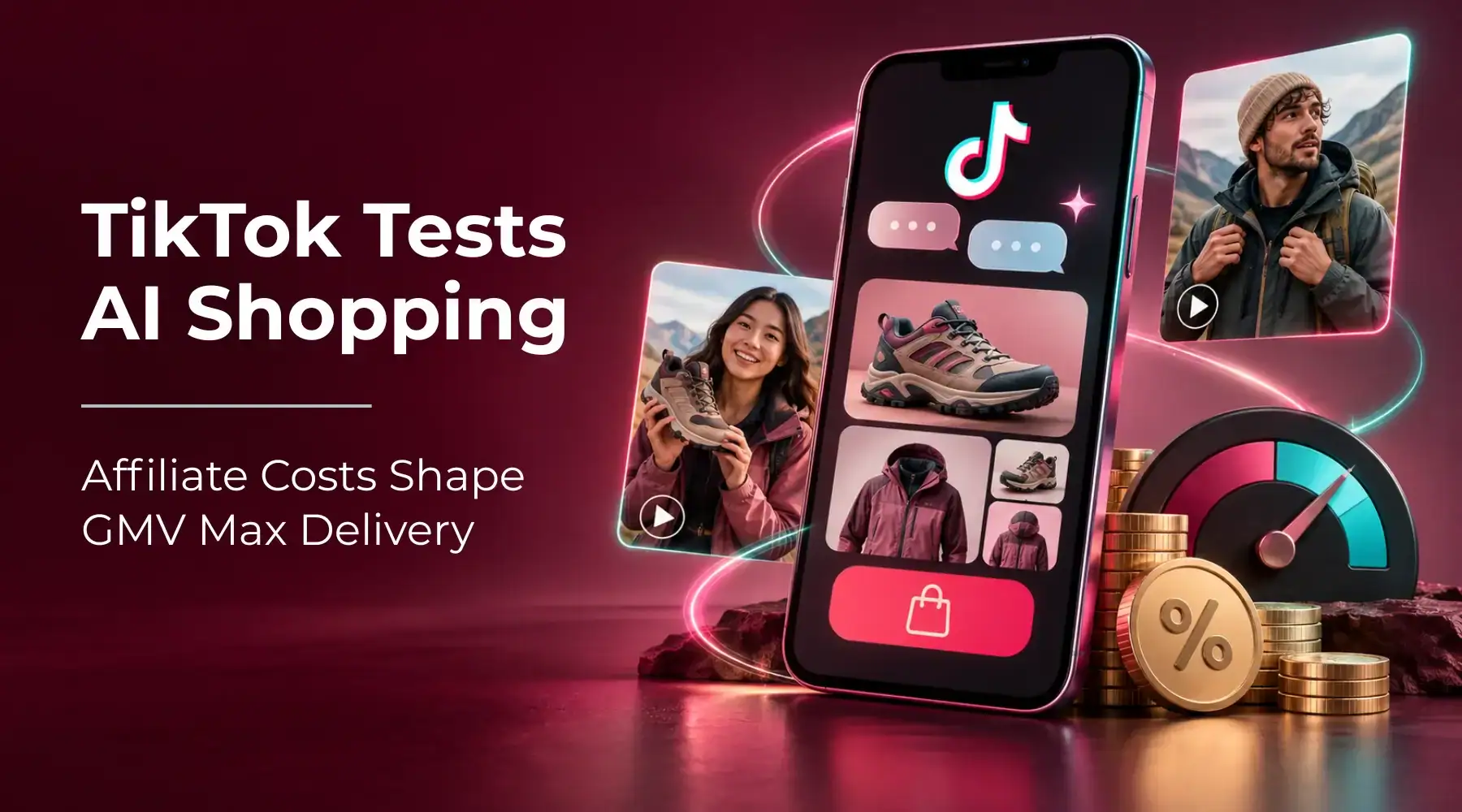
TikTok is testing an AI Shopping Assistant and native checkout tool while outlining further cost-focused updates to GMV Max. Announced on October 5 during Advertising Week New York, the developments bring product guidance and purchasing closer to TikTok’s advertising experience. For affiliate teams, an existing GMV Max capability explains the commercial stakes: commission costs can affect which creator content receives traffic.
David Kaufman, Global Head of Monetization Product Partnerships at TikTok
AI is transforming how advertiser content is created and scaled
Key Takeaways: TikTok Shopping Tests, Wider Ad Reach and Affiliate Costs
- Shopping Assistant answers product questions using merchant-provided information. Both it and Buy Direct remain eligibility-based tests.
- Buy Direct offers native checkout while the brand remains the merchant of record.
- GMV Max already includes affiliate costs for some advertisers; the October 5 announcement outlines further business-cost updates.
- TikTok Ad Network now supports US targeting. TikTok reports nearly 400,000 apps and more than 1 billion daily active users globally.
- TTAN’s performance claims come from internal testing. Campaign ROI still needs to be assessed alongside creator reporting and evidence of incremental sales.
AI Assistance and Checkout Remain Limited Tests
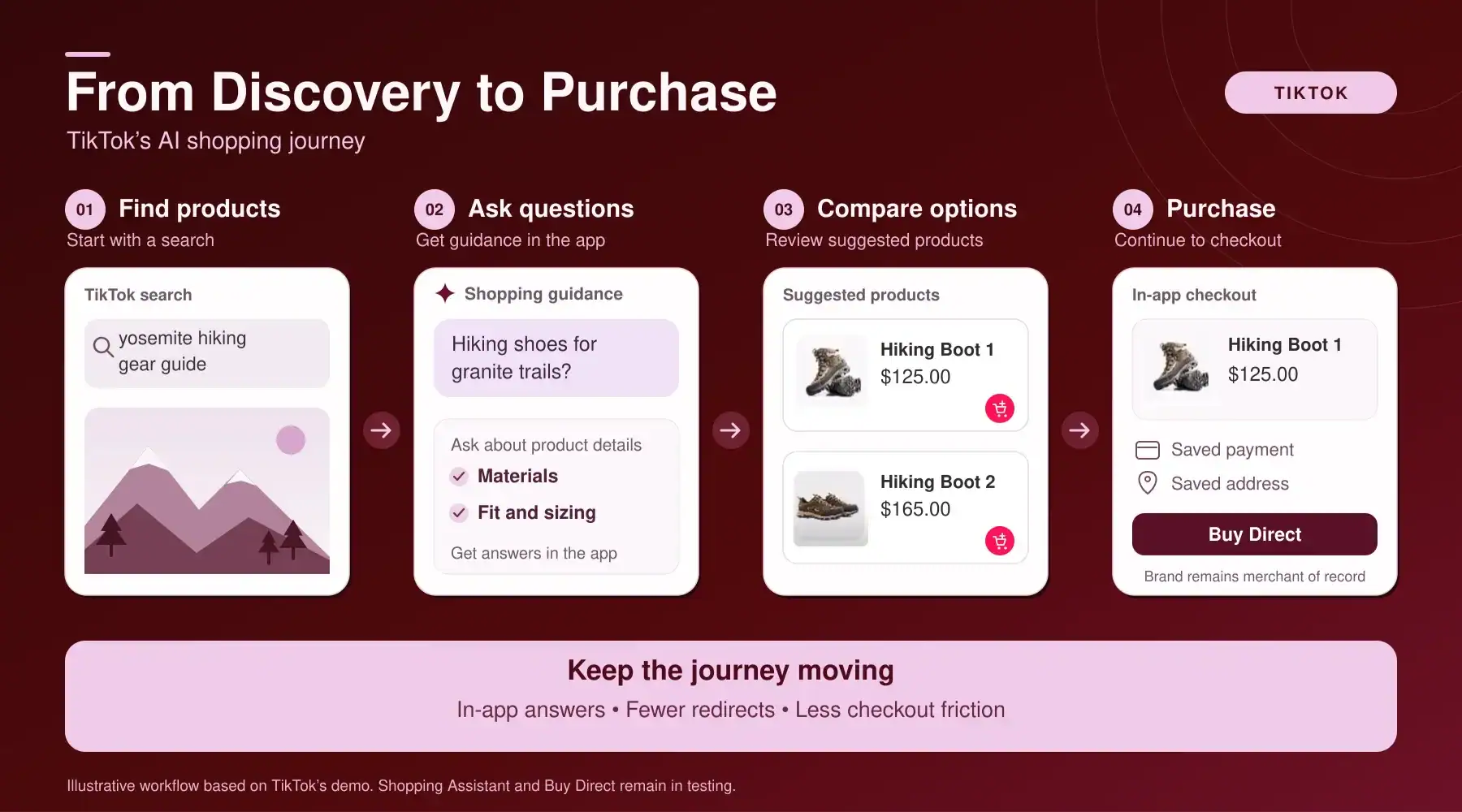
In its product announcement, TikTok describes Shopping Assistant as a chat window on product pages within its in-app browser. Answers use merchant information, and shoppers can continue to checkout on the merchant’s website.
Buy Direct provides native checkout with stored payment details and saved addresses. The brand remains the merchant of record. The tool requires integration with Universal Commerce Protocol, which TikTok says connects merchant systems with AI agents.
Both are available through eligibility-based testing. TikTok directs interested advertisers to their sales partner for access details.
These arrangements matter for partner teams. A purchase on a merchant website and a native Buy Direct transaction can have different tracking requirements. Brands need to confirm how affiliate identifiers and commission rules apply before testing.
Affiliate Commissions Can Affect Creative Delivery
The October 5 Advertising Week announcement outlines further business-cost updates to GMV Max. TikTok says the expansion is intended to improve advertiser profitability by:
TikTok, October 5 Advertising Week announcement:
Factoring in key business costs – like affiliate commissions, coupons, and referral fees
The announcement does not give a general rollout date for these updates.
However, TikTok’s Affiliate Cost Optimization documentation was already updated in July. It describes an existing capability for some Product GMV Max advertisers in the United States and Southeast Asia.
The feature calculates return as GMV divided by the combined ad spend and estimated affiliate costs. The commission estimate uses the selected products’ average commission rate over the previous 14 days.
TikTok says lower-commission or in-house creatives can receive additional traffic when their expected performance is similar. Higher-commission creators can still receive traffic when their stronger results justify the cost.
For affiliate managers, this adds a consideration to commission negotiations. A higher offered rate may help recruit creators, but it can also change the cost comparison used during ad delivery. Teams will need to compare traffic, conversion performance, and payouts together.
Campaign ROI Does Not Establish Creator Credit
TikTok’s GMV Max attribution rules say Product GMV Max credits all paid and organic orders for selected products while the campaign is running. That includes orders from shoppers who did not interact with an ad.
Consequently, campaign return cannot on its own show how many sales were caused by advertising or which creator first influenced the buyer. Including commissions adds commercial information, but the calculation does not establish incrementality.
Affiverse’s TikTok Shop Amazon-halo analysis explores a related problem: creators can influence purchases completed outside the tracked TikTok Shop checkout. Keeping shoppers in-app does not automatically settle which partner deserves credit.
GMV Max is a TikTok Shop advertising solution. The Shopping Assistant and Buy Direct announcement does not set out a single attribution framework linking those tests with GMV Max.
TikTok Ad Network Extends Campaigns Beyond the App
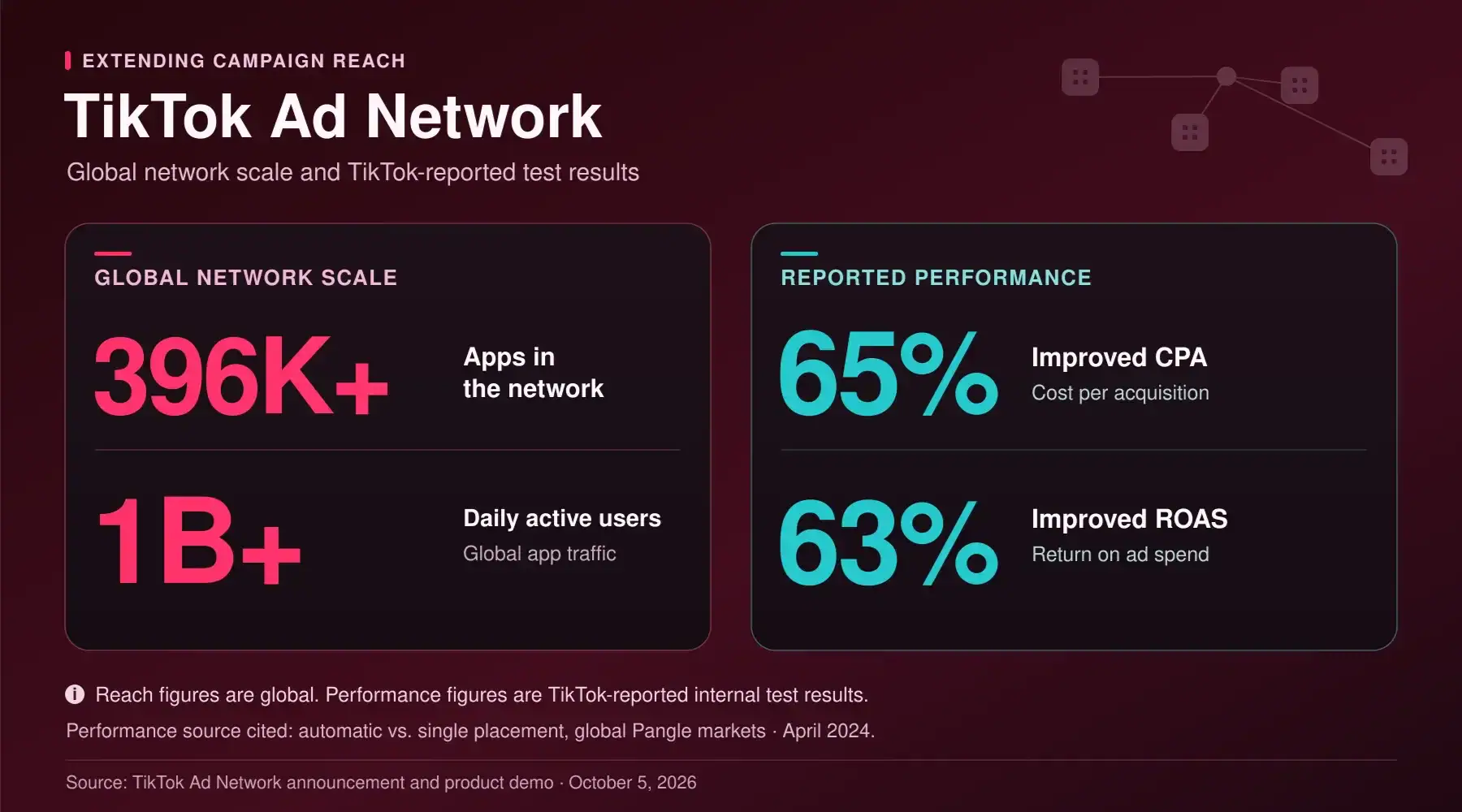
TikTok’s Ad Network announcement confirms general availability for advertisers targeting the US. Formerly known as Pangle, TikTok Ad Network (TTAN) extends campaign delivery into third-party apps. TikTok reports a global network of nearly 400,000 apps and more than 1 billion daily active users. These figures describe potential global reach; campaign reach depends on targeting and delivery.
The company also reports 65% improved cost per acquisition (CPA) and 63% improved return on ad spend (ROAS) in early testing. Its source list cites an April 2024 internal comparison of automatic versus single-placement delivery across global Pangle markets. The figures should therefore be treated as company-reported test results, with that context attached.
For affiliate teams, this raises a reporting question: how do off-platform ad conversions overlap with creator-led discovery and affiliate referrals? Teams should confirm attribution windows and rules for deduplicating conversions before treating additional ad touchpoints as evidence of additional partner sales.
What Affiliate Teams Should Check During Testing
Advertisers considering the tools should verify which features are available to their account. TikTok’s GMV Max Pro documentation says access varies by market, eligibility, and campaign setup.
Practical checks include how returns and cancellations affect the combined cost figure, whether creator-level costs can be reconciled with commission records, and how external affiliate identifiers are handled through Buy Direct.
Creators should also discuss content reuse, commissions, and reporting expectations before providing assets for automated campaigns. Affiverse’s TikTok creator monetization guide explains the different payment models.
These checks can help teams determine whether easier checkout produces measurable partner sales and whether changes in creative delivery reflect stronger returns, different commission costs, or both.
Everflow
Connect
Tradedoubler
Connect
1win Partners
Connect
PIN-UP Partners
Connect
Shopnomix, a Nomix Group Company
Connect
V.Partners
Connect
Huffson Group
Connect
Kawaii Partners
Connect
Share your expertise and expand your reach and become a content contributor with us today!
Contact Us To Find Out More