Reddit Threads Show Publishers Rethinking Amazon Associates
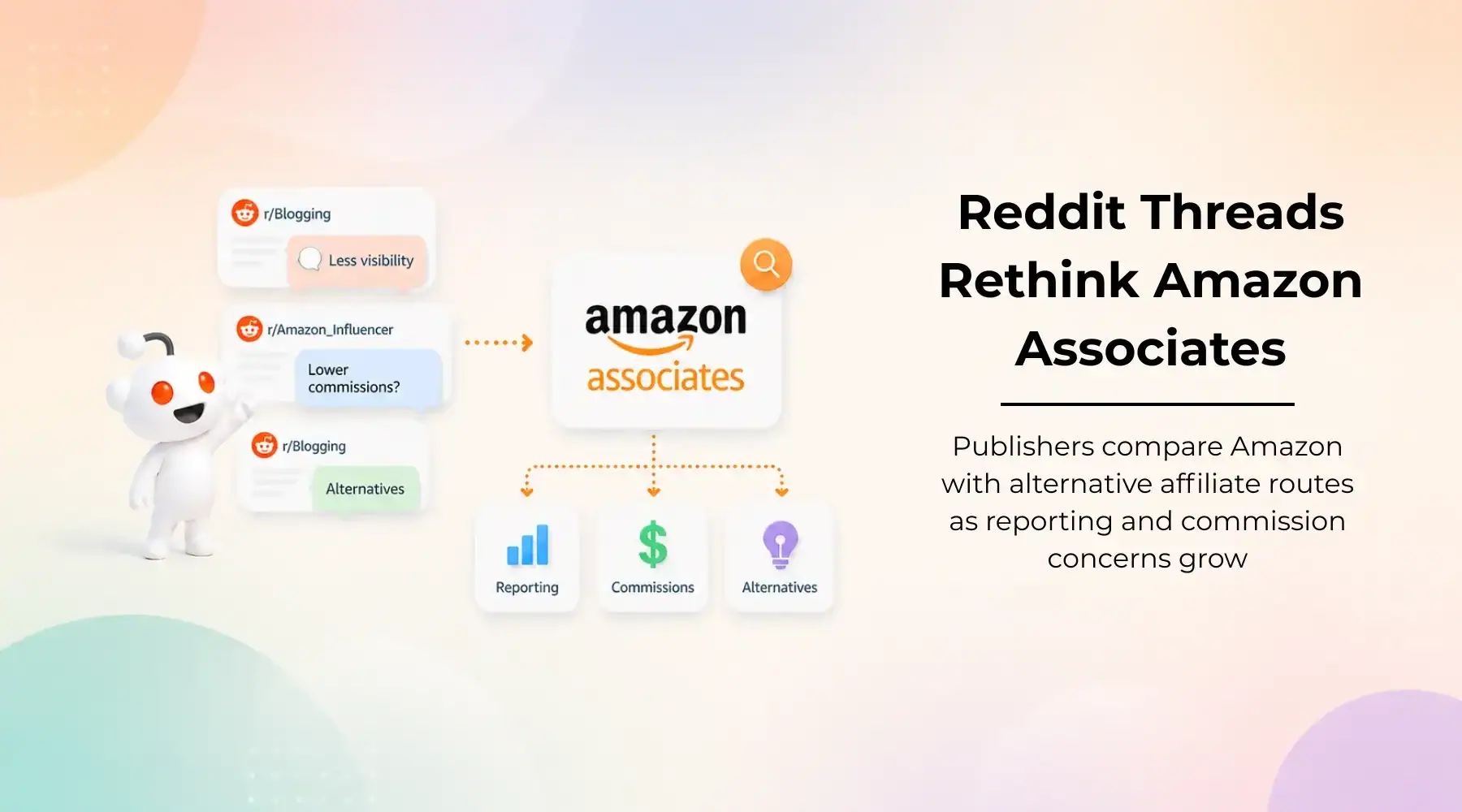
Amazon Associates is still one of the biggest retail affiliate programs in the market, but Reddit discussions show that some publishers are no longer treating it as the automatic default. After reported commission cuts, reduced reporting visibility and changes to parts of Amazon’s attribution model, affiliates are openly comparing Amazon with alternatives that may offer better category fit, clearer data or stronger economics.
This follows wider reporting on Amazon affiliate cuts, where commission pressure, removed incentives, and weaker reporting visibility raised questions for publisher commerce teams. Now, Reddit discussions are showing how those changes are being interpreted by affiliates on the ground.
Key Takeaways From the Amazon Associates Reddit Reaction
- Reddit discussions suggest some publishers are reassessing Amazon Associates after changes to commission, reporting and attribution visibility.
- The reaction follows wider concerns around Amazon affiliate cuts, including weaker reporting access and reduced confidence in the program’s long-term value for publishers.
- Amazon’s own documentation still says Associates can earn on qualifying items placed in a customer’s cart within 24 hours, so the wider “halo effect is dead” claim needs careful framing.
- Alternatives such as Stay22 and ShopMy are getting more attention as publishers compare category fit, commission terms and reporting visibility.
- The larger lesson for affiliates is diversification: better merchant mix, clearer tracking and less dependence on a single commerce partner.
Why Reddit Matters in the Amazon Associates Debate
Reddit is useful here because it shows affiliate reaction in a way that official statements and industry reports often do not. It also matters because Reddit is no longer just a place where buyers talk after a purchase.
Recent Reddit purchase research shows how community discussions now influence product validation and buying confidence before users reach a merchant or publisher site. Affiverse has also covered how Reddit is outranking affiliate content in parts of search, which makes these conversations harder for affiliate teams to ignore.
For Amazon Associates, that makes Reddit useful on two levels. It shows how publishers are reacting to program changes, and it also reflects the wider shift in how product research, trust and buying decisions are shaped online.
What Reddit Threads Reveal About Publisher Frustration
Across Reddit discussions, the same concerns appear repeatedly: publishers are questioning not only Amazon’s rates, but also how much visibility and control they still have over affiliate performance. These posts should not be treated as proof of a universal migration away from Amazon. They are more useful as a signal of publisher mood and the practical questions affiliates are now asking.
Commission Pressure Is Driving Reassessment
In one recent r/Blogging discussion, a publisher described Amazon Associates as less useful for their site and pointed to alternatives such as Stay22 and ShopMy for certain content types. For publishers that rely heavily on Amazon, even small commission changes can affect whether product-led pages remain commercially worthwhile.
Amazon Associates Reporting Visibility Is the Bigger Concern
Another r/Amazon_Influencer thread focused on restricted reporting, with creators and affiliates discussing weaker product-level visibility. That matters because affiliates use reporting to understand which products convert, which categories deserve more content and which pages need refreshing. Without that feedback loop, optimization becomes much harder.
Publishers Are Comparing Amazon Associates Alternatives
The Amazon debate is not only about rates. A lower commission reduces revenue, but weaker reporting makes it harder to respond. The questions being asked are practical: Which pages still make sense for Amazon links? Which categories should move to direct merchant programs? Which platforms give publishers better data, stronger commissions or more control?
The “Halo Effect” Claim Needs Careful Framing
Some affiliate discussions have described Amazon’s changes as the fading of the “halo effect,” where affiliates could earn from broader basket activity after sending a buyer to Amazon. That phrase is useful, but it needs context.
The distinction matters:
- Amazon’s Associates help page still says Associates can earn commission income on qualifying items placed in a customer’s shopping cart within 24 hours of arriving through an Associates link.
- Amazon’s Operating Agreement update says onsite commission income now applies only to direct qualifying purchases of the same ASIN variant as the linked product detail page.
That means it would be too broad to say the entire Amazon cart effect has disappeared across every use case. The safer takeaway is this: Amazon Associates appears more limited and less transparent for some affiliates than it once did, especially where reporting visibility and commission scope are central to content planning.
Why Amazon Associates Alternatives Are Getting More Attention
The Reddit discussions also show why alternatives such as Stay22 and ShopMy are entering more publisher conversations. The point is not that these platforms replace Amazon everywhere. It is that publishers are looking for better fits by content type.
For example:
- Travel publishers may look at tools such as Stay22, which is built around accommodation and travel intent.
- Lifestyle, fashion and beauty creators may compare platforms such as ShopMy, where product recommendations and brand relationships are closer to the content.
- Product review and comparison sites may test direct merchant programs or retail networks where commission terms and reporting are clearer.
Amazon can still work well for broad retail intent, but affiliates are becoming more selective. For some pages, a marketplace link may still be the best option. For others, a direct merchant program, creator commerce platform or category-specific affiliate tool may offer better economics, better data or stronger user fit.
That shift also connects to the wider creator commerce market. As creators and affiliates move closer together, brands and publishers are paying more attention to who influences the sale, who closes it and which partner model gives both sides enough visibility.
How Affiliate Teams Should Review Amazon Associates Dependence
Amazon Associates still matters. For many publishers, it will remain part of the retail affiliate stack because Amazon has reach, trust and a checkout flow users already know. The risk is treating Amazon as the default answer for every commercial page.
Affiliate teams should review their setup in a few practical steps:
- Audit Amazon-dependent pages: Identify which articles, guides or comparison pages rely most heavily on Amazon revenue.
- Compare partner options by content type: Review whether direct merchant programs, retail networks or category-specific tools could offer better commission terms, clearer reporting or stronger user fit.
- Check where reporting gaps exist: Look for pages where performance is harder to understand because product-level or purchase-level visibility has weakened.
- Review the full discovery journey: A buyer may find a product through Google, check Reddit for real user opinions, ask an AI assistant for comparisons, read an affiliate guide and then convert through a merchant or marketplace.
- Connect content strategy with measurement: For publishers reviewing this shift, an AI search content strategy for affiliates should account for community validation, search visibility and commercial outcomes.
The goal is not to remove Amazon from every article. It is to understand where Amazon is still the best fit, and where another partner could create stronger economics or clearer reporting.
What the Amazon Associates Reaction Means for Affiliate Strategy
Reddit threads are not the final word on Amazon Associates, but they offer a useful view of how some publishers are responding to recent program changes. For affiliate teams, the discussion may be a prompt to review how much revenue, reporting and conversion data depends on a single commerce partner. Amazon can still play an important role in retail affiliate monetization, but publishers may want to compare where it performs best against direct merchant programs, retail networks and category-specific alternatives. As affiliate discovery becomes more fragmented, this kind of review can help teams better understand partner fit, traffic source visibility and access to reliable performance data.
Everflow
Connect
Tradedoubler
Connect
1win Partners
Connect
PIN-UP Partners
Connect
Shopnomix, a Nomix Group Company
Connect
V.Partners
Connect
Huffson Group
Connect
Kawaii Partners
Connect
Share your expertise and expand your reach and become a content contributor with us today!
Contact Us To Find Out More