Buffer’s Analysis of 11 Million Posts Challenges Conventional Wisdom on Content Volume
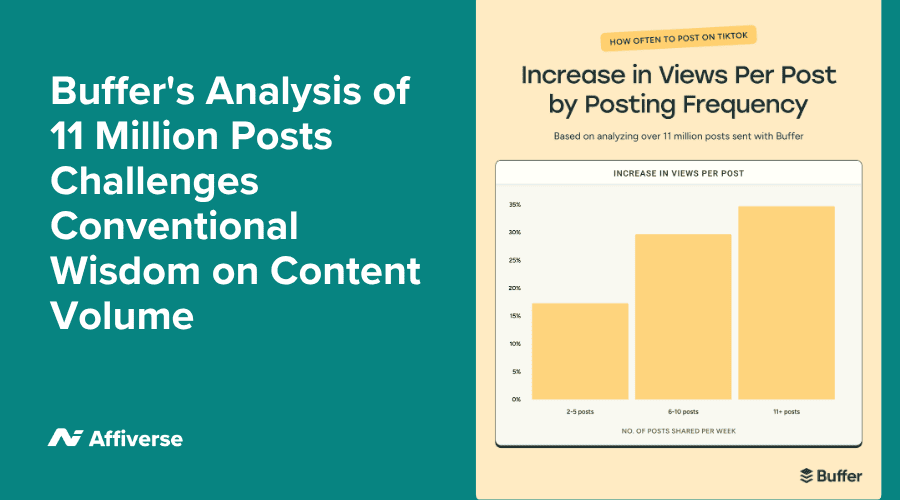
Heads up! If you’re running affiliate campaigns on TikTok—or evaluating whether the platform deserves more of your budget—Buffer’s latest research demands your attention. The data isn’t subtle: affiliates posting 11+ times weekly see roughly double the per-post reach compared to those posting 2-5 times, with the algorithm systematically favouring accounts that maintain consistent output.
This matters because TikTok has evolved from experimental channel to revenue driver for performance marketers. Buffer’s comprehensive analysis of over 11 million TikTok posts from more than 150,000 accounts reveals that the platform’s algorithm actively rewards posting consistency in ways that directly impact affiliate conversion opportunities. For affiliate managers allocating resources across social platforms, or solo creators deciding where to invest production time, these findings have immediate operational implications.
The research, which employed fixed-effects regression models to isolate frequency effects from account-level variables, found that creators who increase their posting cadence from once weekly to 2-5 times weekly see a 17% boost in average views per post. More significantly for performance marketers, accounts posting 11 or more times weekly effectively double that performance rate— up to 34% more views per post. Though the operational implications of maintaining that velocity require serious consideration.
This isn’t merely about vanity metrics. For affiliate marketers operating on TikTok’s expanding commerce infrastructure, increased per-post reach translates directly to more product impressions, higher click-through rates on affiliate links, and ultimately improved conversion economics. The challenge facing affiliate operations—from individual creators to agency teams—is whether they can sustainably produce quality content at the frequencies that unlock these algorithmic advantages.
The Economics of Frequency: Resource Allocation Under Scrutiny
The study’s findings force affiliate marketers to confront an uncomfortable truth about TikTok’s algorithmic economics. The platform demonstrably favours volume, but not every affiliate operation has the content production infrastructure to capitalise on this preference without compromising quality or burning out creative teams.
Buffer’s data shows that while posting 11+ times weekly delivers maximum reach gains, the most efficient return on effort occurs in the 2-5 posts per week range. Crucially, the research suggests that increased posting frequency works primarily by raising the probability of landing a viral hit—most posts will still see modest reach, but more attempts mean more chances for breakout performance that elevates overall averages. This creates a strategic tension: chase maximum algorithmic favour at potentially unsustainable operational cost, or optimise for efficiency while accepting you’re leaving reach on the table.
For affiliate marketers, this calculus must factor in conversion data alongside reach metrics. A viral post that drives 100,000 views but converts at 0.1% delivers the same revenue as a 10,000-view post converting at 1%. The critical question becomes whether increased posting frequency maintains or dilutes conversion quality.
The research methodology—using fixed-effects models to compare each account against its own historical performance—suggests these gains hold across account sizes. This democratises the opportunity somewhat, as smaller affiliate creators aren’t fighting an inherent disadvantage. However, it also means competition is intensifying as more creators recognise that consistent posting unlocks algorithmic preference.
Remember: A smaller, highly engaged audience can be more valuable than massive reach with poor conversion quality.
Content Quality Versus Algorithmic Appeasement: The Affiliate Marketer’s Dilemma
The study reveals a fundamental challenge for affiliate marketers building sustainable TikTok-based revenue streams: TikTok’s algorithm rewards frequency, but audiences reward authenticity and value. Threading this needle requires operational sophistication many affiliate marketers haven’t developed.
Buffer’s analysis doesn’t measure content quality decline at higher posting frequencies, but the risk is real. Rushed product demonstrations, generic trend-chasing, and recycled content formats might satisfy algorithmic preferences while eroding audience trust—the foundation of affiliate marketing success. As Buffer notes in their research, posting more frequently doesn’t necessarily raise the floor, but it does raise the ceiling. The research indicates that higher posting frequency increases the probability of individual viral hits, but doesn’t guarantee that those viral moments translate to sustained affiliate performance.
This creates particular challenges for affiliate marketers in verticals requiring expertise, detailed product analysis, or genuine testing. A skincare affiliate demonstrating product efficacy over weeks can’t simply triple output without compromising credibility. Fashion and lifestyle affiliates might find content multiplication easier, but risk audience fatigue from excessive promotional density.
The data suggests successful TikTok affiliate strategies in 2025 will require sophisticated content planning and automation, batch production workflows, and potentially expanded creative teams. Solo affiliate creators face the starkest choice: invest in production infrastructure or accept algorithmic disadvantage.
Three Operational Models for Different Affiliate Operations
Affiliate marketers have three primary strategic responses to this data, each suited to different operational profiles and risk tolerances.
The Volume Play: Affiliates with production infrastructure and diverse product portfolios can pursue maximum frequency targets. This requires content calendars, batch filming, repurposing strategies, and potentially multiple team members. The approach favours affiliates working with platforms offering robust creator tools, where backend efficiency compensates for frontend production intensity. However, marketers pursuing this strategy must accept that most individual posts won’t achieve viral reach—the goal is increasing the statistical probability of breakout hits that drive disproportionate returns. Success here demands maintaining quality thresholds even at high volume—rushed, low-value content will tank engagement metrics that TikTok’s algorithm also considers.
The Efficiency Optimisation: Many affiliate marketers will target the 2-5 posts weekly sweet spot, where the data shows meaningful reach gains at sustainable production levels. This model emphasises quality over quantity, betting that superior content partially compensates for reduced algorithmic preference. Affiliates pursuing this approach should focus on evergreen content that remains relevant beyond initial posting, maximising return on production investment. This aligns well with affiliate verticals requiring expertise and trust-building.
The Hybrid Strategy: Sophisticated affiliate operations might combine base-level consistent posting with strategic frequency surges around product launches, seasonal campaigns, or promotional periods. Buffer’s data doesn’t address posting pattern variations, but affiliate marketers can test whether temporary frequency increases yield sustained algorithmic benefits or only temporary reach spikes. This approach requires analytical rigor to identify which frequency variations actually impact conversion economics versus just generating empty impressions.
The algorithm has spoken: consistency matters. Whether individual affiliate marketers can respond without compromising the authenticity that drives conversions remains the critical question.
Ready to diversify your affiliate marketing strategy? Explore our training programs and stay updated with the latest trends through our industry insights.
Everflow
Connect
Tradedoubler
Connect
1win Partners
Connect
PIN-UP Partners
Connect
Shopnomix, a Nomix Group Company
Connect
V.Partners
Connect
Huffson Group
Connect
Kawaii Partners
Connect
Share your expertise and expand your reach and become a content contributor with us today!
Contact Us To Find Out More