Black Friday Affiliate Marketing: An 8-Week Strategy for 2026
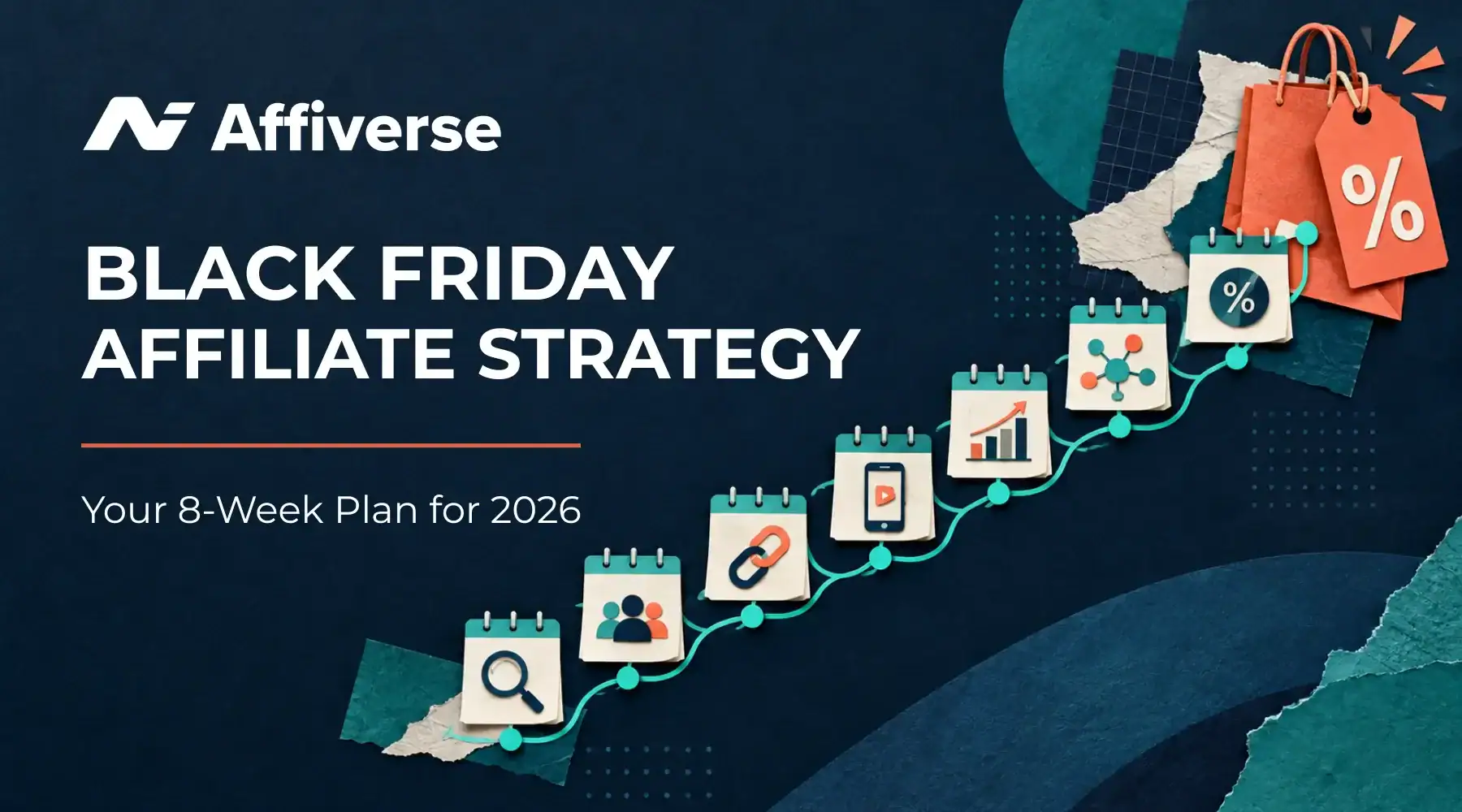
A successful Black Friday affiliate marketing strategy begins before promotional traffic arrives. Brands need time to agree on the offer, recruit partners, confirm commercial terms, prepare creative, and test every path from affiliate click to validated sale.
Black Friday falls on November 27 in 2026, followed by Cyber Monday on November 30. This eight-week plan explains what affiliate managers, advertisers, and agencies should decide before Cyber Week begins.
Why Black Friday Affiliate Planning Should Start Early
Adobe expects US consumers to spend $275.1 billion online between November 1 and December 31, 2026, representing growth of 6.7% from the previous year. It also predicts a 130% increase in retail traffic from AI-powered services.
Cyber Week is forecast to generate $47.5 billion. Black Friday sales are expected to reach $12.9 billion, while Cyber Monday could become the first US online shopping day to pass $15 billion.
The opportunity is not limited to direct retail traffic. Adobe expects affiliates and partners to increase their share of online revenue by 12%, while social media’s share is forecast to grow by 17%. Cashback and rewards partners currently account for 36% of affiliate traffic measured by Adobe, followed by creators and influencers at 22%.
These figures are forecasts rather than guaranteed outcomes. However, they show why brands need more than a last-minute discount code. Shoppers may encounter a product through a creator, research it through search or an AI assistant, compare prices through a publisher and complete the purchase after visiting a cashback platform.
A Black Friday affiliate program should account for that complete journey.
Set the Commercial Plan Before Contacting Affiliates
The first decision is what the campaign needs to achieve.
Revenue may be the headline target, but it should not automatically be the only one. A retailer may want to acquire first-time customers, clear selected stock, introduce a new product range, or increase average order value. Choosing one primary objective makes it easier to select partners and structure commissions.
The offer must then be tested against the economics of the sale.
For example, a product normally sold for $100 might fall to $75 after a 25% discount. If its product cost is $40 and the affiliate receives 10% of the net sale, the remaining amount before fulfillment, payment fees, returns and overhead is $27.50. A campaign can produce substantial revenue while still creating weak or negative contribution margins.
Affiliate managers should confirm whether commission is calculated before or after discounts and whether tax, shipping, returns or excluded products affect the final payment. The same rules should be documented for promotional codes, new-customer bonuses and commission increases.
This prevents the team from approving an attractive consumer offer that the affiliate program cannot support profitably.
Build an Eight-Week BFCM Affiliate Marketing Timeline
For Black Friday 2026, the main planning period begins at the start of October. Larger publishers and creators may need to be contacted earlier if their commercial calendars are already filling.
| Timing | Main Priority | Required Outcome |
|---|---|---|
| By October 2 | Confirm objectives, offer, stock and budget | Approved commercial plan |
| October 2–16 | Select and contact priority partners | Provisional placements and creator commitments |
| October 16–30 | Agree commissions, fees, content and usage rights | Confirmed partner agreements |
| October 30–November 13 | Prepare links, feeds, landing pages and creative | Complete campaign pack |
| By November 17 | Test tracking, codes, mobile journeys and reporting | Signed-off readiness report |
| November 23–30 | Monitor performance and communicate changes | Live dashboard and issue log |
| From December 1 | Validate sales and evaluate partner performance | Post-campaign review |
Teams starting later should prioritize confirmed offers, existing high-performing partners, tracking tests, and accurate product information. Recruiting a large number of unfamiliar affiliates is less useful if there is not enough time to brief them properly.
Black Friday Affiliate Marketing Strategies by Partner Type
Different partners influence different stages of the shopping journey. Sending the same offer and commission rate to every affiliate may be simple, but it rarely reflects the value each partner provides.
Editorial Publishers, Review Sites, and Creators
Content-led partners need time to research products, create useful material, and secure approval where required. Publishers may be preparing gift guides, price comparisons, buying advice, and category roundups weeks before Black Friday.
Give them accurate product details, original images, confirmed pricing, and clear evidence for any performance claims. Early access or product samples may help creators produce more credible demonstrations, but commercial relationships and gifted products must be disclosed.
Creator partnerships may require a fixed production fee, an affiliate commission, or a combination of both. The agreement should also state whether the brand can reuse the content in advertising, email, or product pages.
For more on the overlap between these models, listen to Affiverse’s discussion on rethinking affiliate, creator and marketplace partnerships.
Cashback, Loyalty, and Coupon Partners
Cashback, rewards, and coupon platforms often become more influential as shoppers move closer to purchase. They can provide scale during Cyber Week, but their commercial terms need careful control.
Brands should confirm which codes each partner may promote, whether codes can be combined, and how expired or unauthorized offers will be handled. Exclusive codes should be genuinely exclusive and supported by enough stock to justify the placement.
A partner that appears at checkout may record the final click without necessarily creating the initial demand. That does not make the partner unhelpful, but it does mean its results should be assessed alongside margin, new-customer contribution, and earlier touchpoints.
Paid Search, Comparison, and Product-Feed Partners
Paid-search affiliates, shopping comparison services, and product-feed publishers depend on timely and structured information.
They need confirmed rules covering brand bidding, trademark use, direct linking, approved landing pages, and geographic restrictions. Product feeds should include current prices, availability, images, product identifiers, and promotion dates.
A stale feed can send shoppers to an expired offer or unavailable product. During Black Friday, that can waste paid traffic and damage confidence in both the publisher and the retailer.
Agree on Commissions, Assets, and Campaign Rules
Black Friday commission increases should reward a defined result rather than simply paying more for traffic the program would have received anyway.
A brand might offer a higher rate for first-time customers, selected categories, or revenue above an agreed threshold. Fixed placement fees can be useful when a publisher is providing prominent exposure, while hybrid payments may suit creators who need to cover production costs before sales occur.
The final campaign pack should give partners one reliable source of information containing:
- Confirmed offers, start times, expiry times, and exclusions
- Affiliate links, promotional codes, and approved landing pages
- Product feeds, images, and creative in the required formats
- Commission rates, validation rules, and payment terms
- Brand language, disclosure guidance, and restricted claims
- Named contacts for commercial, technical, and stock issues
Avoid sending pricing or creative through scattered email threads. A dated central document makes it easier to communicate changes and identify which version partners received.
Test Black Friday Affiliate Tracking Before Launch
Tracking should be tested while there is still time to repair it. Waiting until Black Friday morning can leave the team choosing between lost sales data and interrupting a live campaign.
| Scenario | What to Test | Successful Result |
|---|---|---|
| Standard affiliate journey | Complete desktop and mobile purchases through an affiliate link | Click, order value and transaction ID appear correctly |
| Creator or promotional code | Place orders with and without a preceding affiliate click | Code attribution follows the agreed rules |
| App or deep-link journey | Move from partner content into the app or mobile site | Customer reaches the correct product and the sale is recorded |
| Channel overlap | Test an order involving affiliate, email, paid search or paid social | Only the intended channel receives final credit |
| Cancellation or return | Cancel or refund a test transaction | Commission is reversed according to program terms |
The tests should also confirm the attribution window, currency conversion, consent behavior, and treatment of tax, shipping, and discounts.
Deduplication rules deserve particular attention. Recent affiliate commission and deduplication disputes show what can happen when advertisers, networks, and partners apply different rules to the same order.
A documented attribution audit can help identify gaps before higher Cyber Week volumes make them more expensive.
Keep Offers Accurate and Compliant
Partners cannot promote an offer accurately if the retailer’s own information is unclear.
Landing pages, product feeds, and campaign briefs should agree on the price, discount, stock status, delivery terms, and promotion deadline. When availability changes, priority partners should receive an update rather than discovering the problem through customer complaints.
Google says Product and Offer structured data can make product pages eligible for merchant listing experiences that display information such as price, availability, shipping, and returns. It does not guarantee visibility, but accurate markup can help Google understand fast-changing product information.
Affiliate and creator disclosures must also remain visible during promotional periods.
The US Federal Trade Commission’s Endorsement Guides say material relationships that consumers may not expect should be disclosed clearly and conspicuously. This can include commission payments, free products, and other benefits supplied by the advertiser.
In the UK, the ASA’s guidance on online affiliate marketing states that the CAP Code applies to affiliate marketing and that both the advertiser and affiliate can be responsible for compliant content. Affiliate advertising should be recognizable as advertising rather than presented as independent editorial material.
A busy sales period does not reduce those responsibilities.
Prepare a Separate Cyber Monday Plan
Cyber Monday should not be treated as an automatic extension of Black Friday. Shopper urgency, available stock, and competitor offers may all have changed by then.
In Affiverse’s holiday and peak-planning podcast, Team Bespoke co-founder Melissa Feemster recommends anticipating changes in consumer behavior and keeping contingencies ready. Brands should therefore approve backup products, alternative creative, and a replacement offer before the weekend begins. This allows the team to respond if an item sells out, a category underperforms, or a competitor introduces a stronger deal.
If the discount remains unchanged, the messaging can shift toward the deadline, remaining stock, digital delivery, or products that received less attention on Black Friday. Cyber Monday can also support stronger-margin categories instead of extending every promotion.
Landing pages, affiliate links, codes, and campaign rules should be prepared in advance. The partner brief should explain what continues, what changes, the exact changeover time and time zone, and when the promotion ends. Avoid changing URLs unless necessary, as this can disrupt tracking and leave partners publishing outdated information.
Manage Cyber Week and Measure the Result
A live dashboard should show clicks, conversion rate, average order value, validated net sales, commission, earnings per click, and new-customer contribution by partner. Results should also be grouped by partner type.
Teams should monitor rejected transactions, unusual code use, traffic changes, stock levels, and landing-page errors. One named person should have authority to pause an offer or notify partners. Updates should identify the affected products, revised terms, replacement links, and exact timing.
After returns and cancellations have been processed, performance should be judged using net results. Discounts, commission, tenancy fees, product costs, and rejected orders can substantially change a partner’s apparent value.
Affiverse’s Huawei affiliate growth webinar shows why the review should extend beyond the live campaign window. Huawei’s Miranda Yuan described an October publisher investment whose immediate results looked modest, but the publisher later generated the company’s highest Black Friday sales without further spending.
The final review should compare partners according to their intended roles. As Affiverse’s webinar on the new rules of commerce performance explains, one purchase may involve creators, AI tools, comparison services, and cashback. New-customer rates, assisted conversions, margin, code usage, and repeat purchases should therefore be considered alongside last-click revenue.
Final Black Friday Affiliate Checklist
Before the campaign begins, confirm that:
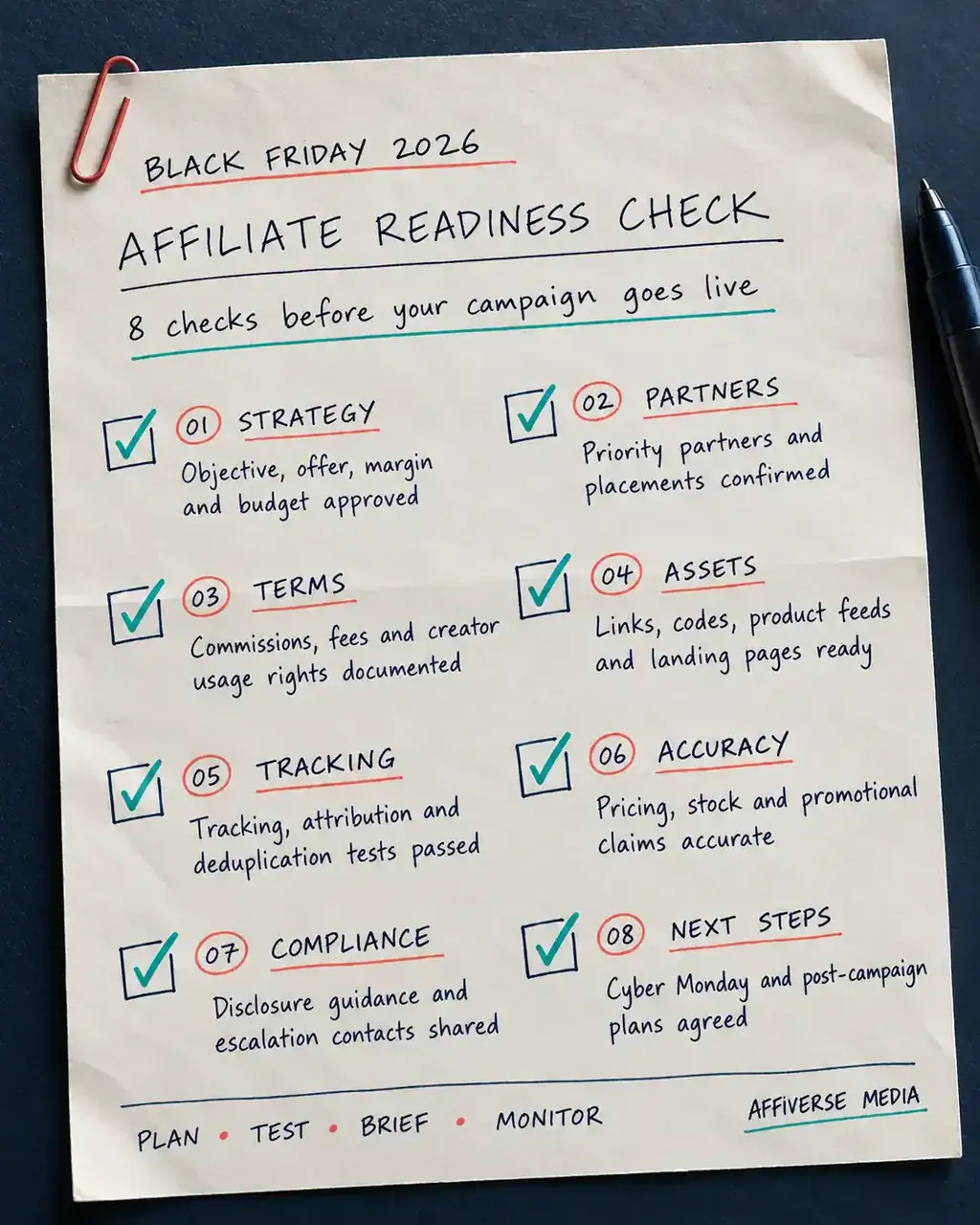
A Strong Black Friday Affiliate Program Is Built Before Cyber Week
Black Friday affiliate marketing works best when the channel is treated as more than a source of discount traffic.
A clear commercial objective, the right mix of partners, accurate product information, and tested attribution give affiliates a better chance of influencing profitable sales. They also give brands the evidence needed to decide which relationships should continue after the holiday period.
The goal is not simply to generate the highest possible number of transactions during one weekend. It is to understand which partners created demand, which converted it and which delivered customers worth retaining.
Black Friday Affiliate Marketing FAQs
When Should Brands Start Planning a Black Friday Affiliate Campaign?
Brands should begin planning around eight weeks before Black Friday. Publishers, creators, and paid placements may need to be booked earlier. If the campaign starts late, focus on existing partners, accurate offers, working links, and tested attribution.
What is a Good Black Friday Affiliate Commission Rate?
There is no single rate that suits every program. The commission must account for product margin, discounts, expected returns, partner fees, and the customer value being generated. Brands can use higher rates for new customers, strategic products, or agreed revenue thresholds.
Should a Black Friday Affiliate Strategy Include Creators?
Creators can support product discovery, demonstrations, and buying advice before shoppers reach a retailer. They may need fixed production payments as well as commission. Their contribution should be assessed using reach, engagement, assisted sales, and new customers alongside last-click revenue.
How Should Black Friday Affiliate Sales Be Tracked?
Use tested affiliate links, unique transaction IDs and controlled promotional codes. Where relevant, test mobile, app and cross-device journeys. Advertisers should also document how affiliate sales are deduplicated against paid search, email, social advertising, and other channels.
Should Black Friday and Cyber Monday Use Different Offers?
They do not always require different discounts, but they should have distinct plans. Cyber Monday can introduce new creative, emphasize the final deadline, support different products, or change the partner incentive. All changes should be communicated before Cyber Week.
Everflow
Connect
Tradedoubler
Connect
1win Partners
Connect
PIN-UP Partners
Connect
Shopnomix, a Nomix Group Company
Connect
V.Partners
Connect
Huffson Group
Connect
Kawaii Partners
Connect
Share your expertise and expand your reach and become a content contributor with us today!
Contact Us To Find Out More