UK Under-16 Social Media Ban Raises New Questions for Advertisers and Affiliates
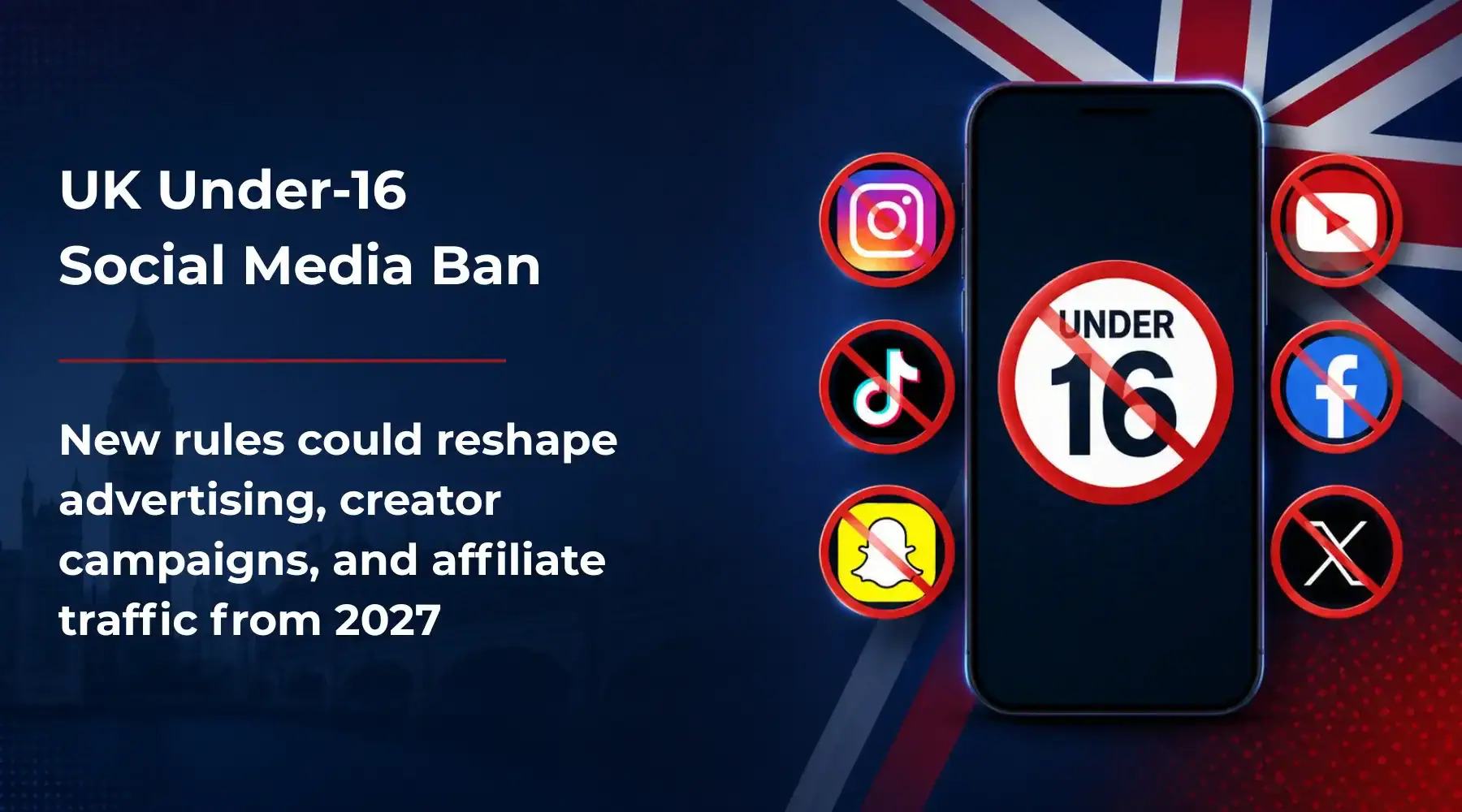
The UK government confirmed on 15 June 2026 that it plans to ban under-16s from accessing social media platforms, a move that could reshape youth-focused advertising, creator partnerships, social commerce, and affiliate campaign planning from 2027.
According to the official government announcement, social media platforms will be blocked from offering services to children under 16, with the changes expected to come into force in Spring 2027. The policy is part of a wider push to reduce online harms and change how children interact with digital platforms.
Key Takeaways: What the UK Social Media Ban Means for Digital Marketers
- The UK plans to ban under-16s from accessing social media platforms from Spring 2027.
- Platforms expected to be affected include major social apps such as TikTok, Instagram, Snapchat, YouTube, Facebook, and X.
- Messaging services such as WhatsApp and Signal are not expected to be included.
- Advertisers may need to rethink campaigns built around youth discovery, creator partnerships, and paid social.
- Affiliates should watch how platforms update age checks, targeting controls, creator monetization rules, and compliance policies.
What the UK Social Media Ban Covers
The UK government’s plan is expected to apply to major social media platforms where children can create accounts, consume algorithmic feeds, interact with other users, and access creator-led content.
Prime Minister Keir Starmer said:
Parents want to keep their kids safe and happy, but the online world has made that harder than ever. That’s why we’re going further than any country in the world by banning social media for under-16s and putting wider protections in place to give kids their childhood back.
The policy follows a similar direction to Australia’s under-16 social media restrictions, which have already placed more pressure on platforms to prevent younger users from accessing age-restricted services.
The UK proposal also goes beyond basic account access. The government has said harmful features, including livestreaming and the ability for strangers to contact children, will face further restrictions for under-18s. These rules could affect some services beyond traditional social media, including gaming and other interactive online environments.
Technology Secretary Liz Kendall said:
Today we take a bold and significant step, towards creating a safer, healthier life online, for our children and future generations. Tech companies have had countless opportunities to keep children safe, yet they have failed to act. That is why we are taking power away from the tech giants and putting it back in parents’ hands.
For digital marketers, this makes the policy much broader than a platform access story. It is also a signal that governments are paying closer attention to platform design, content discovery, age assurance, and the commercial systems built around younger users.
Why Advertisers Are Paying Attention
The potential advertising impact could be significant. The Guardian reported that the ban could lead to a £1.3bn drop in UK digital ad spend in 2027, as platforms lose access to a major youth audience segment.
For brands, that could mean a shift away from youth-heavy social channels and toward safer, more controlled environments. Streaming platforms, family entertainment, TV, sports, education-adjacent partnerships, and contextual advertising may all become more attractive as advertisers look for compliant ways to maintain reach.
The change could also affect how brands approach social commerce. Affiliates already using platforms like TikTok, Instagram, and YouTube for product discovery may need to review how audience age, content placement, and creator selection are being managed. This connects closely with wider changes in social commerce for affiliates, where platform choice and audience fit are already central to campaign performance.
Industry Groups Warn of Practical Challenges
Industry reaction has focused heavily on implementation.
The Institute of Practitioners in Advertising said the UK already has “extensive and robust regulation” covering advertising to under-16s under the CAP Code, including rules on content, targeting and placement.
Paul Bainsfair, Director General at the IPA, said:
In our assessment, the primary challenge is not simply whether young people can access platforms, but how those platforms are structured, supervised and held to account.
The Ada Lovelace Institute welcomed action on online harms but warned that a ban only addresses part of the issue.
Gaia Marcus, Director of the Ada Lovelace Institute, said:
A social media ban for young people – even if successful – only addresses part of the problem. Harms don’t end at 16, 18 or 21. Misinformation, polarisation, surveillance and a low sense of agency over our online experiences are deep problems for all of society left unaddressed by a ban.
Those concerns matter for the affiliate and creator economy. If the final rules push platforms toward stricter age assurance and stronger audience controls, affiliate managers may need clearer reporting from partners, creators, and paid media teams. That overlaps with existing industry concerns around influencer payment transparency and how creator partnerships are measured, audited, and managed.
The Age Verification Question
The biggest challenge may be enforcement. To apply a ban, platforms will need reliable systems for identifying whether users are under 16. That could involve age estimation, identity checks, account behavior, third-party verification tools, or a mix of methods. Each option brings trade-offs around privacy, accuracy, cost, and user experience.
There is also the risk of circumvention. Some users may try to access platforms through false details, shared accounts, VPNs, or less regulated online spaces. For advertisers and affiliates, this creates uncertainty around audience data and traffic quality. Affiverse has covered similar concerns before, when the UK government was still considering social media age restrictions and their impact on affiliate marketing. The difference now is that the policy has moved from proposal to confirmed direction.
What Affiliates Should Watch Next
Affiliates should pay close attention to how platforms respond before Spring 2027.
- First, platforms are likely to update their age-gating systems, ad targeting rules, creator monetization policies, and youth safety controls. That could affect campaign setup, creator eligibility, and reporting.
- Second, brands may become more cautious about working with creators whose audiences include younger users. This could make audience verification and campaign documentation more important in affiliate partnerships.
- Third, performance marketers may need to rethink channel mix. If youth-heavy social inventory becomes more restricted, budgets could shift toward search, streaming, newsletters, content sites, apps, and other environments where audience composition is clearer.
The creator and affiliate sectors have already been moving closer together, as seen in the growing discussion around creators and affiliates no longer being separate budget lines. The UK’s planned ban adds another layer to that shift.
For advertisers and affiliates, it may be worth reviewing traffic sources, creator audiences, age-sensitive content, and compliance workflows ahead of 2027, especially as platforms begin updating their rules.
Everflow
Connect
Tradedoubler
Connect
1win Partners
Connect
PIN-UP Partners
Connect
Shopnomix, a Nomix Group Company
Connect
V.Partners
Connect
Huffson Group
Connect
Kawaii Partners
Connect
Share your expertise and expand your reach and become a content contributor with us today!
Contact Us To Find Out More