Instagram Relaunches Creator Affiliate Commerce. The Shop the Look Mess is the Harder Problem.
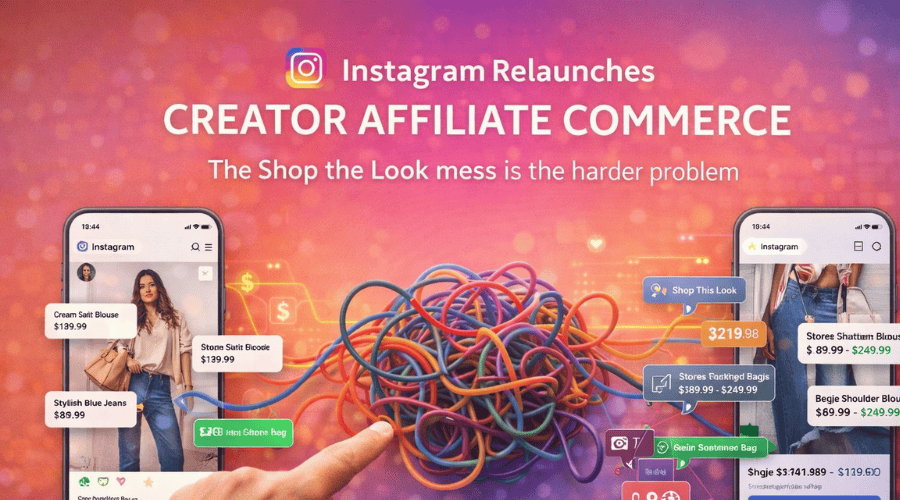
Instagram returned to creator affiliate commerce in late March 2026, more than three years after it shut down the native program that had been its previous attempt at the category. Instagram Head Adam Mosseri announced that creators can now tag affiliate products directly in Reels and earn commissions on resulting purchases. At Shoptalk Spring, Meta’s Head of Global Business Nicola Mendelsohn said “the era of link in bio is finally over.”
The announcement, covered in detail by Net Influencer, lands with a clear commercial subtext. While Instagram sat on the sidelines from 2022 to 2025, competitors built positions that are now genuinely difficult to dislodge. TikTok Shop processed $33.2 billion in global GMV in 2024 and is projected to hit around $66.2 billion in 2025. LTK facilitated more than $6 billion in annual consumer sales. ShopMy reached a $1.5 billion valuation. Instagram is now trying to earn back creator trust and brand participation it walked away from on its own terms.
Affiverse covered the launch mechanics when Mosseri announced the feature. Our earlier piece detailed how creators can tag up to 30 products per Reel, paste affiliate URLs directly, and connect existing accounts from Impact, Rakuten, and Shopify Collabs. What the mechanics piece did not dwell on, and what now becomes the defining commercial question, is whether creators will come back at all given what happened six weeks before the relaunch.
The Shop the Look problem
In February 2026, Instagram tested a feature called Shop the Look, which used AI visual recognition to automatically tag products in creators’ existing posts without asking the creator first. Fashion creator Julia Berolzheimer, who has more than a million followers, wrote publicly that the feature was linking her images to cheap knockoffs and brands she had never worked with, under her own name. Megan Vasquez, Influencer Strategy Director at GRIN, described the structural concern to Digiday: Instagram was positioning itself between creator influence and creator monetisation rather than supporting it.
The affiliate industry has been watching this dynamic build for a while. The broader shift toward creator-led storefronts has been driven precisely by creators wanting to own the transaction layer rather than have it extracted by a platform. Shop the Look was the worst possible preview of the opposite model, tested in public, six weeks before Instagram asked the same creators to come back and tag products inside Reels on Instagram’s terms.
For affiliate program managers briefing creators on Instagram, Shop the Look is now the unavoidable background to any conversation. Creators who felt their work was scraped and monetised without consent six weeks ago are the same creators being asked to voluntarily enable product tagging today. That is a trust rebuilding project before it is a product rollout.
The commercial lead Instagram is chasing
The numbers explain the urgency. Research across 52 e-commerce brands found TikTok Shop averaging a 4.7 percent conversion rate against Instagram Shopping’s 2.3 percent. TikTok affiliate links achieve around 160 percent higher engagement than Instagram’s equivalent. TikTok Shop’s own growth curve from a 2023 US launch to $33 billion in global GMV in 2024 is the trajectory Instagram was absent for.
The structural reason TikTok Shop converts better matters here. TikTok completes the transaction in-app. Instagram’s new Reels feature redirects purchases to the brand’s app or website, reintroducing the friction that killed social commerce conversion rates in the first place. A creator tag on Instagram sends the viewer off-platform to check out. A creator tag on TikTok Shop does not.
LTK and ShopMy built durable positions on a different thesis: creator ownership of the storefront, not platform ownership of the transaction. ShopMy’s $1.5 billion valuation was recently profiled by Affiverse as a bet on authenticity and curation, and LTK’s decade-long bridge between creators, shoppers, and brands is another model Instagram now has to compete with rather than host.
What Instagram has left to work with
Despite the retreat years, Instagram still brings distribution Meta’s competitors cannot match. Previously disclosed Meta figures put more than 130 million users tapping on shoppable posts each month. Instagram influencer marketing spend is projected to reach $3.17 billion in 2025, a 43.4 percent jump from 2024. Reels carry 53 percent of all Instagram ads and account for 46 percent of all time spent on the platform in the US, according to eMarketer data cited by Net Influencer. Affiverse covered the Instagram ad machine numbers for 2026 in more detail earlier this year.
The design of the new feature also addresses the specific failure that killed the 2021 program. Creators are not locked into a closed system. They can paste any affiliate URL, including LTK and ShopMy links, so long as the product exists in Meta’s commerce catalogue. Brands can connect existing affiliate programs through Impact, Rakuten, or Shopify Collabs without rebuilding infrastructure. This is a deliberate product decision, and it matters. The 2021 program failed partly because creators in it could not tag products outside it. The 2026 version does not make that mistake.
What affiliate program managers should do now
Three moves worth making this week.
First, if your brand is already set up on a Meta commerce catalogue, audit it before briefing any creators on the Instagram feature. The catalogue entry is the technical prerequisite for a creator to tag your product, and a poorly maintained catalogue will kill the experience before it starts. If you are not on a Meta commerce catalogue yet, that is the first step, not a creator outreach campaign.
Second, brief your creators on the Shop the Look context explicitly rather than pretending February did not happen. Creators paying attention to the platform already know. Acknowledging the trust issue directly, and explaining that your brand will not benefit from uncontrolled AI tagging of creator posts, is a more credible opening than a standard product brief. This sits with the 2026 affiliate trends already pulling the industry toward creator-ownership models.
Third, do not assume the Facebook economics carry over. Facebook Affiliate Partnerships operates as a closed partner system, while the Instagram Reels implementation is an open affiliate link system. A creator’s commission pathway, attribution window, and program enrolment can differ between the two even when the underlying brand is the same. Run the two programs separately until the interoperability is confirmed.
The bigger question
Instagram’s relaunch is a recovery attempt, not a debut. The platform is asking creators to come back to a product category they were pushed out of during 2022 to 2025 while rivals built multi-billion-dollar positions. The mechanics of the new feature are a real improvement on the 2021 version, and the distribution Instagram still controls is genuine. But the commercial gap to TikTok Shop, LTK, and ShopMy is the measurable story here, and the Shop the Look trust deficit is the unmeasurable one.
For program managers thinking about where creator-driven affiliate budgets should sit in 2026, Instagram now has to be evaluated against the alternatives on both dimensions. Mechanics can be built. Trust takes longer. Instagram has the first one. The second is what the rest of 2026 will actually test.
Everflow
Connect
Tradedoubler
Connect
1win Partners
Connect
PIN-UP Partners
Connect
Shopnomix, a Nomix Group Company
Connect
V.Partners
Connect
Huffson Group
Connect
Kawaii Partners
Connect
Share your expertise and expand your reach and become a content contributor with us today!
Contact Us To Find Out More