Google’s Preferred Sources Feature is Useful. Here is What Affiliate Publishers Need to do About it.
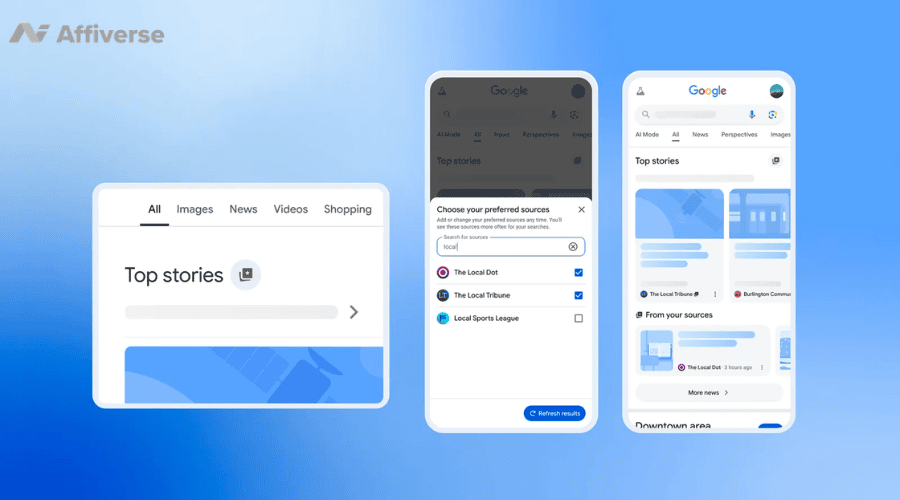
Google has launched Preferred Sources, a personalisation feature inside Search that lets users choose which publishers they want to see at the top of news results. The full announcement is on Google’s blog. The rollout is currently live for English-language searches in the United States and India, with more countries and languages to follow.
The mechanic is straightforward. When users search for trending topics, a small icon appears next to the Top Stories section. Clicking it lets them select publications they want to prioritise. Once chosen, those sources appear in Top Stories or in a new “From your sources” section. There is no cap on how many sources a user can add. Users who tested the feature through Google Search Labs will have their existing preferences carried over automatically.
For publishers, the practical action item is this: Google now supports an “Add as a preferred source” button that can be placed directly on your site. The link format is:
That button can sit on a homepage, an article page, or inside a newsletter. When a reader clicks it, they add you as a preferred source inside their Google Search account. It is worth implementing now, before the feature expands globally.
What this Actually Means for Affiliate Publishers
The honest answer is: it is both an opportunity and a warning shot, depending on who you are.
The opportunity is real. For any affiliate publisher that has built a recognisable brand and a loyal readership, this feature is a direct mechanism to convert that loyalty into sustained search visibility. Readers who already trust you can now vote for you inside Google’s system, and Google will weight your content accordingly when they search. That is a meaningful change from a world where algorithmic authority was the only path to Top Stories placement.
The warning is equally real. As we noted when Google expanded its web connectivity features at the end of 2025, Preferred Sources concentrates traffic among brands that users already recognise. If your site has not built that kind of reader relationship, the feature does nothing for you. You cannot ask someone to add you as a preferred source if they have never heard of you.
This is the same dynamic playing out across the broader publisher landscape. Google’s February 2026 Discover update rewarded topical depth and genuine authority over breadth. The Discover pivot toward YouTube and social platforms further reduced traffic distribution to anonymous or low-recognition publishers. Preferred Sources is another piece of the same pattern: Google is increasingly routing traffic toward sources that users can identify and have chosen to trust, rather than surfacing algorithmically equivalent content from interchangeable domains.
The brand-building argument gets sharper
There is a consistent thread running through every major Google change over the past 18 months, and Preferred Sources makes it more explicit. Building a recognisable brand is now a traffic strategy, not just a marketing nicety. Publishers who have invested in newsletters, editorial identity, and direct reader relationships have something to convert. Publishers who treated their sites as anonymous traffic infrastructure have nothing to leverage here.
For affiliate program managers, this is a useful lens for evaluating publisher partners. A publisher whose readers know and choose them is structurally more resilient than one whose traffic comes entirely from query matching. The search challenge for affiliates has been well-documented: over 58% of Google searches now result in zero clicks. Preferred Sources does not solve that problem for most publishers. What it does is reward the ones who have already done the work of building an audience that comes back by choice.
That same principle applies to how affiliates position themselves for winning more brand partnerships in 2026. Demonstrating a loyal, self-selecting readership is a stronger pitch to a brand partner than raw traffic figures, precisely because that traffic is less exposed to algorithmic shifts.
The Implementation Checklist
If you run a content-led affiliate site and publish news or editorial content in any category, the steps are simple.
Add the Preferred Sources button somewhere visible: your homepage, the top of articles, or your newsletter. Keep the copy direct. Something like “See our content first in Google Search” works better than a generic call to action that requires users to decode what it does.
Tell your existing email subscribers. If you have a list, you already have the warmest possible audience for this ask. A short note explaining the feature and linking to the button is the lowest-effort implementation available.
Watch the rollout. The feature is live in the US and India now. If a meaningful portion of your audience is elsewhere, set a reminder to implement this again when Google expands availability. The publishers who build Preferred Source counts early will have a head start when personalised results start influencing query results in their markets.
This is not the feature that reverses the broader decline in organic search traffic for affiliate publishers. The structural pressures from AI Overviews, zero-click results, and platform competition are real and will not be offset by a personalisation toggle. But Preferred Sources is a mechanism that rewards the investment affiliate publishers should already be making in brand, audience, and direct reader relationships. For those who have done that work, it is worth acting on now.
Everflow
Connect
Tradedoubler
Connect
1win Partners
Connect
PIN-UP Partners
Connect
Shopnomix, a Nomix Group Company
Connect
V.Partners
Connect
Huffson Group
Connect
Kawaii Partners
Connect
Share your expertise and expand your reach and become a content contributor with us today!
Contact Us To Find Out More