OpenAttribution.org Launches PolicyCheck Tool Helping Publishers To Track Which AI Bots Access Their Content

The question of who is scraping your content and what they are doing with it has become one of the most pressing issues in digital publishing. Now, a new open standards body is offering publishers and affiliate marketers a free tool to help them find out.
OpenAttribution, a UK-based nonprofit developing open standards for AI content transparency, has launched PolicyCheck, a tool that allows anyone to check which AI bots can access a given website. The tool analyses robots.txt policies, RSL (Really Simple Licensing) licences, and identifies blocked crawlers across more than 26 AI bots, including GPTBot, ClaudeBot, and Google’s Gemini.
Alex Springer, Director of OpenAttribution.org initiative, announced the launch of the new tool on LinkedIn, positioning it as part of a broader effort to bring accountability to the relationship between AI systems and the content creators whose work fuels them. For affiliate publishers and program managers watching their organic traffic erode through zero-click search experiences, this launch signals a growing infrastructure layer that could reshape how content value is tracked, verified, and ultimately compensated in an AI-first search environment.
Why This Matters for Affiliate Marketers
The timing is not accidental. The affiliate industry is grappling with a fundamental disconnect: AI systems are consuming publisher content to generate recommendations and answers, yet the publishers who created that value receive neither attribution nor compensation for their contribution.
AI platforms are bypassing affiliate links entirely, summarising expert analysis from affiliate publishers and then directing consumers straight to providers. The content investment is being monetised, just not by the people who made it. OpenAttribution is attempting to address this through two complementary standards. AIMS (AI Manifest Standard) provides a decentralised identity framework for AI agents, allowing publishers to verify who is requesting their content and what that agent is licensed to access. The Telemetry standard tracks content events, including when content is retrieved, cited, and displayed, along with conversation turns and commerce outcomes. Together, these standards aim to create an auditable trail from content creation to AI consumption, something that could eventually underpin new compensation models for publishers whose work powers AI-generated responses.
The PolicyCheck tool is the most accessible entry point yet. It gives publishers instant visibility into their current AI bot policies, supporting single URL checks and bulk CSV uploads, with results exportable as JSON or CSV.
For affiliate managers overseeing content strategies across multiple domains, this kind of visibility has been largely absent until now.
The Bigger Picture: RSL, Open Standards, and the Content Licensing Ecosystem
OpenAttribution does not operate in isolation. It is designed to be compatible with the Really Simple Licensing (RSL) standard, which reached version 1.0 in December 2025 and is now backed by more than 1,500 media organisations, including major names such as Reddit, Yahoo, Vox Media, The Associated Press, and BuzzFeed.
RSL allows publishers to embed machine-readable licensing and compensation terms directly into their robots.txt files, moving beyond the binary “allow or block” approach that has defined publisher-AI bot interactions for years. Publishers can specify subscription fees, pay-per-crawl rates, or pay-per-inference compensation when AI systems use their content in responses.
Where RSL defines what AI can do with content from the publisher’s side, OpenAttribution addresses the consumer side. AIMS allows AI agents to declare who they are and what they are licensed to access, while the Telemetry standard records what those agents actually did with the content. The combination creates what is effectively a full licensing and compliance chain.
For affiliate publishers who have watched Google’s AI Overviews dramatically reduce organic click-through rates and who have seen the EU open antitrust investigations into how Google uses publisher content for AI features, these developments represent the early stages of an infrastructure that could eventually support fair compensation for content influence in AI environments.
What Affiliate Practitioners Should Be Doing
The practical implications are worth considering carefully. While these standards are still in their early stages (AIMS is at Draft v0.1, and the Telemetry SDK is in alpha), the direction of travel is clear. The industry is moving toward a model where content usage by AI systems will be trackable, auditable, and potentially compensable.
This aligns with the broader attribution evolution already underway across the affiliate channel, where platforms like Partnerize and impact.com are launching zero-click attribution solutions to address the measurement gap created by AI-mediated discovery.
The 2026 roadmap includes framework integrations with LangChain, LlamaIndex, and MCP, alongside publisher pilot conversations and a registry MVP. If these milestones are met, affiliate publishers could gain practical tools for monitoring and negotiating the value of their content within AI systems before the end of the year.
Three Takeaways for Affiliate Professionals
Audit your AI bot policies today. Use the PolicyCheck tool at openattribution.org to check which AI crawlers currently have access to your sites. Understanding your current exposure is the first step toward making informed decisions about content access and licensing. Many publishers have never reviewed their robots.txt configurations with AI bots in mind.
Evaluate RSL implementation for your content properties. The RSL standard now offers publishers granular control over how AI systems interact with their content, including the ability to permit search indexing while opting out of AI search applications. For affiliate publishers producing high-value product reviews and comparison content, defining clear licensing terms signals to AI operators that your content has commercial value that should be respected.
Track the development of AI content attribution standards. Whether through OpenAttribution’s AIMS and Telemetry specifications, the AFSRC parameter for affiliate tracking, or network-level attribution solutions, the measurement infrastructure for AI-influenced conversions is being built right now. Affiliate managers who understand these emerging standards will be better positioned to negotiate fair compensation models and protect partner relationships as the traditional attribution landscape continues to shift.
The conversation about AI content transparency is no longer theoretical. Tools like PolicyCheck make it operational. For an industry built on measurable performance, the ability to track, verify, and value content influence within AI systems is not just useful. It is essential.
Join our Upcoming Webinar…
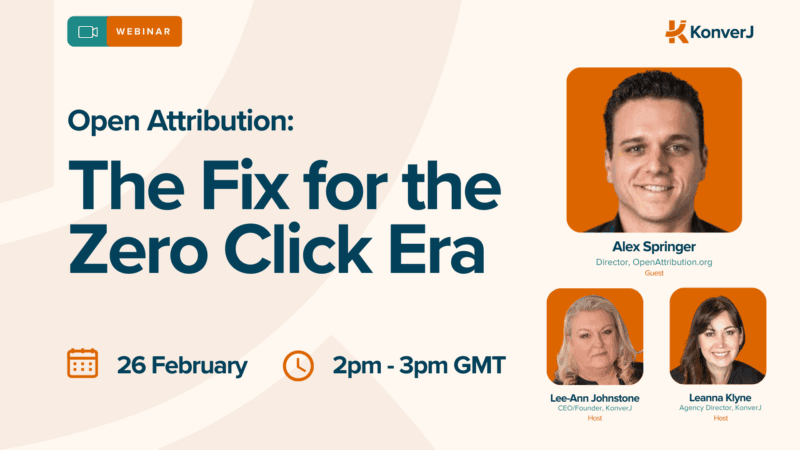
Sign up to join our webinar on 26th February at 2pm GMT where we’ll be discussing the Open Attribution fix with Alex Springer, Director of Open Attribution.org. Secure your FREE seat here
_________________________________________________________________________________________
Need Help with your Affiliate Program?
Whether you’re about to launch or scaling your program to multiple regions, navigating AI-driven attribution challenges and future-proofing your affiliate program can be hard to master. Our Agency is experienced with helping clients grow their sales via performance partnerships that are built on trust and expertise. Our award winning agency team at KonverJ.io – specialise in building high-performance affiliate programs that drive incremental sales.
Book a call to discuss how your program can stay ahead of the curve.

Everflow
Connect
Tradedoubler
Connect
1win Partners
Connect
Shopnomix, a Nomix Group Company
Connect
Huffson Group
Connect
Kawaii Partners
Connect
Trackdesk
Connect
Share your expertise and expand your reach and become a content contributor with us today!
Contact Us To Find Out More