Are Micro Niche Affiliate Sites Dead? Not Quite—But the Playbook Has Changed
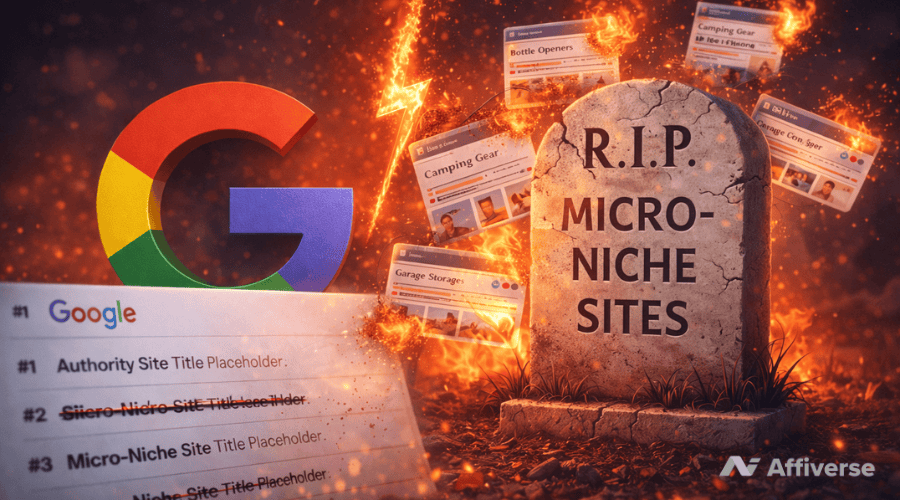
If you’ve spent any time in affiliate marketing forums or communities over the past 18 months, you’ve probably seen the doom-scrolling headlines: organic traffic is cratering, Google’s algorithm updates have decimated rankings, and traditional SEO-focused micro niche sites are ‘finished.’
Here’s the truth: the old playbook is dead. But micro niche affiliate sites themselves? They’re very much alive—they just require a fundamentally different approach to traffic acquisition and monetisation.
The SEO Reality Check: Why Organic Rankings Have Become Harder
Let’s be direct about what’s happened. The landscape for small, content-focused affiliate sites has shifted dramatically, and pretending otherwise helps nobody. A study examining the impact of Google’s Helpful Content Updates found that niche and affiliate sites were overwhelmingly impacted, with nearly half of surveyed sites losing 91% or more of their traffic between December 2023 and August 2024.
Several factors have converged to make organic search significantly harder for micro niche sites:
AI Overviews Are Eating Your Clicks
Google’s AI Overviews now appear in over 35% of all U.S. Google desktop searches. When a user searches for ‘best wireless earbuds under £100,’ Google increasingly provides a direct answer compiled from multiple sources—often without the user ever clicking through to your carefully crafted review. As our coverage of Google’s AI Mode expansion highlighted, AI Overviews are causing a 34.5% drop in position 1 click-through rates when present. The top organic CTR has plummeted from 28% to 19% following AI Overview expansion.
Zero-Click Searches Have Reached Critical Mass
Over 58% of Google searches now result in zero clicks—meaning users find what they need without ever visiting an external website. For micro niche sites that depended on capturing informational and transactional queries, this represents a fundamental disruption to the business model.
E-E-A-T Requirements Have Intensified
Google’s emphasis on Experience, Expertise, Authoritativeness, and Trustworthiness has made it significantly harder for new or small sites to compete. The algorithm increasingly favours established brands with demonstrated authority—meaning your meticulously researched guide to camping gear is now competing against content from REI, The Wirecutter, and major outdoor publications that Google inherently trusts more.
The August 2024 Core Update specifically targeted sites that appeared to be ‘engineered solely for search engine performance’ while demoting content that lacked genuine value—a direct shot at the templated review site model that dominated affiliate marketing for years.
Site Reputation Abuse Crackdowns
Google’s Site Reputation Abuse policy has targeted sites publishing low-value third-party content under the authority of high-trust domains. This has impacted not just the major publishers who hosted ‘parasite SEO’ content, but has created ripple effects throughout the affiliate ecosystem as Google more aggressively scrutinises commercial content.
The Opportunity: Micro Niches as Traffic Destinations, Not Traffic Sources
Here’s where the conversation needs to shift. The fundamental value proposition of micro niche affiliate sites hasn’t disappeared—what’s changed is how you drive traffic to them.
A micro niche site focused on, say, mechanical keyboards for programmers still offers genuine value: deep expertise, comprehensive comparisons, and trusted recommendations. The expertise you’ve built isn’t worthless—it’s just that Google is no longer the primary vehicle for connecting that expertise with potential customers.
This is where paid search, paid social, and organic social strategies become not just alternatives, but potentially superior approaches.
Paid Search: The Economics Can Actually Work
The knee-jerk reaction to ‘use PPC for affiliate marketing’ is often dismissal—surely the margins don’t work? But that assumption deserves scrutiny, particularly in higher-value niches.
As we explored in our analysis of SaaS affiliate commissions through strategic PPC, the mathematics become compelling in certain verticals. When you’re earning upwards of 30% of a standard $199 monthly subscription that customers keep for an average of 18 months or longer, the total commission from a single conversion can exceed $1,000. That changes the entire PPC equation.
The key considerations for paid search with micro niche affiliate sites:
Target High-Value Affiliate Programmes: The maths simply doesn’t work for low-commission physical products. Focus on SaaS, financial services, education, and other verticals where lifetime customer value supports meaningful affiliate payouts.
Calculate Your Unit Economics Precisely: Before launching any PPC campaign, establish your target Cost Per Acquisition based on commission value. If your average commission is £150 and your target profit margin is 40%, your maximum CPA is £90.
Leverage Long-Tail Intent Keywords: Competition for broad terms is fierce and expensive. Your micro niche expertise allows you to identify and target highly specific queries that larger competitors overlook—’best project management software for architecture firms’ will cost less and convert better than ‘project management software.’
Build Conversion-Optimised Landing Pages: Your micro niche site becomes a conversion machine rather than a traffic generator. Every element should be optimised for the specific audience arriving from your paid campaigns.
Paid Social: Meeting Your Audience Where They Already Are
Paid social advertising offers targeting capabilities that organic search never could. Rather than hoping the right person searches for your keywords, you can put your content directly in front of precisely defined audiences.
For micro niche affiliates, this represents a paradigm shift worth embracing:
Facebook and Instagram: Despite the narrative of Facebook’s decline, it remains the largest social platform globally with nearly 3 billion monthly active users and sophisticated targeting options. For lifestyle, home, and consumer product niches, the detailed demographic and interest-based targeting allows you to reach highly specific audiences. Facebook leads among affiliate marketers, with 75.8% using the platform according to recent industry surveys.
TikTok Ads: For product-focused niches with visual appeal, TikTok’s advertising platform offers access to highly engaged audiences at costs that often undercut more established platforms. The platform’s integration of shopping features through TikTok Shop creates additional monetisation pathways beyond traditional affiliate links.
LinkedIn Ads: For B2B micro niches—software tools, professional development, business services—LinkedIn’s targeting by job title, industry, and company size allows precision that’s impossible elsewhere. The higher costs are offset by the quality of traffic and typically higher-value conversions.
The critical shift is viewing your micro niche site as the destination for paid traffic rather than expecting Google to deliver visitors. Your deep expertise and comprehensive content become assets that convert paid traffic at rates generic landing pages cannot match.
Organic Social: Building Authority Through Platform-Native Content
Perhaps the most sustainable long-term strategy involves building genuine audiences on social platforms—turning your micro niche expertise into platform-native content that establishes authority and drives traffic without ongoing advertising costs.
This approach aligns perfectly with the hyper-focused nature of micro niche sites. As our guide to the best social media platforms for affiliate marketing explores, different platforms suit different niches and content styles:
TikTok and Instagram Reels
Short-form video dominates engagement metrics, and the algorithmic distribution on these platforms means new creators can achieve significant reach without existing audiences. For product-focused niches, demonstration videos, quick tips, and ‘day in the life’ content that naturally incorporates affiliate products performs exceptionally well.
TikTok maintains a 5.2% affiliate link engagement rate—significantly higher than Instagram’s 2.0% or YouTube’s 0.2%. For new creators, TikTok’s algorithm advantages and high engagement rates make it an ideal starting point.
YouTube
For niches requiring detailed explanation or comparison, YouTube remains unmatched. Review-style videos achieve 4.1% conversion rates, while the platform average sits at 3.2%. YouTube also commands higher purchase values, with the highest average cart value at $84, compared to Instagram’s $61 and TikTok’s $57.
The investment in video production is higher, but YouTube content has exceptional longevity. A comprehensive review video can continue driving traffic and conversions for years—something increasingly difficult to achieve with search-optimised written content.
Often overlooked by affiliate marketers, Pinterest offers unique advantages for certain niches. Users actively search for inspiration and solutions, creating high-intent traffic. For home, fashion, food, and lifestyle niches, a well-optimised Pinterest strategy can deliver passive, consistent traffic for years.
Reddit and Discord
Community-based platforms reward genuine expertise over promotional content. For technical niches, becoming a trusted contributor in relevant subreddits or Discord servers builds authority that translates into traffic and conversions. Many Discord-focused affiliate marketers report conversion rates 2-3 times higher than their traditional social media efforts.
The Hyper-Focus Advantage
Here’s what micro niche site operators often miss: your specialisation is your superpower in building organic social audiences.
General affiliate sites struggle on social platforms because they lack distinctive expertise. But someone who genuinely understands mechanical keyboards, or ultralight backpacking gear, or home espresso equipment can create content that resonates deeply with specific communities.
As we’ve covered in the power of niche selection, focusing on a specific audience allows you to:
Speak the language of your community with authority and authenticity. Address specific pain points that generic content ignores. Build genuine relationships with followers who share your passion. Develop a reputation that makes your recommendations carry weight.
This is the evolution that Google’s algorithm changes are forcing: from anonymous content mills to personality-led influence. People don’t want to read the ‘Top 10 Air Purifiers’ written by an AI or random freelancer—they want recommendations from real people with real opinions and demonstrated expertise.
The Integrated Approach: Your Site as a Conversion Hub
The most successful micro niche affiliates in 2025 and beyond will treat their sites as conversion destinations rather than traffic sources. Consider this framework:
1. Build Social Audiences: Create platform-native content on TikTok, YouTube, Instagram, or wherever your target audience congregates. Establish yourself as the go-to expert in your niche.
2. Capture Email Subscribers: Use your social presence to build an email list—the only audience you truly own. Email marketing remains highly effective for affiliate marketing and provides insulation against platform algorithm changes.
3. Drive Traffic to Deep Content: When followers are ready to make purchasing decisions, direct them to your comprehensive site content—detailed comparisons, in-depth reviews, and buying guides that social content cannot replicate.
4. Supplement with Paid Advertising: Use paid search and social to accelerate growth, target high-intent audiences, and scale what’s working organically.
This approach addresses the fundamental challenge our coverage of alternative traffic channels identified: relying solely on organic search for affiliate marketing success is no longer viable. Diversification isn’t optional—it’s survival.
The Verdict: Evolution, Not Extinction
Are micro niche affiliate sites dead? No—but the lazy, SEO-only approach certainly is.
The affiliates who will thrive are those who recognise their deep niche expertise as a genuine asset worth leveraging across multiple channels. Your knowledge of vintage camera lenses, or sustainable pet products, or budget travel hacking isn’t less valuable because Google’s algorithm changed—it’s actually more valuable, because authentic expertise is exactly what social platforms reward.
The playbook has changed. Building a successful micro niche affiliate site now requires becoming a content creator and community builder, not just a publisher optimising for search engines. It requires investment in paid acquisition alongside organic growth. It requires viewing your site as one component of an integrated marketing strategy rather than a standalone business.
For those willing to adapt, the opportunity remains substantial. Micro-influencers and niche content creators are achieving impressive conversion rates precisely because they’ve built trust within specific communities. Your micro niche site can be the foundation for that same success—it just can’t be the entire strategy.
The era of building a content site, optimising for keywords, and watching Google deliver traffic is over. The era of building genuine expertise and audiences across multiple channels while using your site as a conversion hub? That’s just beginning.
Everflow
Connect
Tradedoubler
Connect
1win Partners
Connect
PIN-UP Partners
Connect
Shopnomix, a Nomix Group Company
Connect
V.Partners
Connect
Huffson Group
Connect
Kawaii Partners
Connect
Share your expertise and expand your reach and become a content contributor with us today!
Contact Us To Find Out More