How to Grow Your Google Visibility in an AI World Via Digital PR
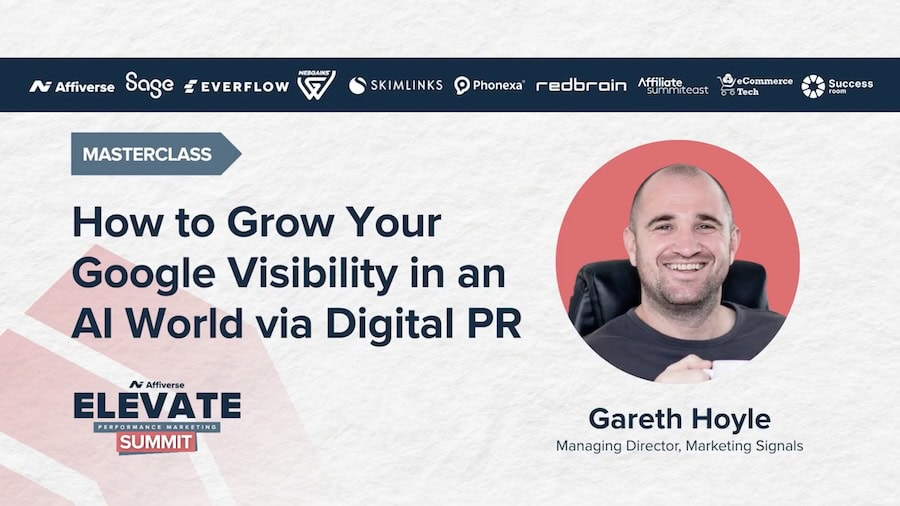
Continuing our ELEVATE Education Series…
Gareth Hoyle opened his ELEVATE masterclass with characteristic directness, outlining three scenarios where attendees would gain value: those wanting to improve their LLM and Google visibility themselves, those wanting to understand what their agencies are actually charging them for, and those ready to hire external expertise. While his preference leaned heavily toward the third option, his session delivered actionable insights for all three audiences facing Google’s AI transformation.
When industry veterans start admitting they’re genuinely terrified about fundamental changes to their business model, it’s time to pay attention. That raw honesty came from Gareth Hoyle, Managing Director at Marketing Signals, during his masterclass on surviving Google’s AI transformation. His message was uncompromising: traditional SEO strategies are rapidly becoming obsolete, and businesses have months, not years, to adapt.
This wasn’t corporate-speak about “emerging trends” – this was a practitioner with 20 years of SEO expertise explaining why everything affiliate marketers thought they knew about Google visibility needs immediate reconsideration. Building on our ELEVATE Education series covering performance marketing’s reality check, B2B partnership strategies, and media buyer partnerships, Gareth’s session delivered the wake-up call many needed about AI’s impact on organic discovery.
Watch this masterclass in full now…
The AI Takeover Timeline: Why Denial Isn’t a Strategy
Gareth’s opening statistics eliminated any possibility of treating AI overviews as a distant concern. According to Semrush data he referenced, AI overviews triggered for 13% of all queries by March 2025, up from 6.5% in January 2025 – representing a 100% increase in just two months. “If you’re not thinking about LLM, then you’re not going to be in business for two years; Is the reality of this situation,” he stated.
The geographical rollout timeline provides clear markers for when businesses must adapt. AI overviews have already transformed search behaviour in US markets, with the UK and Europe following within 12 months. “Within the next six months, AI and the ChatGPT style window is going to be the default for how you search for stuff. Within the next 12 months, that’s going to be the same in the UK and Europe,” Gareth explained.
The space consumed by AI overviews presents an existential threat to traditional organic visibility. His example of searching for “Amazon agency” revealed the brutal new reality: “There was four adverts and three scrolls on my phone of AI overview. Like that is what we’re starting to deal with. On mobile, you’ve got no chance. If you’re not in that AI overview, you’re nowhere basically.”
This isn’t gradual change – it’s algorithmic revolution that demands immediate strategic response rather than cautious observation.
Earned Media Emerges as the LLM Authority Signal
While the scale of change appears overwhelming, Gareth’s analysis revealed clear patterns in what content AI systems prioritise for citations. Research from PR Agency One in Manchester, conducted with the CIPD, identified digital PR and earned media as the primary sources feeding LLM references.
“Digital PR driven content is what is driving the references that LLMs are using. Earned media is still the source and well structured brand websites, the corporate blogs, Wikipedia pages, Quora, Reddit, all the usual suspects of what’s getting referenced in LLMs,” he explained.
This discovery validates increased investment in digital PR over traditional link-building approaches. Google’s EEAT framework (Experience, Expertise, Authority, Trust) has evolved beyond an SEO buzzword into the fundamental ranking methodology. “If you’re not showing experience, explaining expertise, showing Google your authority, and making the users trust you, then why should you rank, to be honest?” Gareth challenged.
The authority requirements have intensified significantly. “It’s taking more and more authority than ever to rank on Google. Google has been going for 20-odd years now. There are businesses that have been investing in SEO for 20-odd years now. You can’t just start a new business and expect to be on the front page of Google.“
Practical Tactics That Cut Through Journalist Overwhelm
The masterclass shifted from theory to implementation with specific tactics for securing earned media coverage. Gareth’s approach acknowledges the harsh reality facing journalists: One journalist reported 250 pitches where “he could tell by the subject line, they just weren’t right for it.”
This email overwhelm creates both challenge and opportunity for brands willing to approach outreach strategically. Gareth’s recommended tactics focus on genuine value creation rather than spam-based approaches.
Survey-driven campaigns emerged as particularly effective. His team’s success with “cheapest cars for new drivers” coverage in The Sun‘s motoring section exemplified the approach: relevant data presented to publications whose audiences genuinely need the information. Similarly, a mortgage broker client secured coverage through research on homeowners considering moves to more affordable areas.
Local relevance continues to matter despite AI’s global reach. “Why not target a Birmingham website with some Midlands based data? Why not target Gloucester Live with some Gloucester based data?” Gareth suggested. The reasoning proves sound: publications face staffing cuts while maintaining content quotas, making them receptive to well-researched, locally relevant stories.
The expert commentary approach offers another accessible entry point. Gareth highlighted opportunities from Financial Times and SaaS Advisor specifically seeking SaaS business opinions, noting: “If you work for a decent business with a reputation, your opinion carries weight. Take advantage of that.”
Three Strategic Priorities for AI-Era Visibility
1. Shift Budget from Traditional Link Building to Strategic Digital PR
AI systems prioritise earned media and authoritative publications over manipulated link schemes. Reallocate SEO budgets toward survey creation, expert commentary, and journalist relationship building. Focus on publications your target audience actually reads rather than high domain authority sites with irrelevant audiences.
2. Implement Systematic Journalist Relationship Management
Treat journalist outreach as sales process rather than marketing blast. Use affordable tools like IFTTT for opportunity monitoring and ChatGPT for media list building, but prioritise personalised, relevant pitches over volume. Build relationships with freelance journalists who work across multiple publications for maximum coverage potential.
3. Create Content That Ranks for Informational Queries Before AI Summaries
Use SEO skills to rank original research and surveys for informational keywords related to your industry. When journalists search for data, they should find your content first. This positions your brand as the primary source, shifting power dynamics from information seller to information provider.
The AI transformation of search represents both existential threat and unprecedented opportunity for performance marketers willing to adapt quickly. As Gareth demonstrated, success requires acknowledging the scale of change while implementing practical tactics that work within the new reality.
If you want to learn from the people who are actually changing how affiliate marketing works, get your tickets here for ELEVATE 2026 and learn directly from the industry’s most innovative minds.
Everflow
Connect
Tradedoubler
Connect
1win Partners
Connect
PIN-UP Partners
Connect
Shopnomix, a Nomix Group Company
Connect
V.Partners
Connect
Huffson Group
Connect
Kawaii Partners
Connect
Share your expertise and expand your reach and become a content contributor with us today!
Contact Us To Find Out More