YouTube Cuts Affiliate Shopping Threshold Eligibility to 500 Subscribers as Platform Race Heats up
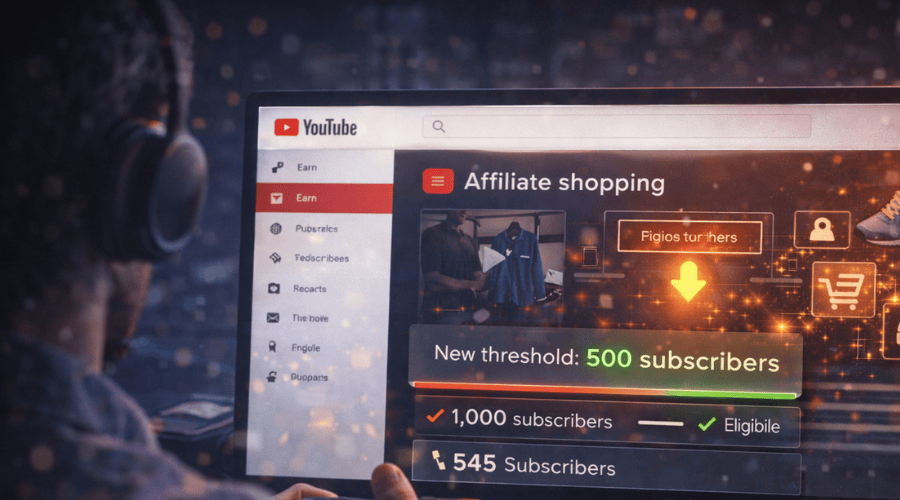
YouTube has lowered the subscriber count required to access its Shopping affiliate program from 1,000 to 500, opening commission-based product promotion to a significantly wider pool of creators.
The change, announced on 25 March 2026, applies across YouTube Shorts, long-form video, and Live content. Creators still need to satisfy the broader YouTube Partner Program requirements, which include 4,000 watch hours in the past 12 months, compliance with monetisation policies, and an active AdSense account. The subscriber reduction alone does not unlock access without those conditions also being met.
The YouTube Shopping affiliate program launched in 2022, allowing creators to tag products from third-party merchants directly inside their content. When a viewer completes a purchase through a tagged link, the creator earns a commission. YouTube takes a share too. It replaced the platform’s earlier product-tagging tool and has been gradually expanding its reach across markets including Singapore via a Shopee partnership and several other Southeast Asian countries.
Why 500 matters more than it sounds
Halving the subscriber threshold is not just a minor policy update. The 500-subscriber mark sits squarely in micro-creator territory, a segment the industry has been paying considerably more attention to as brands recognise that smaller, tightly focused audiences often convert better than mass-reach channels.
For affiliate program managers, this is worth paying attention to. Creators who were previously locked out of YouTube’s native commerce tools can now monetise product recommendations directly through the platform, rather than relying on external links in descriptions or profile bios. That removes friction from the attribution chain and makes YouTube’s own commerce layer more competitive with what TikTok Shop offers.
The timing is also deliberate. The announcement came one day after Meta formally launched shopping links in Reels, allowing creators on Facebook and Instagram to link to up to 30 products per video from marketplace partners. Meta’s Facebook Affiliate Partnerships rollout included Amazon as a launch partner in the US, with Temu and eBay confirmed to follow. Instagram’s version allows open affiliate links from any product registered in a brand’s commerce catalogue. These are not coincidental announcements. Both platforms are moving fast to capture creator-commerce spend, and both are lowering the bar for who gets to participate.
What it means for affiliate program managers
The practical effect is more eligible creator inventory on YouTube. Brands and program managers running YouTube creator partnerships now have a broader pool to recruit from, particularly among subject-matter specialists and niche communities whose audiences skew toward specific product categories.
Impact.com’s integration with YouTube’s Creator Partnerships API, confirmed at NewFronts 2026, adds a layer of utility here. Program managers using impact.com can now evaluate YouTube creators through verified audience data inside the same dashboard they use for broader affiliate management, rather than pulling platform metrics separately. The subscriber threshold reduction means more creators become searchable within that system.
There is a geographic constraint worth noting. The Shopping affiliate program remains restricted to creators in the United States, South Korea, Indonesia, Thailand, Vietnam, Malaysia, Philippines, India, and Singapore. European, Latin American, and African creators are still excluded, regardless of subscriber count. For global programs, that limits which creator partnerships can actually activate through the native YouTube Shopping infrastructure.
The platform commerce race
YouTube’s subscriber reduction fits into a broader competitive dynamic that has been building for some time. As we covered in our comparison of TikTok and YouTube Shorts monetisation, YouTube has historically restricted affiliate link placement in Shorts, which gave TikTok a structural conversion advantage through its native in-app shopping flow. The 500-subscriber threshold change does not resolve that Shorts link limitation, but it does make YouTube’s longer-form and Live commerce tools available to more creators earlier in their growth.
There is also a strategic context around Google’s own changes to how it surfaces content. Google Discover’s pivot toward YouTube has already changed the distribution arithmetic for video creators versus traditional publishers. More creators monetising through YouTube’s affiliate infrastructure means more incentive to produce content that performs well within Google’s ecosystem, not just YouTube’s own recommendation engine.
For affiliate managers who have been treating YouTube as a secondary or supplementary channel, the combination of lower entry thresholds, improved creator data access through API integrations, and Google’s increasing prioritisation of YouTube in Discover feeds warrants a reassessment. The strategic case for YouTube shopping content has strengthened materially over the past 12 months. This latest change is another step in the same direction.
Everflow
Connect
Tradedoubler
Connect
1win Partners
Connect
Shopnomix, a Nomix Group Company
Connect
Huffson Group
Connect
Kawaii Partners
Connect
Trackdesk
Connect
Share your expertise and expand your reach and become a content contributor with us today!
Contact Us To Find Out More