Affiliate Fraud: Detection and Prevention Guide for 2026

Affiliate fraud detection means checking whether clicks, leads, sales, and commission claims are genuine and eligible for payment. To detect affiliate fraud, compare traffic and attribution records with verified customer outcomes before approving commissions. Prevention starts earlier, with partner vetting, clear program rules, and secure tracking.
This guide explains the main fraud tactics, warning signs, investigation steps, and software options for web, app, and lead generation programs.
- What Is Affiliate Fraud?
- Common Types of Affiliate Marketing Fraud
- Click Fraud and Bot Traffic
- Cookie Stuffing and Attribution Hijacking
- Fake Leads and Synthetic Identities
- Fraudulent Orders, Self-Referrals, and Multiple Accounts
- Coupon Abuse and Unauthorized Promotions
- Forged Conversions and Postback Manipulation
- Mobile Install and Event Fraud
- How to Detect Affiliate Fraud
- Establish a Baseline for Each Partner Type
- Monitor Traffic and Conversion Warning Signs
- Reconcile Tracking With Customer and Payment Records
- Check Duplicate Claims Across Networks
- Investigate Before Rejecting Commission
- Affiliate Fraud Prevention Best Practices
- Vet Partners Before Approval
- Set Clear Program and Payout Rules
- Require Transparency From Sub-Affiliate Networks
- Validate Events and Secure Accounts
- How AI Changes Affiliate Fraud Detection
- Affiliate Fraud Detection Software at a Glance
- How to Choose Affiliate Fraud Detection Tools
- How to Measure Affiliate Fraud and Its Cost
- Affiliate Fraud Protection Checklist
- Build Fraud Checks Into Commission Approval
- Affiliate Fraud Detection FAQs
What Is Affiliate Fraud?
Affiliate fraud is deliberate deception used to obtain commissions or other rewards that a partner has not earned under the program’s rules. It can involve invented activity, stolen customer information, or manipulation of the tracking that decides who receives credit.
The customer action and the attribution claim need separate checks. A fabricated lead is invalid at submission. In an attribution hijacking case, a customer may make a real purchase while a third party improperly claims the referral commission.
Poor performance alone does not establish fraud. A genuine campaign may attract visitors who do not buy. A partner may also breach a traffic rule without fabricating activity. Record fraud, policy breaches, tracking errors, and commercial underperformance separately so each receives an appropriate response.
Common Types of Affiliate Marketing Fraud
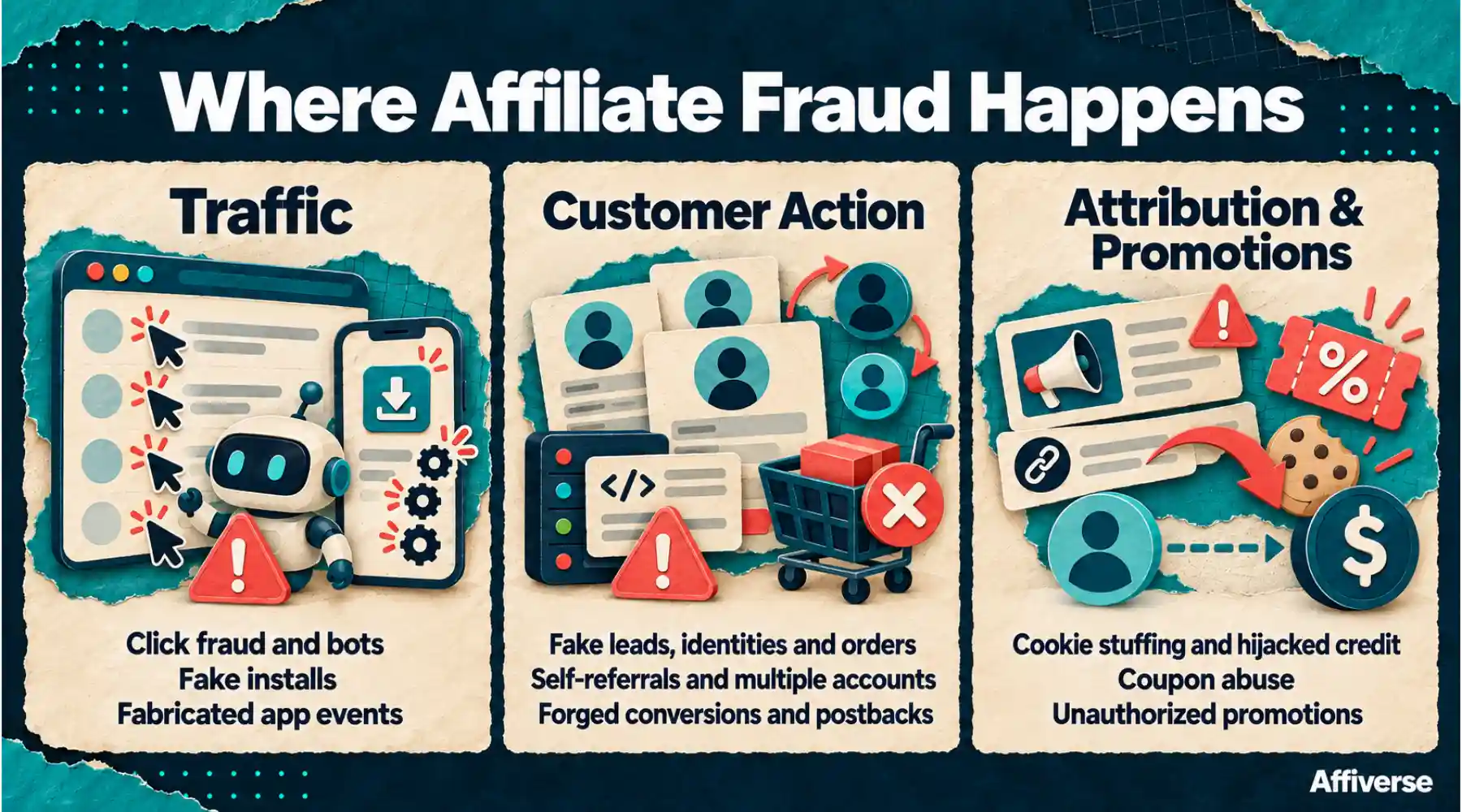
Affiliate marketing fraud can target the traffic, the customer action, or the claim for credit. Identify which part of the journey may have been manipulated before deciding what evidence to collect.
Click Fraud and Bot Traffic
Artificial clicks can inflate reports or trigger payments in a cost-per-click campaign. In programs that pay for sales or leads, fake clicks may support attribution manipulation rather than generate a direct payout.
Investigate repeated activity, implausible timing, or large click increases without corresponding customer activity. As Affiverse’s analysis of bot traffic and affiliate attribution explains, automated traffic also includes crawlers and other legitimate tools. Automation alone does not prove commission fraud.
Cookie Stuffing and Attribution Hijacking
Cookie stuffing records an affiliate tracking cookie without the qualifying referral interaction required by the program. Attribution hijacking more broadly involves taking credit that belongs elsewhere, including through unauthorized link replacement or software that intervenes near a purchase.
Review the referral path, click timing, and approved promotional method. A browser extension or cookie is not itself evidence of abuse; the question is how credit was obtained.
Fake Leads and Synthetic Identities
Lead fraud includes invented submissions, recycled records presented as new prospects, and stolen personal information used without a genuine inquiry. A completed form may pass format checks while failing customer verification.
Compare repeated details, contactability, qualification, and sales feedback. Record complaints from people who say they never submitted an inquiry. A low contact rate should trigger review alongside other evidence.
Fraudulent Orders, Self-Referrals, and Multiple Accounts
Claims may involve stolen payment details, fabricated transactions, or coordinated orders designed to earn a reward before cancellation. Multiple accounts can be used to bypass new-customer restrictions. Self-referrals may breach program rules when prohibited.
Check payment and fulfillment status, account relationships, refunds, and chargebacks. Shared household addresses or IP addresses do not establish common ownership or fraud. Separate deliberate abuse from ordinary returns and permitted customer referrals.
Coupon Abuse and Unauthorized Promotions
Coupon leakage, misleading promotions, typosquatting, and prohibited brand bidding can create policy problems. Some cases also involve deceptive attribution. Ad hijacking can involve impersonating a brand’s search ads and routing visitors through affiliate links. Distinguish that behavior from brand bidding expressly permitted by the advertiser.
Document approved codes, placements, incentives, and how code-based attribution interacts with tracked clicks. Check the agreement and evidence before classifying a breach as fraud.
Forged Conversions and Postback Manipulation
A postback is a server message reporting an event to a tracking platform. Fabricated or manipulated messages can claim conversions that never happened, or misstate their value or eligibility.
Match reported events to the order, billing, or lead system. Check for normal retries and integration faults before attributing repeated messages to deliberate manipulation.
Mobile Install and Event Fraud
App campaigns can face fake installs, fabricated in-app events, click injection, and click flooding. These attacks can distort attribution even when a real person installs the app.
Compare click-to-install timing, repeated device activity, and later in-app behavior across similar campaigns and traffic sources. Validate rewarded events against app or payment records before approving commissions. Unusual timing should prompt investigation rather than automatic rejection.
How to Detect Affiliate Fraud
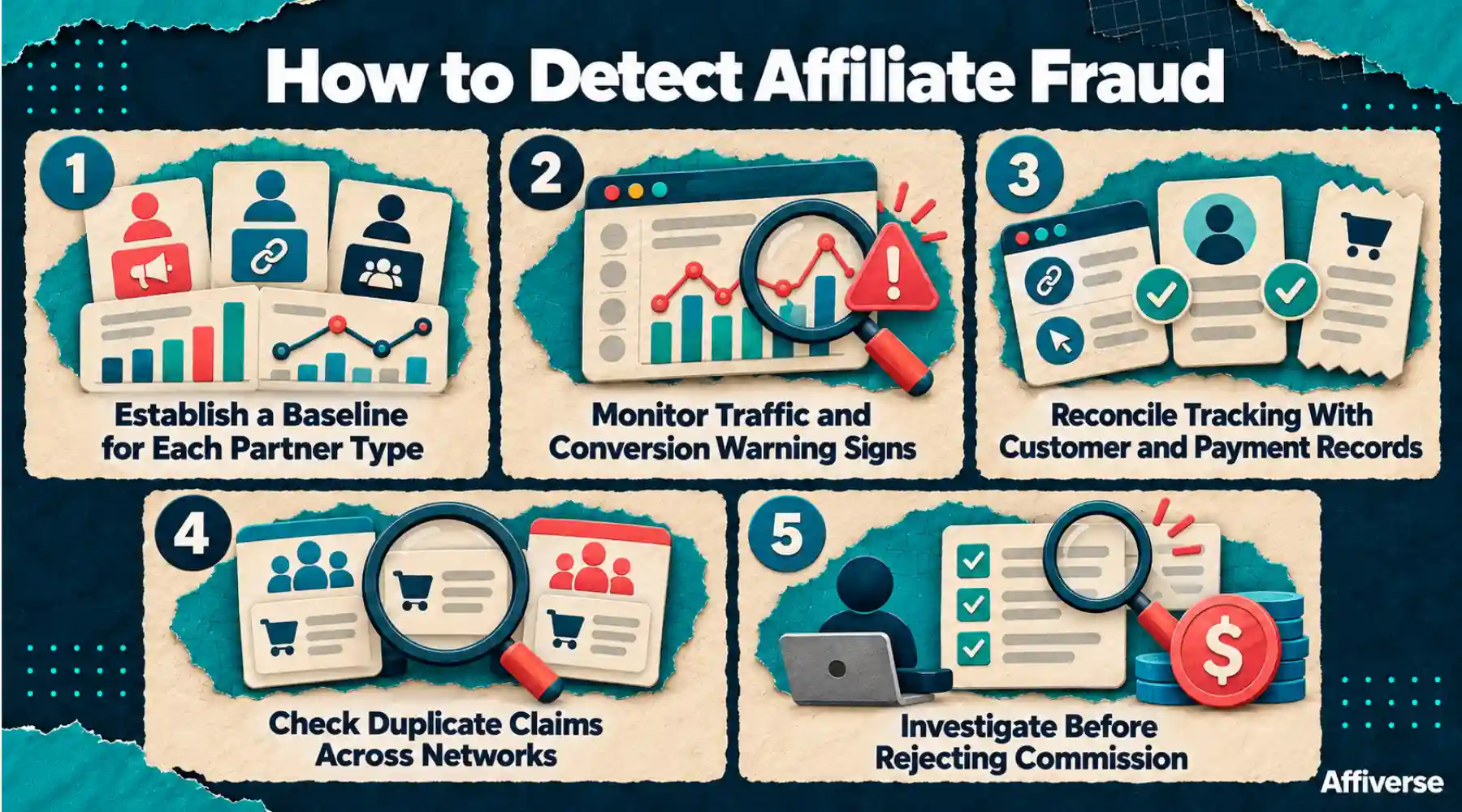
Start with a specific anomaly, validate the customer action, and investigate whether the partner earned the commission. Use the following steps to turn an alert into a documented decision.
Establish a Baseline for Each Partner Type
Record the approved source, target market, offer, and commission trigger. Compare performance with the partner’s history and similar campaigns.
Account for sales, new placements, product launches, and tracking changes. Use consistent observation periods and sufficient volume: a small sample can produce extreme conversion rates without manipulation.
Monitor Traffic and Conversion Warning Signs
Affiliate marketing fraud detection works best when each alert leads to a validation step. These signals are investigation prompts, not automatic rejection rules.
| Signal | What to investigate | Check before deciding |
| Clicks rise sharply | Automation, changed placements, or attribution manipulation | Compare referral paths with customer activity and ask what changed. |
| Unusual click-to-conversion timing | Clicks recorded without a normal referral journey | Compare timing patterns across similar offers and partner types. |
| Repeated contact or account details | Duplicate leads, recycled records, or coordinated accounts | Check existing customers and verify the qualifying action. |
| Unexpected locations | Undeclared sources or attempts to bypass market rules | Review VPN use, travel, targeting, and declared placements. |
| Leads or sales fail later checks | Invented demand, stolen details, or misleading acquisition | Compare CRM outcomes, refunds, and payment disputes by source. |
| Several claims for one transaction | Duplicate tracking, retries, or competing attribution claims | Match transaction IDs and event histories before approval. |
Engagement and bounce metrics add context, but their meaning depends on the analytics setup. Check missing tags, consent choices, and broken landing pages before treating brief sessions as fake visits.
Reconcile Tracking With Customer and Payment Records
Use a transaction or lead ID to connect the affiliate record to the business outcome. Confirm that the action happened, qualifies for payment, and is attributed according to the agreement.
For leads, review acceptance and qualification with sales. For retail, include cancellations, refunds, and disputes. For subscriptions, verify the paid or retained milestone specified in the agreement. Restrict access to customer data and collect only what the review needs.
The affiliate data stack connects tracking, CRM, reporting, and finance records. Dashboard differences can reflect processing delays or definitions as well as invalid activity. Affiverse’s webinar on affiliate tracking and revenue checks also explains how to find tracking gaps.
Check Duplicate Claims Across Networks
A single purchase may appear in reports from two affiliate networks. Before approving commission, match the order ID and event type across both reports, then review the recorded clicks, promotional codes, and timestamps.
Check whether the overlap comes from duplicated tracking or separate partner referrals. Correct duplicate records and apply the program’s agreed attribution rules to determine which commissions are payable. Preserve valid repeat purchases and subscription renewals as distinct events. Duplicate claims alone do not establish fraud.
Affiverse’s coverage of cross-network commission deduplication explains why merchants need visibility across platforms.
Investigate Before Rejecting Commission
Give each case an owner and review deadline, then follow a consistent process:
- Define the concern. Record affected partners, sources, IDs, dates, and the rule involved.
- Check the measurement. Look for duplicate events, tracking changes, time-zone differences, or a legitimate promotion.
- Preserve relevant evidence. Keep logs, placement URLs, screenshots, and validation results with controlled access.
- Request an explanation. Ask for the specific placement or source information needed to resolve the discrepancy.
- Record the outcome. Classify the case as confirmed fraud, a policy breach, a technical error, or cleared activity. Keep unresolved cases marked as under review.
Where the agreement permits, hold the disputed commission or pause the affected source during review. Explain reversals, provide the agreed appeal route, and share the decision with finance. Correct tracking errors and restore valid commissions when warranted.
Affiliate Fraud Prevention Best Practices
Prevent affiliate fraud by controlling entry to the program, defining payable activity, and validating events before money leaves the business. Use findings from completed investigations to improve these controls.
Vet Partners Before Approval
Review business identity, channel ownership, promotional methods, and audience. Ask where traffic originates and whether third parties will distribute the offer.
Traffic estimates and domain history support due diligence but do not verify individual visitors. Confirm that the proposed placement exists and the applicant can explain how it reaches customers. Test unfamiliar sources at limited volume before scaling.
Set Clear Program and Payout Rules
Define eligible customers and actions, permitted markets, incentives, brand bidding, coupon use, extension behavior, and self-referrals. Explain how duplicate claims, canceled orders, rejected leads, and confirmed fraud affect commission.
Choose a validation window that fits the sales cycle and expected reversals. Document dispute deadlines and communicate changes before partners send traffic. Delaying payment alone does not validate a conversion.
Require Transparency From Sub-Affiliate Networks
Network totals can conceal publisher-level problems. Ask how affiliates are recruited, how your terms reach each publisher, and what evidence the network can provide during an investigation.
Require stable publisher or sub-source IDs. Agree whether new sources need approval, how individual placements can be paused, and who handles reversals and disputes. Audit whether declared methods match the activity received.
Validate Events and Secure Accounts
Have the technical team verify that conversion messages come from authorized sources, match them against business records, and prevent the same payable event from being processed twice. Separate test activity from transactions that qualify for commission.
Server-to-server reporting still needs to represent a valid customer action. Protect account and payout access with multifactor authentication and permissions appropriate to each person’s role. Verify bank-detail changes through an established contact route and review access when staff or partners change.
How AI Changes Affiliate Fraud Detection
AI can make convincing websites, profiles, and lead records easier to produce. Validate ownership, sources, and commercial outcomes rather than accepting a polished application as proof of legitimacy. AI-written content alone is not evidence of fraud.
AI tools can also summarize anomalies and prioritize reviews. Check their explanations against underlying records and test alternatives such as tracking faults or a genuine promotion. Keep customer information in approved systems and retain human review for commission decisions.
The Affiverse podcast on AI affiliate fraud and partner vetting explores how synthetic content and credible-looking profiles affect recruitment checks.
Affiliate Fraud Detection Software at a Glance
These Affiverse Directory listings include dedicated traffic screening and management platforms with relevant controls. Their coverage differs: a traffic score does not validate every lead, order, or attribution claim. Confirm current features, integrations, and package availability with each provider.
| Software | Potential fit | Relevant capabilities | Check before use |
| Anura | Dedicated screening of affiliate traffic | Real-time invalid traffic analysis and source-level findings | Connect traffic findings with lead or order validation. |
| Everflow | Partner tracking with traffic controls | Click-to-conversion reporting, filtering, and specialist fraud integrations | Identify native controls and separately purchased services. |
| impact.com | Partnership and promotional activity monitoring | Invalid traffic checks, paid search monitoring, and promo code monitoring | Confirm module coverage and how findings enter commission reviews. |
| Phonexa | Lead generation and pay-per-call programs | Lead filtering, verification services, and duplicate analysis | Check verification charges and when checks affect lead processing. |
| Trackdesk | Affiliate tracking and configurable fraud flags | Click, conversion, and account rules, plus an Anura integration | Review thresholds, integration availability, and additional costs. |
How to Choose Affiliate Fraud Detection Tools
Match the tool to the commission trigger. Traffic screening, mobile attribution checks, lead verification, and payment risk controls address different problems. During a pilot, ask:
- Which events and sources are covered, and what remains unverified?
- Does the tool block traffic, prevent attribution, or flag activity for review?
- Can reviewers export reason codes, source IDs, and supporting records?
- How are disputed flags and false positives resolved?
- Do findings match validated outcomes, and can your team manage the integration and review workload?
Test against known valid activity as well as confirmed abuse before automating decisions. A useful system must explain its findings well enough for your team to act on them.
How to Measure Affiliate Fraud and Its Cost
Keep alerts separate from confirmed fraud. Track these measures for the same conversion cohort and allow its validation window to close:
- Review outcomes: cases cleared, corrected as tracking errors, or resolved as policy breaches, plus review time and overturned decisions.
For example, if 40 of 1,000 checked conversions are flagged and 10 are confirmed fraudulent, the flagged share is 4% and the confirmed fraud share is 1%. State whether the other 30 are cleared or still under review. These are illustrative figures, not industry benchmarks.
Unpaid invalid commissions prevented are not the same as money already lost. Keep prevented payouts, paid losses, and recovered funds separate so changes in detection do not create misleading performance claims.
Affiliate Fraud Protection Checklist
Before approving a new source or releasing commission, confirm that:
- The partner, channels, and any sub-sources are identifiable and approved.
- Traffic, attribution, validation, and dispute rules have been accepted.
- Conversion claims match qualifying business outcomes.
- Duplicate events, tracking faults, and legitimate campaign changes have been checked.
- Disputed cases have evidence, an owner, and a review deadline.
- Finance has the final decisions, and valid commissions can be restored after review.
Build Fraud Checks Into Commission Approval
Start with one practical control: match payable conversions to verified business records before approval. Add source-level monitoring and a documented investigation process as volume grows. The goal is to stop invalid payouts while giving legitimate partners a clear explanation and a fair route to resolve mistakes.
Affiliate Fraud Detection FAQs
Does a High Conversion Rate Mean Affiliate Fraud?
No. A targeted email, coupon offer, or returning audience may convert well. Review the campaign context, sample size, referral path, and validated customer outcomes before deciding whether the pattern indicates abuse.
Can You Prevent Affiliate Fraud Without Dedicated Software?
No. Genuine customers may use VPNs, and incentives may be allowed. Check market and traffic rules, partner disclosures, and the qualifying action. Concealed or fabricated activity needs a different response from permitted use.
Does Low Incrementality Prove Affiliate Fraud?
No. Incrementality asks whether the activity caused additional business that would not otherwise have happened. A valid referral can have low incremental value without deception. Use commercial testing to assess value and evidence-based investigation to assess fraud; do not change earned commission rules retroactively.
What Should an Affiliate Do if a Commission Is Wrongly Reversed?
Use the program’s dispute process. Request the affected transaction IDs, reason, relevant rule, and review deadline. Provide placement and referral evidence without exposing unnecessary customer data. Ask the advertiser or network to correct tracking errors and reinstate eligible commission.
Everflow
Connect
Tradedoubler
Connect
1win Partners
Connect
Shopnomix, a Nomix Group Company
Connect
Huffson Group
Connect
Kawaii Partners
Connect
Trackdesk
Connect
Share your expertise and expand your reach and become a content contributor with us today!
Contact Us To Find Out More